Team NinjaCat
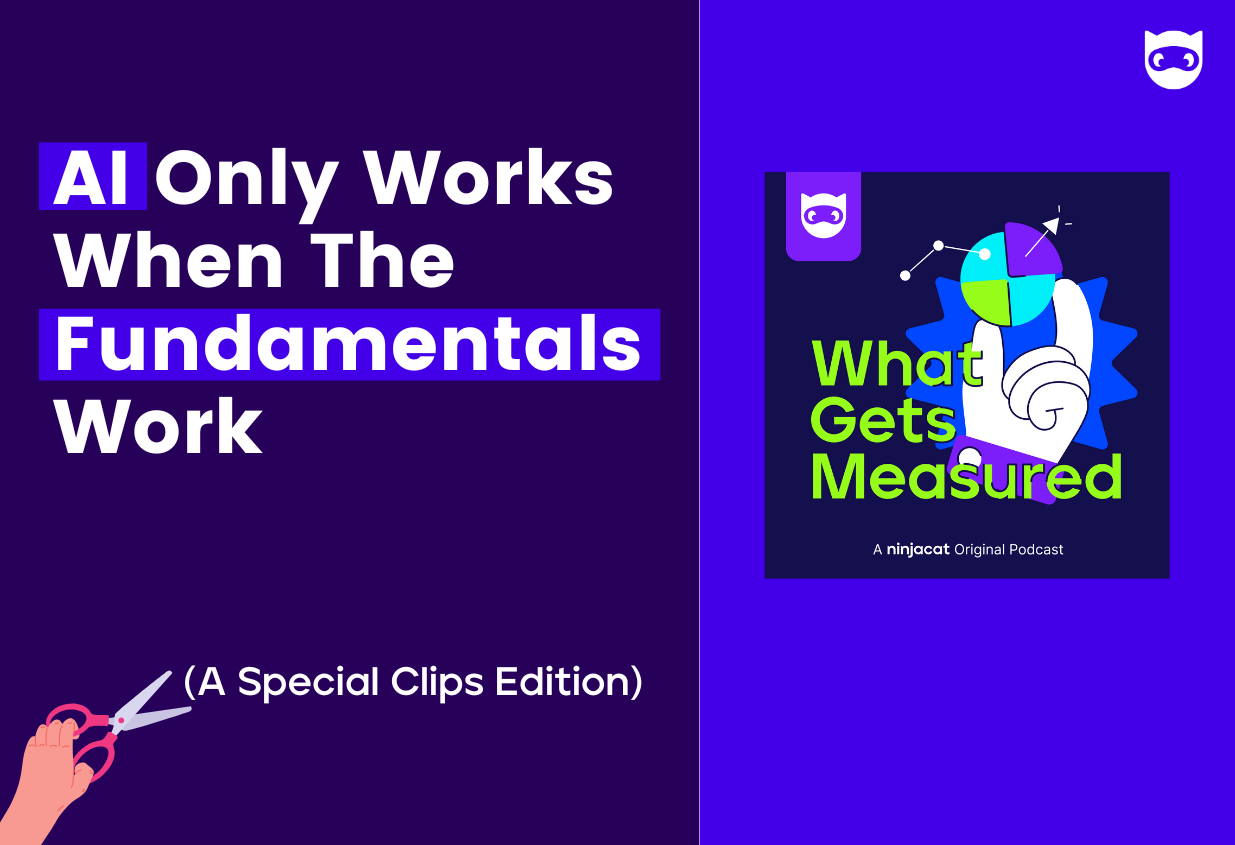
If 2025 taught us anything, it’s this: AI only works when the fundamentals work. This theme kept repeating across our conversations this year, so for our 100th episode, we pulled together six clips from this year that hit this truth the hardest.
In the first selection, from his episode “What’s Next For Digital Marketing?” AI consultant Mark Sirkin explains what he does when chaos hits: he returns to first principles.
He rattled off the questions too many teams skip:
Do you know your market position? Are you upper-funnel or lower-funnel? How long is your sales cycle? What do you actually value?
His point was simple: when the world gets noisy, strategy becomes your anchor. AI can accelerate execution, but it can’t manufacture clarity you don’t have.
Then there’s Susan Walsh, whose story about a manufacturer with six retailers—each naming the same product differently—was a perfect illustration of the requirement to get fundamentals locked. Once her team standardized product names, the company could finally build an AI tool to scale the work.
The invisible groundwork unlocked the automation. Without it? The AI wouldn’t have stood a chance.
Listen to “Data Cleaning: Fix Dirty Data, and Boost ROI” to hear the whole interview.
The next two clips zoom in on the leadership required to make AI transformation real—not the inspirational kind, but the practical kind that shows up in day to day reality.
In ““Smarter AI Starts With Human Know-How” founder Vanessa Liu broke down why 95% of AI deployments never reach production: not because AI lacks ROI, but because business context is missing.
“If you hired ten people and didn’t onboard them,” she said, “you wouldn’t expect success. The same is true for agents. They need context.”
Before an agent can be helpful, a team needs to understand its own workflows. If the pathway through the organization is unclear, AI will expose every weak spot.
AI strategist Cecilia Dones delivered the most honest articulation of this dynamic between AI readiness and humans in her episode, “The Real Work Behind AI-Ready Organizations.” Try to automate a broken process, she said, and the system will “scream at you.” Bottlenecks. Hidden manual handoffs. Fragmented data. Every brittle surface becomes visible.
It’s painful—but it’s also a roadmap for improvement if you’re willing to do the real work.
And finally,, two final conversations pointed toward the future of AI-driven marketing.
In “Fixing The Disconnect Between Brand, Demand, and Dollars,” data strategist Charlie de Thibault warned that even high-performing campaigns may sit deep in diminishing returns. Spend more, waste more—while dashboards still look great.
As AI scales experimentation and volume, marketers will need stronger statistical rigor, not blind trust in platform metrics.
And back in February, Marketing AI Institute’s Mike Kaput predicted the rise of human supervisors for AI agents—a role he expects to be essential for years. Someone must understand what the agent is doing, why it’s doing it, and whether it should continue.
Trust in agents will depend on trust in the humans who guide them.
Check out, “Rethinking AI for Smarter Marketing” to hear the full interview with Mike.
Across 100 episodes, one lesson keeps repeating: AI doesn’t replace work, but amplifies whatever foundation you bring—your strategy, your data, your processes, your leadership.
Teams who keep sharpening those basics will get the most out of AI and agents in 2026.
Thank you for being with us through these first 100 episodes. There’s much more to measure ahead.
Have a great holiday—and we’ll see for the next hundred.
Listen now: Spotify | YouTube | Apple
Subscribe to What Gets Measured for more conversations like this.