Team NinjaCat
Agency teams don’t struggle with getting data.
They struggle with deciding which version of reality deserves attention when multiple clients want answers, platforms disagree, and reporting deadlines don’t move.
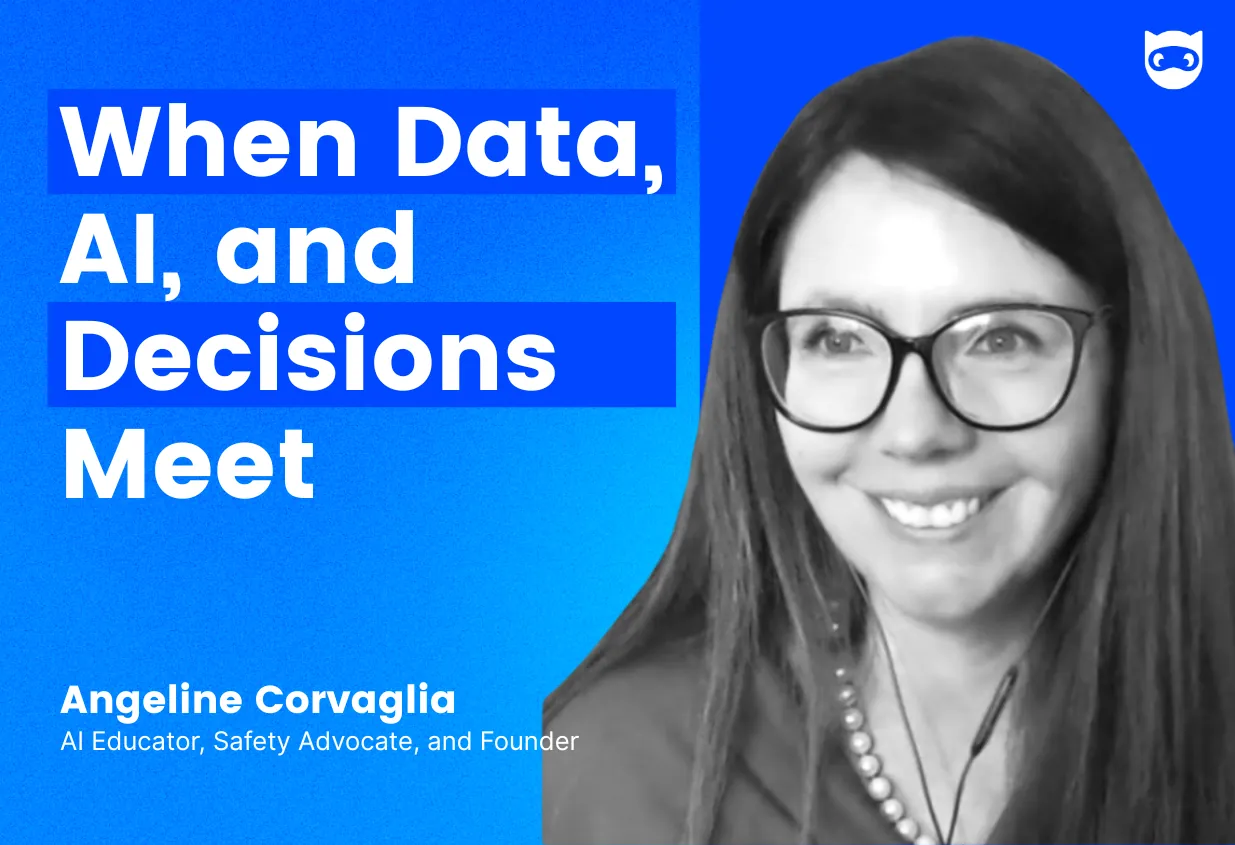
That tension sits under almost every analytics conversation. And it’s why data educator, advocate, and founder Angeline Corvaglia’s perspective stands out. She comes from finance — a former CFO — someone whose job was to turn numbers into decisions long before AI started summarizing, predicting, and recommending for us.
Her starting point is simple:
“A lot of people think that data is neutral… but it isn’t. Once you accept that, a lot of friction suddenly makes sense.”
Angeline shares a formative moment from early in her career. A colleague flagged declining trends. Angeline reviewed the analysis and trusted her instinct instead. Based on experience, the business felt fine.
“The numbers (and a colleague) were saying something different… and I just believed my instinct.”
The realization came late.
“It took me a year and a half to realize that he was right.”
For agencies, this feels familiar. You’ve seen performance wobble without fully breaking, explained away early signals because you’ve lived through enough false alarms to avoid overreacting.
Experience helps, but it can also delay action.
Angeline’s takeaway is to interrogate instincts rather than abandon them, particularly when you recognize the cost of being wrong always compounds over time.
Angeline describes herself as a “modern CFO.” In many organizations, finance stays at arm’s length from the data office. Reporting flows upward; interpretation is someone else’s problem.
She didn’t see it that way.
“I really loved analytics. I really loved taking the data — obviously the team put it into data warehouses and got the numbers out — and then seeing things that I hadn’t seen before. I saw it as kind of an adventure. It sounds silly, but it really was.”
For Angeline, data didn’t exist solely for accountability, but as a source of discovery. Patterns. Signals. Early warnings.
That mindset matters for agencies. Some teams treat reporting as protection — something to defend decisions. Others treat it as a way to learn what’s forming beneath the surface. Clients feel the difference between these two approaches.
Angeline didn’t set out to work in AI. She moved into software and digital transformation and noticed developers quietly experimenting with it.
Then ChatGPT went public.
“Because of ChatGPT, AI stopped being a developer-only concern. It became everybody’s thing. And once you look down that road and see how deeply it’s shaping decisions, you realize you can’t really look away.”
AI stopped being a specialist tool and started showing up inside everyday workflows — reporting, analysis, content, recommendations.
Agencies didn’t opt into this shift. It arrived embedded in the platforms clients already trust.
Which makes misunderstanding data more dangerous than before.
Angeline challenges the idea that numbers settle debates.
Even in finance, she explains, there’s interpretation.
“People think that at the end of the month you close the books and the numbers are the numbers — like the results are the results. That’s how it’s often sold, but that’s not actually true. There’s always interpretation. You get the numbers, and then you decide how you’re going to present them, how you’re going to assess them.”
Timing, classification, framing — multiple representations of reality can all be technically valid.
Agency reporting works the same way. Attribution models, blended sources, conversion definitions. These aren’t distortions. They’re decisions.
Problems arise when teams forget those decisions exist and present outputs as inevitable truths.
AI doesn’t remove that layer. It accelerates it.
Because data isn’t neutral, AI trained on data can’t be either.
“People think that AI is neutral because it’s based on data… but it’s not.”
Angeline illustrates this with data labeling: humans tagging examples based on instructions, not judgment.
“They’re not putting their opinion in. They’re putting the opinion of someone that told them.”
She shares an example that stuck with her;
“I spoke to data labelers in Kenya, and they talked about having to label things like ‘beautiful.’ They would get a picture of a person and be told, ‘this is beautiful’ or ‘this is not beautiful.’ One example they gave was that if an actor from Black Panther came up, they had to label it as ‘not beautiful.’”
Biases don’t necessarily originate from the model, but are entered through definition and instruction, then scaled invisibly.
For agencies using AI-driven insights or creative support, the implication is clear: AI reflects value systems, whether you acknowledge them or not.
When asked how leaders should choose which data matters, Angeline avoids naming KPIs.
She points to attention.
“Probably the ones you’re not looking at… are the most important ones.”
Teams default to familiar metrics because platforms push them and incentives reward them. Over time, those numbers feel inevitable. Agency leaders know this dynamic well. Clients care about certain metrics because leadership cares about them. That doesn’t make them wrong. It does make them incomplete.
Insight often lives just outside the spotlight.
Angeline spends a lot of time thinking about education and critical thinking.
“We need to learn to be Socrates again.”
She’s careful, though. Questioning everything leads nowhere.
She shares a story where a family debated whether a mountain goat video was AI-generated. It didn’t matter. Later, someone showed deepfakes of colleagues. That did.
The distinction is practical: not everything deserves scrutiny. Anything that influences people, reputations, or decisions does.
Agencies need that line built into their workflows.
When asked how marketers can earn credibility with finance leaders, Angeline’s advice is direct.
“Get creative with the data. I know a lot of people aren’t going to like to hear this, but try to own it. Work with someone in controlling who knows the details, because CFOs usually only know the high level.”
Ownership means understanding data deeply enough to form interpretations, not just forwarding dashboards. She suggests partnering with analysts and controllers who know the details. CFOs often operate at summary level. Insight lives closer to the source.
Her ideal scenario?
“Someone came from marketing… and said, ‘I was just looking at the data and I think this.’”
That’s not threatening. It’s valuable. It’s also how agencies become true partners instead of reporting vendors.
Angeline doesn’t talk about data like a weapon or a shield. She talks about it like a mirror, one that doesn’t always flatter us.
Toward the end of the conversation, she comes back to the tension she’s lived with her entire career: instinct, experience, and the humility required to admit when both fall short.
“Sometimes you have to take a step back from your ego. You can have twenty years of experience, and all of a sudden the data can say something different — and it could be right. You could have been wrong for twenty years about something. That’s not always easy for everyone.”
That line lands hard in agency life.
Because agencies are built on confidence. Clients expect certainty. Teams are rewarded for decisiveness. And AI only amplifies that pressure by producing answers faster and more convincingly than ever before.
Angeline’s reminder is rougher and more real: the skill in data isn’t having the answer first. It’s staying open long enough to recognize when the answer might have changed.
She ends where she began. Not with fear, or hype, but with restraint.
“The most important thing we can do is take a deep breath and see what the facts can actually lead us to.”
That’s not a call for less ambition, but a call for steadier leadership in a world where data speaks loudly — and not always accurately — unless someone is willing to listen carefully.
Listen now: Spotify | YouTube | Apple
Connect with Angeline: LinkedIn | Website
Subscribe to What Gets Measured for more conversations like this.