Jake Sanders
Content Strategist
A strong-looking programmatic campaign can still be doing the wrong work.
Behind solid CTRs and efficient CPAs, many campaigns are running on inventory buyers don’t fully understand, optimized toward metrics that don’t reflect real business impact. That disconnect is where performance can break down.
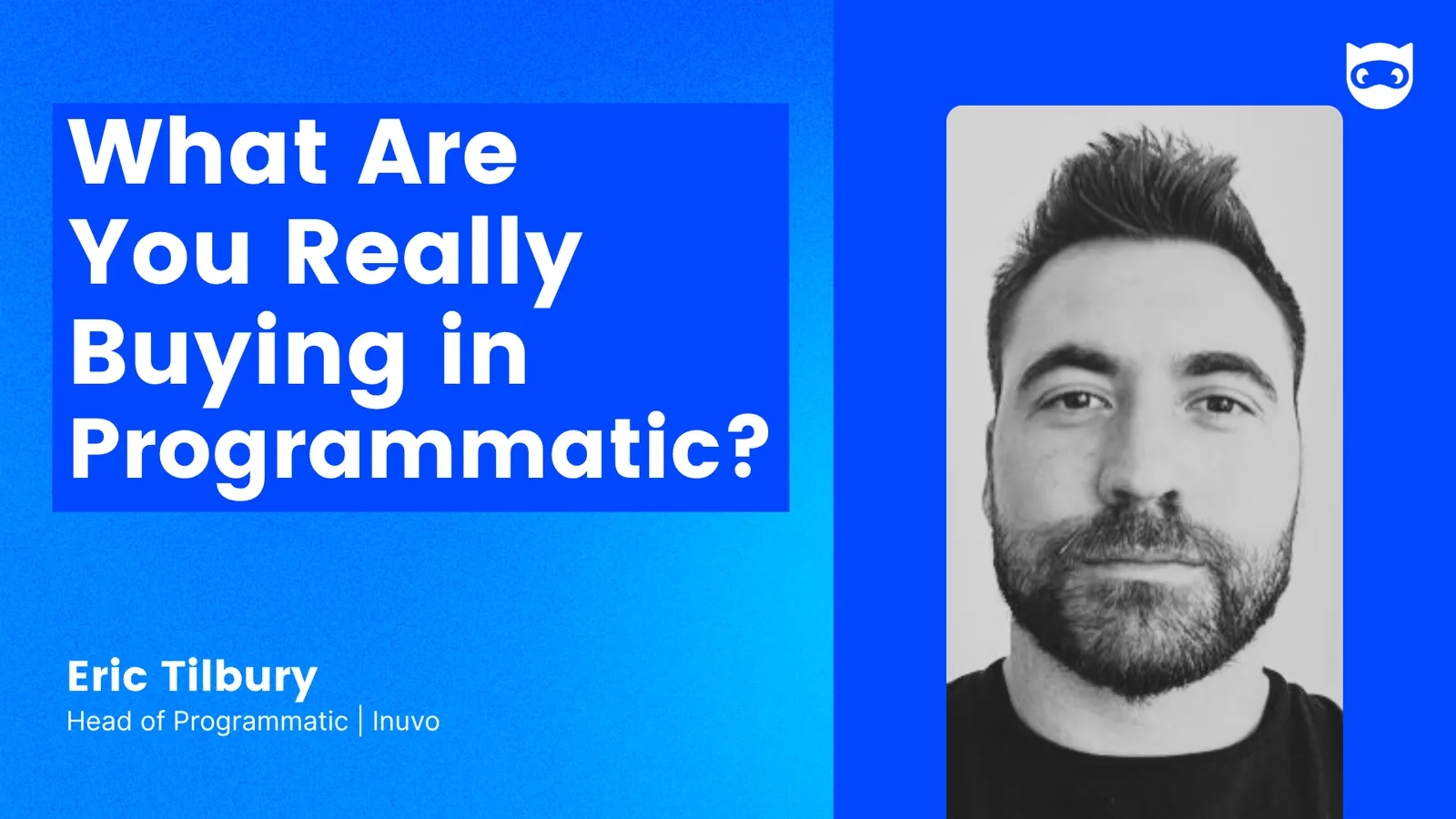
Eric Tilbury, Head of Programmatic at Inuvo, has spent over a decade inside that gap, helping brands and agencies understand what they’re actually buying, and why it matters.
Recently, he’s taken that perspective public. His LinkedIn, which is part education, part blunt reality check, part memes, has become a running commentary on how programmatic really works. And best of all, it’s based on Eric’s experience with actual clients, sharing wins and fails.
“I had a lot of conversations… where people didn’t understand how to think about programmatic. And it came down to mixed incentives—like, ‘I need to hit this goal to survive another QBR.’ So you have a story to tell, but if you go down that path, you start doing things very incorrectly.”
For years, those conversations stayed behind closed doors. Then he stopped holding back.
“I was relatively a nobody until about a year ago… and I just got really fed up,” says Eric. “I’m gonna start talking about this publicly. I’m gonna start telling people how to buy… and simplify something that’s very complex.”
That perspective leads to a simple question:
What are you really buying in programmatic?
Most programmatic strategies start with clarity: audience, budget, KPIs. What’s far less clear is where those impressions actually come from.
“If you asked any buyer right now what exchange they’re buying from in the DSP—95% plus, probably 99% plus—they have no idea,” says Eric.. “They’re just setting an audience… doing their creative, their budget, their frequency… but you don’t even know who you’re buying from.”
That blind spot is reinforced by how teams are measured.
“They have certain goals… ‘I have to hit the CPA, I have to hit the CPM, I have to hit the CTR,’” he said. “So you do whatever you need to do to make it happen. And it is so wrong—but it’s so easy.”
So optimization stays shallow.
“It’s not common,” Eric says. “Optimizations are mostly, ‘what CPA am I getting, what CTR am I getting?’ They never go down into who they’re actually buying from.”
And that’s how misleading performance shows up.
“I’ll have a client come in and say, ‘I need this CTR.’ And I’ll say, ‘give me a domain list.’ When I take a look, it’s all fraud—VPN apps, weird apps, weird sellers. I don’t even need a verification report.”
When campaigns shift to real inventory, the numbers change—and that’s the point.
“I’ll show them—ESPN, the New York Times… actual publishers,” says Eric. “And this is what click-through rate you should expect, because I’m targeting humans.”
Humans don’t behave like dashboards assume.
“Humans don’t really want to click ads,” admits Eric. “They want to purchase stuff, they’ll see the ad, but they might not want to admit it. And admitting it is clicking.”
That’s where Eric reframes the channel entirely.
“When you start to think about programmatic as more of a digital billboard—like, I put this idea in your mind, and then I touch you in all these other channels—that’s when you start to move the needle.”
The goal shifts from chasing clicks to building presence, reaching real people, in real environments, in ways that compound over time.
AI is improving how programmatic buying works.
“Now you can take multiple different signals within a bid request and say, ‘how well does this fit my audience?’” states Eric. “AI really helps with getting all of those signals to make a better decision.”
That added business intelligence matters, especially in a fragmented ecosystem. It doesn’t remove the need for judgment.
“There’s a dark tide and there’s the Jedi Knight on each side,” he says. “The good players are gonna have a good solution. The bad players are going to capitalize on the crap.”
The outcome still depends on what you ask the system to optimize for.
“It comes down to the human that’s actually buying it,” says Eric. “Is this actually benefiting the end client? The biggest hoop is cash margin—keeping the client, trying to hit what goals they think they need to hit, even though they’re not the goals they should be going for.”
The biggest difference Eric sees across teams isn’t tooling—it’s how performance gets evaluated.
“The clients and partners that are the most sticky… are the ones that are taking measurement completely out of the platform. They’re asking, ‘how is each channel actually impacting our business?’”
Inside platforms, performance can look definitive.
“You’ll see a hundred-to-one ROAS and think, ‘you’re awesome,’” says Eric. “But that’s using the platform as the source of truth.”
Eric mentioned that stronger teams treat those metrics as signals, not answers.
“They understand platform metrics as directional optimization,” he says. “They’re not the source of truth—they’re in-platform signals you use when you understand how the platform operates.”
That perspective becomes critical as growth evolves.
“You have great growth in Google and Meta… they’re great for lower funnel,” Eric says. “But after a while, you have to fuel them. You can ride someone else’s brand early… but if you want to grow, you have to find a way to start branding yourself.”
Eric doesn’t view the missing knowledge gaps in programmatic as a philosophical problem, but as an operational issue. When asked if he had one piece of advice for a VP of Analytics crying in an airport bar over digital advertising, Eric didn’t hesitate.
“Do you know what you’re buying? Do you know who you’re buying from? How you’re buying?”
Those questions sit underneath everything else—targeting, optimization, reporting. If you can’t answer them, the rest of the marketing data strategy is built on assumption.
That’s where most programmatic campaigns drift. Not because the tech fails, but because no one is close enough to the inputs, or even cares to look.
The shift Eric pushes is straightforward, even if it’s not easy:
This is the work behind the dashboard, the part that doesn’t show up in a slide, but determines whether the numbers mean anything.
Eric didn’t start posting on LinkedIn to build an audience. He started because these conversations weren’t happening in the open. And now they are.
That’s the throughline with his advocacy; focusing on a clearer standard for programmatic that is easy to understand for more people. So rather than launch a new tactic, or pivot to the latest tool, take Eric’s suggestion, gather your team, and ask a simple question: do we know what we’re buying?
Listen now: Spotify | YouTube | Apple
Connect with Scott: LinkedIn | Website
Subscribe to What Gets Measured for more conversations like this.
# Eric Tilbury Interview - WGM
[00:00:00]
**Jake:** Eric Tilbury, welcome to the show. How are you today, sir?
**Eric:** Doing great. It's a hundred degrees out, so. I actually do much better in the heat than the cold. I am, I am so bad when it comes to cold weather, really. Um, so a hundred degrees is my element. So we're, we're having a great day.
**Jake:** Okay, good, good, good. But you're inside at least. Um, and you are often online.
You're in the programmatic space. Um, just. Profoundly educational. Um, super helpful. Um, it comes from [00:01:00] a deep subject matter expertise, and I just wanted to start really fast. If people aren't following Eric online, you should, um, you're, you're passionate. About what you do. Um, and I think it's helping people com like sort of comprehend something complicated like programmatic advertising in a simple, relatable way.
You use Ryan Gosling memes, you know, you, you know, you know, you're not just, you're not just putting things out. Um, so I think it's rare and I think it's more required than ever. I just wanna know where that energy comes from.
**Eric:** Yeah. Uh, so what's funny is I always kind of refer to myself as kind of the legend of the phoenix.
Like my, my entire, uh, social presence really came from burning down a lot, uh, because I have a lot of conversations with a lot of different buyers. I have a managed service side. Mm-hmm. I have a self-service side where I push, you know, PMPs over to clients. [00:02:00] And a lot of conversations of just the other side, not understanding how to think about programmatic, how to buy programmatic and when and, and when.
You mean
**Jake:** other side, are you talking clients?
**Eric:** Yeah. So you're talking clients, you're talking either brand direct or you're talking agency side. Those are like my two largest type of, uh, verticals. Right, right. Um, and a lot of just mixed incentives on the other side of like, okay, well I need to hit this certain goal.
To survive another QBR or whatever. So I have a story to tell, but it's like, okay, if you're gonna go down that path, you're gonna start doing things very incorrectly. So I had a lot of, I had a lot of conversations and really what you're seeing is like the, the frustrated side of me coming out and saying, Hey, like there's a better way to do this.
And if I just put this idea into the universe, [00:03:00] like what happens? Right. Um, so I, I put my thoughts out into the universe all the time and it just started catching on. What's funny is a lot of people were like, I feel like you've been around for a long time on socials. It's like, I only started a year ago talking.
No, really? Yeah. Yeah. I've been, I've been in programmatic for 14 years now, but like I was relatively a nobody until about a year ago where I just got really fed up and was like, I'm gonna start talking about this. Uh, publicly, I'm gonna start telling people how to buy. Uh, I'm gonna give you a, something that's very complex that I have to do all the time for real though, where I simplify it, right?
So I simplify it, I put my spin on it. Uh, like I always. Like people joke about like, one of my super powers is likability, right? So I sprinkle in that likability. It's where you see the, the Ryan Gosling memes and memes. It works, all that good stuff. [00:04:00] Yeah. Yeah. So it's, it's actually been great. What's funny is like, I, I'm not gonna take credit for it, but there's a lot of initiative now in the industry of like, we need, we need to figure this out.
Right? And I'm kind of like, did I play a part in that? I hope I did.
**Jake:** So let's, let's, let's, let's speak a bit more. Personally, and then we'll get or over to the industry kind of fluctuation. But what was that moment when you were like, I'm about to do it. Were you holding back? Um, or did you not quite know how to phrase it?
Because I, I find. Sharing how you actually think, um, in a candid way gets much more engagement rather than posturing how you think you might want people to perceive you.
**Eric:** Yeah.
**Jake:** I I, I don't know if you've been dealing with that, but, but you, you're raw, you're real, and you're helpful.
**Eric:** Yeah.
**Jake:** And you were sitting on that.
Is that what you're saying? [00:05:00] Like, man, I'm tired of having these conversations. Was that the impetus or why did you get out there?
**Eric:** I think initially it was fear. Of, 'cause I like, I'm still relatively young, right. Um, I mean, I've been in the industry 14 years Right. But like, literally since college, uh, I've been in the industry the entire time.
Mm-hmm. Um, so it was one of those of like, okay, is someone going to hold something against me with this, you know, impact? Like if I was going to get. A future position somewhere. Like if I say something wrong online, it's there forever. Right? And then I was just like, okay, like just be yourself like, 'cause I'm not a.
I, I did like wrestling, I did martial arts, so I'm more very calm, right? So like, if someone attacks me, like I'm very calm, right? Mm-hmm. So it's just like, just be yourself. Don't, don't go and be hostile and, you know, just speak the facts. So like when you, when you [00:06:00] get my perspective, it is literally just the facts.
Like I'm not. I'm not bombarding other companies, I'm not talking crap on other companies. I am just giving people the facts. And I think that, I think people appreciate that.
**Jake:** So, absolutely. I mean, that's what drew me to you because it's so often that it's, um, I think part of the reason why a lot of the clients may be that you're interfacing with have ignorance in regards to this complicated.
But complicated, not complex.
**Eric:** Yeah.
**Jake:** But comp complicated 'cause we made it so, yeah. Do you think that not. Ignorance, but maybe not unwillingness to engage with the raw material. Yeah. Like, you know, I mean, this next, this next question is like, you're talking about ads txt and j you know, sellers json, like you're Yeah.
You're using real technical terms in a way that's frank, and you know what I'm talking about? Yeah. I wonder if a lot of people are ignorant because they're just [00:07:00] exhausted. Yeah. Or why don't people wanna care like you do?
**Eric:** So, yeah, a lot of it comes down to like what their incentives are on their other side, right?
Like you, so, and it comes down to a knowledge gap at the buyer level, right? So if you start talking about, like people at the top be like, we need this stuff. We need this to happen. But then it goes down to the buyers and the buyers to actually make certain things happen. A, they don't know how. And B, they have certain goals that they are pressed on at the end of the day, even though at the highest level someone told them to do something, they're like, I have to hit the CPA, I have to hit the CPM, I have to hit the CTR.
So you do whatever you need to do to make it happen. Right? And it is so wrong. It's, it's.
**Jake:** But it's so easy. E Eric, it's so easy. Would you say that that's the thing where you have to get in here and say, I know it seems easy. Yeah. But when I'm [00:08:00] telling you, check your ads dot DTXT, this is basic hygiene, but most people are not looking at it, you know?
Yeah. So maybe they don't know that they should, and so I just, I just wanna. Into this why? Why in regards to the ads txt, these are, these are ongoing problems that you see proliferating and through maybe a bit of convenience or ease, or ignorant incentives, meaning exhaustion. You just say, sure.
**Eric:** Yeah. Yeah.
**Jake:** Um, why aren't they checking simple things like this? Like, I, if, if I'm out here and I'm seeing the chatter, I'm like, what are y'all doing with my money? You know? Yeah. There's,
**Eric:** yeah, there's multiple reasons. Um, a they just don't know how. Right? Like, it's so
**Jake:** technical.
**Eric:** Yeah, they don't know how, like some DSPs, like they don't even have ads Tech as a flag for you to say like, yeah, I wanna buy [00:09:00] within Ads Tech.
I wanna add buy ad tech seller, direct, like direct sellers, right? Mm-hmm. Um. And they don't, which be helpful. Be helpful. Yeah. Yeah, yeah. Exactly. Exactly. And then some of them make it hard to, like, you can't just pull a report by Ads Tech and Tellers that JSON, you would need some kind of log level integration with the DSP.
Right. To get that data and say like, okay, am I actually buying, uh, authorized direct? And is it validated through sellers? JO because all ads text is, is a publisher saying, Hey. This is who could sell my inventory. These are the, these are the direct sellers and these are the resellers, right? And sellers, JS ON says, this is all the inventory that I can sell.
Right? And then they, you validate those two and you say, who, like, what publishers did I buy from? What inventory source did I buy from? And do they match? [00:10:00] Right? Like, do they, do they meet up? Right? And if they don't, you have something weird in there. You just, just block the living crap out of it. Right? Like,
**Jake:** and,
**Eric:** and
**Jake:** just to, just to update the audience, how many people are doing this?
Like what percentage of agencies?
**Eric:** It's not, it's not common. The, the optimizations that are done are mostly, Hey, I'm buying these domains. What CPA am I getting from these domains? What CTR am I getting from these domains? What, uh, what, what CPM am I getting? Let me optimize That way. They never go down. Like if you asked any buyer right now, what exchange they're buying from in the DSP 95% plus, probably 99% plus, well, I have no idea.
Exchange. They're buying from, they're just setting an audience in the line item. They're doing their creative, they're doing their budget, they're doing the frequency, right. They have all these like magical tools that they say that they have, right? [00:11:00] Like we're doing all these crazy things to manage frequency, cross platforms and all that.
But it's like you don't even know who you're buying from, right? Like you have no idea. So like, yeah, like I, I literally just. Had an article published about this of like, most campaigns fail before they even run an impression because they don't know who they're gonna buy impressions from.
**Jake:** Woo. And so and so.
So then someone would say, targeted. And then someone would say data. Yeah. I mean, I, I, I'm, I'm, this is a professional podcast, but these people say, you know, they're like, well, we have the targeted stuff. We can, we have the data. We can go for them at that. Clip now. Um, like when we're talking about maybe Yeah, speak to that, like targeting, like someone says, no, no, no, Eric's, he's talking crazy because you just make an impression or.[00:12:00]
They're just there to awareness or I'm about to target this thing. So laser tight.
**Eric:** Yeah.
**Jake:** How, what, what are the, what, what's your comeback for those people? 'cause that does exist or how does it work? In a programmatic, they universe.
**Eric:** Yeah. They drank the Kool-Aid. Right. Like it, it comes down to where they're like, this audience that was sold to me, or that was created by, you know, my agency or whatever is so good.
Right. It's going to figure out, it's going to figure out what is the best impression, right? Mm-hmm. Which there are solutions that will do that, right?
**Jake:** This, this is what I'm saying. The tech is here and, and if I gave a custom, I did deep market research. I know about the tech. Yeah, I know about these people.
So then that's all good. But when you're taking this off the shelf box that says, buyers, you know, or like Exactly.
**Eric:** Exactly. Like, you know, like there'll be a segment in A [00:13:00] DSP that just says Auto imp intenders 5 million users. Like what does that mean?
**Jake:** I like my odds.
**Eric:** Right, like people who drive, right?
**Jake:** Ooh, I could get all of them.
Get in the funnel. We're gonna convert 'em all. Well, so I, no, you're right to say that. But now, now it gets to this question of ai, like massive amounts of data. I mean, that's what's going on in programmatic right now. You know, if you have thousands of campaigns out in launch, you, you are gonna need to use some kind of data tool to get it.
Set, get it normalized, get your data cleaned. How do you see AI actually improving, like quality in programmatic today? And what kind of data foundations do you have to have in place?
**Eric:** It comes down to more just like complex decision making, right? Like before the, the, the common setup was to push. Push IDs from a, like a DMP into a [00:14:00] DSP, and then like you're off to the races now with AI and, you know, all these different tools, you could take multiple different signals within a bid quest and say like, how well does this actual bid quest fit my audience?
Right. And like a lot of people run into the, into the problem or the, the. They, they try to think that they could run programmatic like the walled gardens, right? Mm. Where they set an audience and they say, you know, like the, the walled gardens, they own that entire ecosystem. They know exactly who that idea is, right on their inventory.
But then you go into programmatic where it's very fragmented and the strength of it is the fragmentation, right? But there's a ton of different ownership. All of these different signals are happening at one time, so AI really helps with getting all of those different signals to make a better decision.
[00:15:00] Where, you know, the, the traditional way is just matching the ID and the bid quest or some stale URL or whatever. Right?
**Jake:** Right.
**Eric:** But yeah, AI like really, really, really helps with that. Like, that is a, that is a game changer, right?
**Jake:** I mean, it's, it's a huge game changer. And, and just speaking about data, because you know, ninja Cat, we've been in the data game helping franchise people to, you know, um, turn reports, roll 'em up, roll 'em down, do whatever you want.
Um. But it's weird because I feel like, are we having ai, does it feel like it's changing the conversation or it's just speeding up an old conversation like,
**Eric:** that's the beer.
**Jake:** What do you think?
**Eric:** I mean, there's a dark tide and there's The's, the Jedi Knight on each side, right? Like
**Jake:** mm-hmm.
**Eric:** Right. So, um. If there's good players and there's bad players, true, the good players are gonna, you know, have a good solution.
The bad players are going [00:16:00] to capitalize on the crap. And the unfortunate thing is AI will do very good things, very, very creative things, but it comes down to the human that's actually buying it, right? Mm-hmm. And saying like. Is this actually benefiting the end client? And you know, there's a lot of hoops to jump through there.
And the biggest one is, you know. Cash margin, right? Like keeping the, keeping the client trying to hit what goals that they think that they need to hit, even though they're not the goals that they should be going for. And, you know, that, that comes with real conversations and that's what I try and have on a daily basis.
**Jake:** Um, talk to me about when you've had that conversation. Like when, when you had somebody, they're like, this is it, and you'd be like, ah. Oh yeah. It's very, very, very, how, how does that work? Because a lot of people are thinking, I'm not even gonna say anything if I think I, I'm just gonna be like, cool. [00:17:00] Sign the check.
**Eric:** They risk losing the client. So I'll have a client, like a very common use case. They'll come in and say, I need this CTR, this is the CTR, because I talk about these click trends and my QBR and so on and so forth. And I will show them. I'll be like, okay, give me a list of. Just, just a straight domain list.
Show me the domain list of your previous buy where you were getting this. This click through rate, right? And what does it come back with? It's all fraud. VPN apps and weird, just weird apps, right? Mm-hmm. Or weird URLs that no one's ever heard of. Right? Weird sellers. And you're like, well, I could, I don't even have a verification report from what you bought before, but I can tell you it was all bought.
Just by looking at the inventory that you bought from and the inventory sources that you bought from. Wow. Right? And then I will go and show them like, Hey, like I'm buying, you know, ESPN, the New York [00:18:00] Times, right? Like actual, and this is what click-through rate, you know, you should expect from these, because I'm targeting humans, right?
Like humans. Don't really want to click ads, right? They wanna see ads, right? Like in their, in their unconscious mind, they want to see ads because they want to purchase stuff, but they don't want to admit it and admitting it is clicking on an ad. So when you start to think about like digital and programmatic as a, like more of a digital billboard of like yes, right?
Of like, Hey, I put this idea in your mind. And then I'm going to touch you in all of these other different channels. Right? Right. Then you start to move the needle 'cause you're showing ads to humans. Humans are making that connection in their mind consciously or subconsciously, and then going and acting upon it.
But you have to show ads to humans and you have to show visible ads. Right. And that's, you know, that doesn't align with [00:19:00] the incentives that. Most buyers are going for, right? Like clicks, accidental clicked. You piss someone off, you target a bot. Uh, well, but
**Jake:** when you said real people gotta watch these ads, that's one thing that I did.
I looked up the, um, statistics for what counts as an impression.
**Eric:** Yeah,
**Jake:** you, I was shocked. And, and, and as I describe these things, um, you know, I, it also feels weird. You're like, do people want to hear this, that LinkedIn says, you know, you see 0.5 of an ad for like, whatever, that's an impression, you know, and you're like, wait, what is an impression?
And, and so. Having some of these curious questions. Yeah. Knowing that you have relationships that you'd have to understand chain, uh, uh, of events, you know, um, also thinking of digital as a billboard. Starting to think of it like in home, in, out of home. Yeah, [00:20:00] something like that. Maybe that could help, but I wanted to talk more about reporting at that level.
When you were talking about separating data signal from noise, it just seems like when you said, show me your click through rate, I'll show you the noise. You know what separates organizations that extract real signals from their marketing data and those that just produce more dashboards? It seems like the people who just produce dashboards don't think about it.
**Eric:** They're not,
**Jake:** what are those clients that do think about it?
**Eric:** Yeah, the, the, the clients that, well, so the clients and partners that I work with that are the most sticky with their clients or they keep their job at the brand are the ones that are taking measurement completely out of the platform and saying, Hey, these are the actual metrics that we're seeing on our side.
How do we measure how each channel and tactic is, is actually impacting. Our actual business, right? Rather than saying, you know, [00:21:00] a lot of times the platform metrics, they're used as a source of truth, right? Like you, oh, for sure you have a hundred to one roas, you're awesome, right? Like. It's, it's one of those, so like you'll get a lot of the churn from the ones that use the platform as a source of truth, right?
The stickiest ones, the best ones, the ones that actually move the needle. Those are the ones that actually care and use alternative forms of measurement and understand the platform metrics. They're directional optimization. They're not the source of truth. They're in platform optimization that you can use when you understand how the platform can operate.
**Jake:** And you understand what to optimize because if it's click through radar, ROI or ROAS or whatever, whatever, and it's not tied to something that actually make that real number go up, um, that, that is, that's key. Well, so if people come to you and they're like, Hey, how do I [00:22:00] tie my ads to business effects?
Yeah. Do, do you, do you have advice there or do you notice something in those clients again?
**Eric:** Yeah.
**Jake:** How, how are they tethering it?
**Eric:** We actually got so fed up with the platform metric, uh, that we stood up an entire MMM solution on our side, and we started offering it as the added value. Whoa. And then it opened up a can of worms where we had our clients who were like, okay, I don't want you grading your own homework.
I'm gonna get my own and measure it. And then the numbers match up and they're like, okay, you're cool. Right? And then, but they took
**Jake:** your advice to go off platform, which is cool.
**Eric:** Like, go ahead. Exactly, exactly. Yeah. So we started offering it as added value of like, Hey, like if you really wanna see the power of like targeting on iOS, right?
I will show you this. V-N-M-M-M, it's gonna take a while. The whole time I'm going to be talking to you about your model's health, the inventory health, right? Like [00:23:00] I'm going to be buying real stuff, and I'm going to tell you that story, rather than saying, Hey, your click through rate is this, each month, you know, your CPA is this, it's more so, Hey, your model is saying this in terms of like what the audience looks like.
Your, the inventory sources that I'm buying are this. Right. And that is a much better way to go about programmatic rather than, you know, just metrics that don't mean anything. You'll have like a hundred slides of this bullshit.
**Jake:** Well, I mean, and, and, uh, marketers are offended. We're like, Hey, some of those slides we worked hard on.
Um, but the point is,
MMM, everybody. He was talking about MMM. He wasn't talking about MMA or you thought it was wrestling or whatever.
No, that's Eric's talking about media mix modeling. So, so, so medium mix modeling, take, taking a look at all these things in an incremental way. But you just said you offer this thing. Um, that's awesome. How much data do you need to plug into this? Like, because that's where it's like, if [00:24:00] that's my question, don't you know that's
**Eric:** the knock, that's the knock on it, right?
Is it takes time to measure it. They want to see, they're so geared towards, you know, what is my return today? Right now? Which they're trained on from Google and Meta. Right? And they were able, they, they pulled that information very quickly and they claim a lot of the credit. They claim all of the credit, right.
So marketers are trained on that and something that actually shows the effectiveness. Right, takes time. Like not every single user is the exact same. Not every single decision is the exact same. To see patterns and trends and real actual trends, it takes time. Totally. Right. It's not like, it's not an instant thing.
Um, I think that the, like in Google and Meta, they're very strong channels. Like I, I would never knock them, like they're very Oh, no. Yeah,
**Jake:** they're
**Eric:** working. But you're serving on very specific inventory sources. Mm-hmm. Right? Unless you let Pax just go [00:25:00] rogue. Right. Uh, but for the most part, like you're just serving on very specific inventory sources and that starts to plateau after a while.
Like you have the initial growth, you have great growth, and they're awesome channel. They're great for nurturing that lower funnel. Right. And really bringing it, like bringing home that conversion. But you have to fuel them like they, after a while, you have to fuel them. Like in the beginning, if you're some brand, like a, like a water bottle, right?
Like a, like a Stanley Cup competitor, you're using Stanley Cup's branding to just like, you know, to. Hijack their branded spend with, you know, your, your, your spend. Uh, but after a while, if you wanna hit a certain growth, you have to start branding yourself. And that's where you start to, to, to dive into other channels.
Right. And that's, people don't understand that. And then you have the biggest brands in the world that are going heavy in those channels, and they [00:26:00] start to forget about brand and they run into issues.
**Jake:** Oh my gosh. I mean, it's that you talk about Adidas.
**Eric:** Nike. Nike had that problem.
**Jake:** So these are big brands that should have things figured out, but they took a deep look at what matters to them.
What gets measured, gets managed, but you gotta manage it yourself and don't just look at the measurements. And then if you need somebody to talk to about you gotta get with Eric. My last question. My last question. Yeah. Um, let's say you're in an airport. Okay. Mm-hmm. And you see an advertising, uh, you know, exec, you know, one of your, your client, you know, profile, um, they're stressed at the bar about efficiency and they're wailing about ROI and you're like, oh God.
Like that's bad. What one? I mean, probably don't even approach them. Probably Eric is, don't do it, but. If you did and you leaned in and you were like, Hey, what [00:27:00] would that one piece of advice be? Just like, Hey, by the way,
**Eric:** I would say you need to look under the hood immediately into your advertisement. Like what are, what are you actually buying?
Right? Like, do you know what you're buying? Right.
**Jake:** That's it. And
**Eric:** then you would just
**Jake:** blow throw a smoke capsule down and
**Eric:** just like piece out like that, man. Yeah. Where, what are you buying? Do you know who you're buying from? How you're buying? Do you understand your advertising strategy? Most of the executives don't know, and then they have an idea of what they're trying to do, and then it goes down to the bottom.
And the bottom is just trying to survive. Right? And it's just this churn of just. Like, like the CML position is a revolving door for this issue of this. It's
**Jake:** so tough because it's, it's, it's trapped at that measurement thing and then felt the stress at the bottom. But from all levels, if we said, what are we buying?
Um, you know, check what's [00:28:00] in the bag. You know, TSA tells you that, you know, you don't leave your baggage unattended.
**Eric:** Like, what's your actual strategy, right? Like do they even have a strategy, right? Like that's
**Jake:** the, well, but I mean, Eric, I'm thinking too, you're just a practitioner. What the hell are you talking to me about strategy for and giving good advice, but also I'm like, this man doesn't have to care about strategy.
He could just do his work as a tactical person. But why, why, why? Again, I think that goes back to the top. You have a strategic underpinning, um, to your advice?
**Eric:** Oh, yeah.
**Jake:** Yeah. So how, how do you get that across? Like, I'm not just knocking people's game or like, you know, rocking boats.
**Eric:** Yeah, it's, it's more so just like the more information I can get out there, hopefully high level positions start to take notice to that.
Which, you know, for the most part has, and then that starts to trickle down of like, Hey, we should be caring about [00:29:00] this. Mm-hmm. And if that trickles down to the actual buyer, the people making the actual decision, right? Mm-hmm. Mm-hmm. Like the executives aren't, what's funny is they aren't the one re making the high level decision, but they're not
**Jake:** in these conversations.
**Eric:** Yeah. Like what exchange? Divide, like there.
**Jake:** Well, and then you'd think how, how silly it would be to go to the head up and be like, we don't know what we're buying.
**Eric:** Yeah. Yeah.
**Jake:** We actually don't know what we're doing. Yeah. Um, not doing, but we don't know what's inside of what we're doing.
**Eric:** Yeah. And a, a lot of them, like, it's funny, you see their creative strategies, like this is a no rabbit hole, and you're just like, you don't even really have a creative strategy.
You're just like saying words. Right. And they don't understand the difference between a display ad and a meta ad. Right, right. Yeah. Is essentially a display ad, but it has copy, right? You can different Yeah. There right. Display ads. You have a couple, like you have like a [00:30:00] couple seconds, if not milliseconds, to say this is exactly what this is, this is better.
Jump into it. Right. Then you'll get that same type of meta ad on display and it's so wordy and no one knows what's going on. Or it like, there's just so many different, like just video environments. Right?
**Jake:** Oh, the instream outstream don't, don't, we don't have that much time.
**Eric:** Yeah, exactly. Exactly.
**Jake:** Well, but.
Quality, um, programmatic, rethinking, digital advertising, more akin to the old way of just like, exactly like, you know, I think there's something more freeing. Um, but Eric is amazing. Um, and you gotta follow him. If people want to connect with you and learn more about you, Eric, how can they do that?
**Eric:** So the two platforms that I used the most are LinkedIn, just Eric Kilberry on LinkedIn, and then Twitter is like where I was birthed.
That's, that's literally where like I am a product [00:31:00] of Twitter. That
**Jake:** explains it. Yeah. I, I was like, wow, how he's just hitting it, like knows what to say and how to say it in a lot of characters. It makes sense, man. Yeah. I cut my teeth on Twitter.
**Eric:** That's literally, that's where I got the, that's where I got all of my initial traction was from Twitter.
Um, and then I just started copying and pasting what I was saying on Twitter, on the LinkedIn and it like, you know, cop,
**Jake:** come on, follow 'em. Are you ready
**Eric:** now?
Let's go
**Jake:** Cheese or chocolate.
**Eric:** Oh, chocolate.
**Jake:** You're a hedonist. Erica. The way you answered that was just like, oh man. Okay. Chocolate. Ah. All right. Eddie Van Halen or Steve vi.
**Eric:** Van Halen.
**Jake:** I know, right? What's Steve V doing? You know? Yeah, it's okay. But yeah. [00:32:00] Fine. Oh, I, I think I met Joe Satriani, which was,
**Eric:** you did
**Jake:** surfing with the, I mean, but I put Steve V the answer was Eddie Van Halen.
Either way. Okay. Um, surfboards or skateboards here in Cali could be either.
**Eric:** I skateboards
**Jake:** safer.
**Eric:** No, I just grew up in that skateboarding generation of like, you know, CKY and all of that.
**Jake:** Totally. Oh boy. I'm on the pipe. I see it. Um, all right. Being chased on land or being chased in water.
**Eric:** Oh, land. I can find stuff.
I'm fast. Asked water. I sink.
**Jake:** Wait, wait. I don't even know. Some of these questions I come up with. I was like, is that. Whatever, but go for it. Okay. Uh, poetry or kittens.
**Eric:** Kittens. Kittens are cool.
**Jake:** Poetry sucks. That's what he said, [00:33:00] Eric. All right. Our, our relationship's on the mat. It's on the, the ropes, bro. Um, okay.
You're right. Not that there was a right answer, but it probably was kittens. Um, yeah. Okay. And then finally, throw pillows. Are they useful or are they useless?
**Eric:** They're useless.
**Jake:** You just done, like before
**Eric:** I was married, I had just the pillow I slept on, on my bed.
**Jake:** I like it because with women, and I'm not trying to say anything.
**Eric:** No,
**Jake:** they, they're coming with extra pillows. That's just a thing. Right.
**Eric:** Yeah, no, I, they get thrown off the bed and literally I like had one pillow until I was married, just one pillow on my bed,
**Jake:** just so man in his pillow. Uh, dude, excellent. I have
**Eric:** no decorations. No,
**Jake:** I mean, that's what I'm saying, like the popery bowl.
**Eric:** My walls were completely blank.
**Jake:** Oh my God. Don't know. Okay. Stop. Don't tell [00:34:00] anymore. Oh my God. You lived in a bunker in a cot. Yeah. Oh, really? Well, somebody, somebody took care of you. Somebody fell in love with you.
**Eric:** Yeah. Yeah.