Team NinjaCat
What happens when marketing reporting stops being the end of the workflow and becomes the starting point for action?
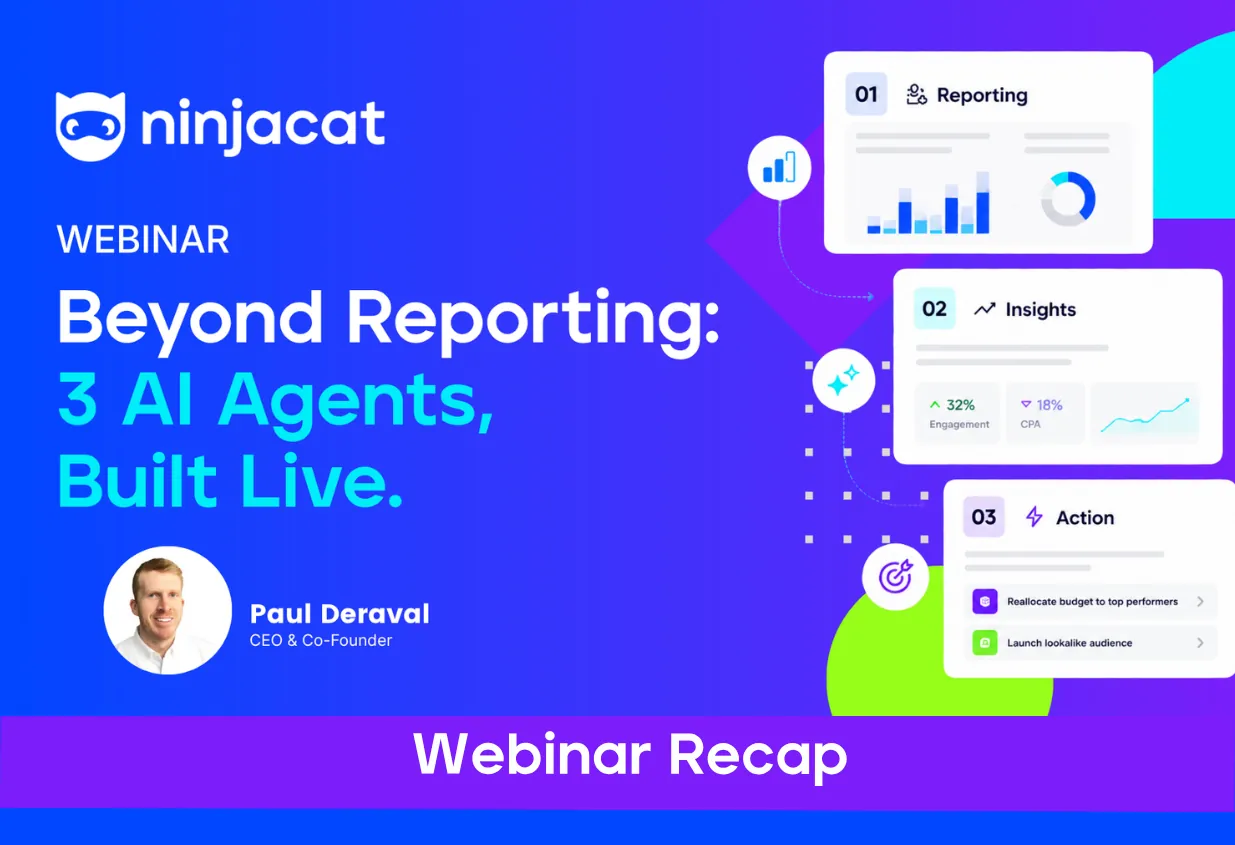
In a recent webinar, “Beyond Reporting: 3 AI Agents Built Live,” NinjaCat CEO Paul Deraval, demonstrated three ways AI agents can revolutionize the work marketers do—from proving value, to finding opportunities, to catching issues before they become problems.
No slideware. No hypothetical AI use cases. Just agents being built around the kinds of workflows marketing teams already manage every day.
For years, marketing teams have invested in getting their data into one place, building reports, and making performance easier to understand. NinjaCat's AgentOS opens up the next step: putting that data to work for multi-account teams.
Instead of waiting for someone to review a report, spot an issue, decide what needs to happen, and manually execute the next task, an agent can be given a specific job and continuously work against the data already flowing through your organization.
The goal isn't to replace the marketer making the decision. It's to change where their time goes: from assembling and checking the work to reviewing, approving, and improving it.
Reporting that adapts to the ask.
Paul starts out by building a client reporting agent from scratch, then connects it to live marketing data, and generates a polished client-ready data story. But the agent doesn't reset every month, with the data layer attached it has memory and flexibility. The same agent can respond to custom requests, benchmark performance across advertisers, incorporate client-specific briefs and brand context, and produce everything from web presentations and PDFs to interactive data apps—all without building a new reporting template for every request.
Insights that help marketers optimize.
The next experience moves from what happened? to what should we do about it? Paul shows how agents can work across connected datasets, run analysis, surface meaningful insights, and support optimization workflows like Google Ads—giving teams a co-pilot that can investigate performance and help determine the next best move.
Monitoring that catches the smoke before the fire.
Then Paul pushes agents from reactive to proactive. An agent can continuously monitor data health, permissions, budget pacing, campaign performance, and other signals; identify anomalies or opportunities; recommend the next action; and automatically send alerts where teams already work. Think an underspending budget, a high-performing campaign limited by budget, or a data connection that suddenly breaks—flagged in Slack before someone has to go looking for it.
Perhaps the most important idea from the webinar: the move to AI agents doesn't require abandoning the reporting infrastructure you've already built.
Your existing data, workflows, and marketing expertise become the foundation.
That's what makes the expansion from reporting to agents interesting. Reporting answers what happened? Agents can help teams move toward what needs attention, what should happen next, and what can we do about it?
The result is a shorter distance between the analyze → optimize → act cycle.
AI agents can sound abstract until you see them being built.
The recording gives you the practical version: how an agent goes from a defined job to a working part of a marketing workflow, how multiple agents can be orchestrated around different responsibilities, and where human oversight fits into the process.
If you're already using NinjaCat for reporting—or simply wondering what AI agents could realistically take off your team's plate—this is a useful look at what's on the other side of the dashboard.