How Data Drives Ecomm Brand Marketing
Published:
November 10, 0226
Updated:
November 10, 2026
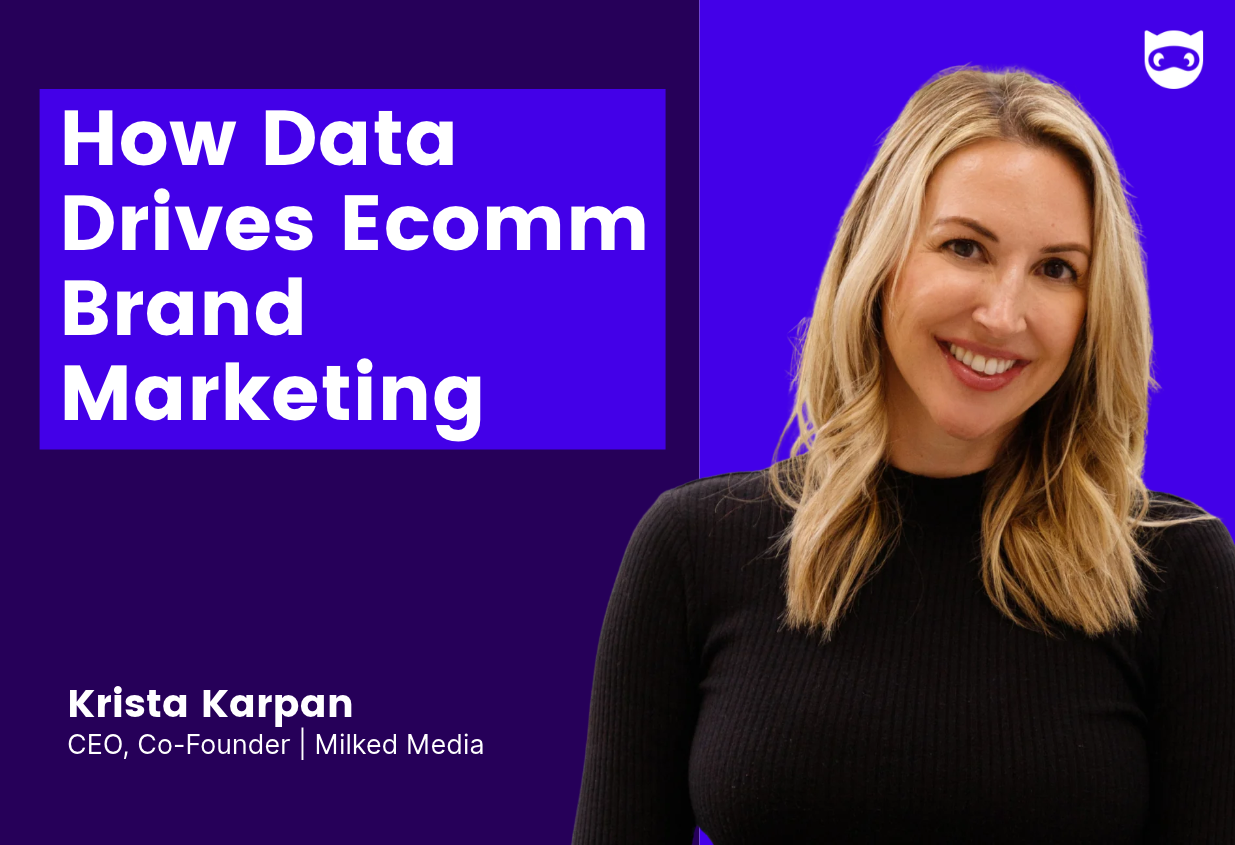
Table of Contents
Krista Karpan is co-founder and CEO of Milked Media. She and her business partner Nicolette started the company in 2017 doing a little bit of everything for anyone who would pay them — organic social, branding, influencer marketing, mostly local businesses.
In early 2020, they made a call that felt risky at the time: fire all the clients that didn't fit, narrow the focus entirely to ecommerce brands in fashion, jewelry, beauty, and home, and go all in on Meta ads and email.
"We were down to one client," says Krista. "Maybe not the smartest move. It was definitely risky, but we're like, 'Hey, we're gonna go all in.' And it ended up working out for us."
More than 60 brands and $160 million in revenue later, the bet paid off.
Krista joined What Gets Measured to talk about how data actually functions inside an ecommerce ad account — not as a scoreboard, but as the tool that tells you where to look next.
Why Multi-Channel Attribution Is Always Going to Overlap
The first thing Krista walks through is why multi-channel reporting is so hard to trust — and why most ecommerce brands are looking at inflated numbers without knowing it.
When a brand runs ads on Meta, Google, and email simultaneously, all three channels report their own revenue figures and return on ad spend. All three figures overlap, because each platform measures credit against a different attribution window.
"Meta is a one-day view, seven-day click," says Krista. "Google's standard is within 30 days. Typically on Google, we're seeing like 21.33 purchases because it took partial credit for the sale. That's a fun game we play — multiple platforms are usually taking credit for the same sale, and they all report on different attribution windows."
Add up what each platform claims and compare it to what Shopify actually recorded. "I guarantee it's likely more than even your Shopify-reported revenue," says Krista. "That's a good indicator that what the platforms are telling you is definitely inflated."
Platform-reported ROAS is built to make each channel look as good as possible, not to give an honest read on what's driving revenue across the whole account.
Using individual platform figures to make cross-channel budget decisions means optimizing toward numbers assembled for each platform's own purposes.
Optimizing attribution models for measuring digital marketing success means getting your head out of the platform and into the P&Ls.
Reading Creative Data Before Refreshing the Creative
When account performance drops, the instinct in most ecommerce teams is to refresh the creative. Krista says creative is the problem nine times out of ten — but the diagnosis still has to be right, because the fix for a creative problem and the fix for a landing page problem are completely different.
"If Meta is zeroing in on two to three top-performing ads, your new creative tests aren't stacking up, and frequency is getting higher — that's a good signal you need to get some new creative in there," says Krista. "But we will also see that the ad is actually performing well — CPMs are good, click-through rate is good, video watch time is good — but the conversions are low. That indicates there is an issue with the site or the landing page. If someone is engaging with an ad, watching it, clicking it, but then they get to the site and they're not buying, there's something wrong with the onsite experience." Replacing creative does not fix a checkout conversion problem.
The same logic applies to reading platform data by channel. Google almost always reports a higher ROAS than Meta — not because Google is working harder, but because Google captures bottom-of-funnel demand from buyers already in a purchasing mindset.
"Meta is very good at top of funnel, getting in front of new customers," says Krista. "But where is that search demand coming from? It's coming from the other platforms that are building that demand, like Meta, like TikTok." Cutting Meta to chase Google's higher number tends to shrink the Google return within a quarter.
The Two Metrics That Cut Through Attribution Noise
When Jake asks what to use instead of platform ROAS, Krista's answer is two calculations that take the platforms out of the equation entirely.
"We have had to explain attribution to clients until we are red in the face," says Krista. "To simplify we say, 'If you don't wanna worry about any of that, here's two numbers to look at: your marketing efficiency ratio and your acquisition marketing efficiency ratio.'"
Marketing Efficiency Ratio — MER — is total revenue from your source of truth divided by total ad spend across every channel. "At the end of the day, it says how much are we spending and how much are we making in total, and that's really going to tell you what is being effective."
Acquisition MER narrows the picture: new customer revenue divided by total ad spend. Paid ads have one job — finding new customers. Email's job is to retain them. "That's what ads should be solely responsible for. Let email marketing drive those repeat purchases."
A high platform ROAS alongside flat total revenue is a warning sign under this framework, not a win. "The last thing you want is a high ROAS but your overall revenue is down,” says Krista. “I'd much rather see a lower ROAS on the dashboard and a higher overall revenue. That's an indicator that there's room to scale."
Breaking the Discount Habit With a Launch Calendar
Ad accounts plateau. Krista's first adjustment is to the comparison period — year-over-year, not month-over-month, because seasonality makes adjacent months a misleading baseline. When year-over-year numbers show genuine stagnation, the easiest lever is a sale. The problem with pulling that lever every time is predictable.
"You get into a situation where you're like, 'Now we need to do a sale every month in order to move the needle,’” explains Krista. “So how else can you create these exciting moments outside of having to discount the product?"
The answer she describes from a specific client: a launch calendar. Two sales a year — a summer event and Black Friday — with the rest of the year structured around new product releases. "Their audience is dialed in. They are waiting on the next launch. They are waiting for the next new thing. When they weren't doing a lot of launches and were resting on the products that were already in their catalog, yeah, it plateaued. We've been able to build this excitement in the account, and that has helped them grow astronomically."
Product launches don't require new inventory. "Build a giftable box with your existing products — it's just the way that you are marketing it. Taking what you already have but packaging it differently can also create excitement in the account." And for figuring out what to launch: "I think a lot of people get so caught up in the data, the analytics, the numbers. But how about you just ask your customer what they're looking for? A simple survey with an incentive is far more valuable a lot of times than trying to dig into the data."
When asked at the end of the episode for one piece of advice for ecommerce brands trying to run better reporting, Krista doesn't hesitate.
"I would say, and this is what I say often, is don't let ROAS be your North Star metric. I would definitely prioritize MER. If you really wanna make sure that your advertising dollars are efficient, look at your new customer revenue, divide it by how much you're spending across all platforms, and that is going to tell you how efficient your marketing spend is."
Track MER and acquisition MER on at least a monthly basis, she says — weekly if budget decisions are being made in real time. The platform numbers are still worth looking at. They just shouldn't be the ones driving the calls.
Listen now: Spotify | YouTube | Apple
Connect with Krista: LinkedIn | Website
Subscribe to What Gets Measured for more conversations like this.
Transcript
# How Data Drives Ecomm Brand Marketing
**Jake:** [00:00:00] Krista Karpen, welcome to What Gets Measured. How are you today?
**Krista Karpan:** I'm doing great. How are you?
**Jake:** Fantastic. We were just recording, having a lovely chat, um, about Stanley mugs uh, AI. But we're going to now focus. Um, there's a bunch of history with Milked Media. Um, you've been working in this area with lifestyle brands for a while. I just wanted to give the audience a chance to get, like, a bio, a ramp, a runway f- before the takeoff. Um, you know, what made you decide to work in lifestyle brands and then, you know, from 2017 to today, tell us the story.
**Krista Karpan:** Yeah. Well, uh, really started the business with my business partner Nicolette. I had tried a bunch of different things, business ideas before starting Milt Media that were a little outlandish or, like, outside [00:01:00] of the realm of what I could actually accomplish. So when we came together, we're like, "All right.
**Krista Karpan:** Let's do something we actually know," which was marketing, and we started the business doing a little bit of everything for everyone. So we did organic social to branding to influencer marketing for anyone that would pay us, essentially,
**Jake:** Right
**Krista Karpan:** so a lot of local businesses. Uh, but in early 2020, we decided that we needed to niche down, so we decided to focus on e-commerce brands, and even more specifically, brands in the fashion, jewelry, beauty, and home space.
**Krista Karpan:** We also decided we needed to niche down our services, so we decided to focus only on meta ads and email marketing, later added in Google ads. And it just happened to be good timing when we made that decision, uh, because it was 2020, the world shut down, [00:02:00] e-commerce was booming. So that's essentially how we, uh, grew our business from there.
**Jake:** That's amazing. And so you started, um, w- did you see some energy that was coming from lifestyle in your current portfo- or as then your current portfolio of clients? Or, or were you just, was the niche... did you decide the niche?
**Krista Karpan:** I think we had worked with a wide variety of clients, and we at the time had one e-commerce client, and that's what we really decided we wanted to do. Nicolette has more of a background in fashion, so that's how we decided more on these industries. As far as services, I have always loved Meta ads, so that's what we decided to really go all in on.
**Krista Karpan:** Uh, but yeah, we, we essentially fired all of our clients that weren't within there. We were down to one client, so maybe not the smartest move. It was definitely risky, but [00:03:00] we're like, "Hey, we're gonna go all in." And it ended up working out for us
**Jake:** I mean, 160 million in revenue, whatever. More than 60 brands, whatever. So, but you, this, this, that's a pretty sizable portfolio. I- we're, we're talking about measurement, we're talking about data on this show. What's, uh, just kind of when you're talking about channels, you say you're only working in a few, and I think that's smart. Um, what do you find when you're looking at a client, like when they, like a brand is telling them, "This channel is driving sales"? Like, when you look at the data, what do you usually see? Is there a theme? Is, is there sort of just attribution in channels? Or what's your thought on that? How do people get it right?
**Jake:** How do people get it wrong?
**Krista Karpan:** Yeah, attribution is a fun one because for the most part, our clients are not just on one platform. So while we prioritize Meta and Google, for the most part, those are the main platforms we recommend advertising on, [00:04:00] we also will do TikTok or Pinterest or even have been experimenting with ChatGPT ads. We also do email marketing for our clients.
**Krista Karpan:** So the thing about that is when you are marketing or advertising on multiple platforms, each of those platforms is going to have their own platform-reported revenue, platform-reported return on ad spend, and yes, they, they are going to overlap. There is always going to be, uh, an overlap between what they're reporting, and then they all report on different attribution windows.
**Krista Karpan:** So Meta is a one-day view, seven-day click is their standard attribution window. So if you view an ad and you purchase within one day, or you click an ad and you purchase within seven days, Meta says that came from them. Google is completely different, but essentially their standard is within 30 days. If you engage with a Google ad, they can take [00:05:00] credit for the sale, but they also won't take full credit for a sale if you interacted with other marketing channels along the way.
**Krista Karpan:** So typically on Google, we're seeing like 21.33 purchases because it took a partial credit for the sale. So that's a fun game we play in that multiple platforms are usually taking credit for the same sale, and they all report on different attribution windows
**Jake:** Well, and, and, and do you think it's partially true? You know? I mean, I, I'm just wondering, like, within one day, what? You know, within 30 days, what? And then you're like, "Well, actually an ad might work longer." Like, I, you know, or, you know, I, I would love for a person to see an ad. I don't know anybody who's seen an ad and drops whatever they're doing.
**Jake:** Like, I'm holding a baby and I see an ad, and I'm like, "Hold my baby, I have to go buy this thing."
**Krista Karpan:** Exactly. Yeah
**Jake:** seen that. But [00:06:00] if there was an engagement on that platform, and then later on another platform they take it, it does make sense kind of that the attribution is spread around. W- is it up to us to parse that?
**Jake:** You said overlap, which I was just like, I was thinking about flaky croissants. I'm like, well, how do you cut into that? Like,
**Krista Karpan:** Mm-hmm.
**Jake:** you to sort of tease through it. What, what's your thought when two people are saying, three people, four channels apparently all helped you
**Krista Karpan:** Ja
**Jake:** this? How am I gonna prioritize?
**Jake:** Like, what, what's, what's your answer? How do you parse through that hay in the needles?
**Krista Karpan:** I mean, I do think that every platform should get credit for the sale that they helped drive. So if there is Meta, Google, and email all taking credit for the same sale because they played a part in driving that sale, I think that they should get credit for that. And yeah, I [00:07:00] I'm a true millennial over here.
**Krista Karpan:** If I see something on my phone, I'm typically never buying anything from my phone. I need to get my laptop, and I, I need to go on my laptop and do it. So am I getting attributed to the ad? Probably not. Did it affect my purchase decision? It probably did. So yes, we look at the, the platform-reported numbers, and yes, I think they should get credit for the sale, but the overall thing that we wanna be looking at is how is this affecting the bottom line?
**Krista Karpan:** How much revenue are you actually making? So yeah, a metric that we like to look at to kind of take attribution out of the equation is marketing efficiency ratio, which takes your total revenue divided by your total spend. So at the end of the day, it says how much are we spending and how much are we making in total, and that's really going to tell you, tell you what is being effective.
**Krista Karpan:** Of course, there's a ton of things that you can do in [00:08:00] channel, like on platform, like different holdout tests or different lift tests to see their true effectiveness. But at the end of the day, the easiest way to look at that is what are we spending and what are we making to determine is this working for us?
**Jake:** We're, uh, I wanna get into MER, uh, later. There's a specific question about it, but I, I, I wanna stay here on this, um, data and attribution because wait, what you, what you just said something that made me... It was marketing efficiency rating. Ratio.
**Krista Karpan:** Yeah.
**Jake:** get that right. And I'll, I'll edit this gap in here. Um It, w- what are some of the common misconceptions?
**Jake:** Like, I, I think I've talked to enough clients to understand they feel like Pinterest is it, they [00:09:00] feel like blank is it. how do you sort of dissuade people, um, new clients or maybe existing ones, when they get platform fever?
**Krista Karpan:** Yeah
**Jake:** mean? Like, how do you sort of... Do you give them the charts, but sometimes even the charts aren't enough.
**Jake:** They're like, "Nah, I really feel it." And then you're like, "Are we in a casino, or what are we doing here?" Um, how do you, how do you kind of break apart the mythologization of things like, "We have to have a TikTok. Sorry, we have to have a Pinterest. I'm sorry." You know? And you're like, "Maybe."
**Krista Karpan:** Mm-hmm.
**Jake:** how do you have that conversation?
**Krista Karpan:** I mean, yeah, that, that is a difficult one, and we're always, you know, willing to, to test new, new platforms. Um, and of course, yeah, we're, we're looking at the return on ad spend that the platform is, is reporting on. But, uh, yeah, a lot of times sales take out- sales take place outside of that, that attribution [00:10:00] window, and every channel d- plays a little bit differently.
**Krista Karpan:** So for example, Meta is very good at top of funnel. It's very good at getting in front of new customers. It's very good at that brand awareness piece, whereas... And even TikTok too. Um, Google is much better at that middle to bottom of funnel. Of course, we have layers built into Google where we have prospecting efforts with shopping campaigns or even demand, it literally, demand generation is the name of the campaign, uh, that's focused, uh, more on YouTube to basically generate that demand.
**Krista Karpan:** But by nature, Google is much more middle or bottom of funnel. It's people going onto Google searching for your product or a similar product. They're already in, in the mindset of purchasing something in that realm. Um, so by nature, Google is always gonna typically have a higher return on ad spend because it is those, those more [00:11:00] engaged buyers.
**Krista Karpan:** It is more of that middle to bottom of funnel. So a lot of people might look at that and be like, "Oh, well, Google is what's performing better for us." But where are they getting the demand? Where is that search demand coming from? It's coming from the other platforms that are building that demand, like Meta, like TikTok, the ones that are much better at that top of funnel.
**Krista Karpan:** So really looking at, again, the bigger picture, the, the, the holistic nature of the ads rather than just zooming in on the platform-reported ROAS is going to be what leads to overall growth and success
**Jake:** Uh, I mean, that ROAS is important because it's not, it, it's a useful tool, but they'll get tied to it. ROI is, like, famous. They're like, "I need to make money.
**Krista Karpan:** Yeah
**Jake:** money directly." And you're like, uh, but also when they started their brand or whatever, they were like, "Well, you gotta spend money to make money."
**Jake:** I'm pretty sure when you went and [00:12:00] got a bank loan to start your brand or whatever, you said, "We gotta spend some money to make some money."
**Krista Karpan:** Yeah
**Jake:** to marketing, they're like, "Mm-mm.
**Krista Karpan:** Yeah.
**Jake:** I'm not giving you a dollar unless I get 50 cents, or if I get $2 back, I'd like that." And you're like, um, do you get people pumped on the idea of longer windows of influence?
**Jake:** I mean, if you're just measuring things by sales and revenue, sometimes that doesn't kick in.
**Krista Karpan:** Mm-hmm.
**Jake:** get people to hold the line and, because this'll, this'll tie into the changing creative con- um, conversation next. But I'm just wondering, how do you get people to establish a foothold, you know, in the advertising space, in the marketing, you know, ecosystem where I've, I've heard of you, I've seen you, I'm familiar enough with you? How, how do you get people cranked on that when they want ROI today?
**Krista Karpan:** Oh, it's so difficult. It's so difficult.
**Jake:** don't have an answer?
**Krista Karpan:** [00:13:00] Well, I do, but yeah, they, they, I do feel like a lot of the clients we work with get very fixated on that, that return on ad spend. They want, they're spending the money, they wanna see the return. But here's the thing, especially we work with a lot of higher AOV clients, we work with a lot of fine jewelry clients.
**Krista Karpan:** I don't know about you, but I'm not likely going to click an ad and buy a $5,000 piece of jewelry within seven days. The consideration cycle is much longer than that. So it, there is an education piece with like, okay, maybe we're not seeing these purchases come through being reported within Meta, but what are we seeing come through where, with email, where we're able to nurture this customer over time and get them to make that, make that purchase?
**Krista Karpan:** And then I think another thing is looking at the overall business model. If we have some clients who are in, you know, very [00:14:00] focused on that first purchase or maybe they only have one product, yeah, it's gonna be far more difficult because we do need to make sure that our acquisition costs are in line. We do to ma- need to make sure they're profitable on that first order.
**Krista Karpan:** But we work with a lot of clients where their product is very repurchaseable, if that's a word. But,
**Jake:** Right
**Krista Karpan:** you know, so that we want to look at the lifetime value. We wanna see how likely is this person to purchase over 30, 60, 90 days, and let's get a little bit more comfortable spending money to acquire this customer if we know that they are going to make us money over time.
**Krista Karpan:** Let's focus on getting those repeat purchases, nurturing them, so that we can be a little bit more flexible with acquiring that, that new customer because we know once they're in the funnel, they're going to likely spend this much money over their lifetime
**Jake:** My gosh. I mean, and you know, it's just, it's insanely difficult, but I think that's a great [00:15:00] way to think of phases, stages, increments, you know? Like, eh, getting people m- fixated on time, thinking about time as a, uh, something that you're enduring, not having to, like, deal with. Because most people are like, "I, I just want it now."
**Jake:** I
**Krista Karpan:** Yeah
**Jake:** it made me think of the li- the, um, I bought, I bought a, a wedding ring recently. Um, you know, it sh- well, it was a couple years ago.
**Krista Karpan:** Yeah.
**Jake:** married, it's fine, it went through. But the point is, I got an email from them the following day about, like, discounts and, like, special things and jewels, and I was like, "Bro, did I just buy the once in a lifetime piece of jewelry from you? the following day you're like, 'I could get you a sweet deal on more stuff.'" And you're like, "What are you talking about, man?" know? So how, uh, what, what do you think about automation [00:16:00] in, in, in kind of the cadences about email marketing? How, how have you seen that? Lifestyle brands are very intimate, different than a, like, a chip, soda, SaaS, who cares? Lifestyle stuff is a reflection of a person. Have you noticed certain automated things missing the cues, or have you noticed a brand that really hits the email marketing great? Like, just give me some ideas about email marketing success in lifestyle brands. I just gave you a horrible example. have good ones?
**Krista Karpan:** Yeah. Well, that's funny, 'cause like what you're describing is literally like a bounce back offer. I'm pretty sure that's maybe someone in their company was like, uh, they heard a lot about that. "Oh, bounce back offer. We should test that." Which is funny, 'cause we actually do do that for some of our clients, but we would never do that for like a high AOV client.
**Krista Karpan:** We do that mainly for like one of our jewelry clients is [00:17:00] very low AOV. It's like about 40 bucks. Uh, so it's, you know, fashion jewelry. For them, it worked well, because yes, I can buy other pieces.
**Jake:** I'm
**Krista Karpan:** Yeah.
**Jake:** at that point
**Krista Karpan:** Exactly. I can buy a lot from your store at a pretty rel- you know, low price. So the bounce back offer works well there.
**Krista Karpan:** But no, I would not recommend it for a fine jewelry bar- brand or an engagement ring brand. Probably not best, but-
**Jake:** you know what I mean? You
**Krista Karpan:** Yeah
**Jake:** so, and, and I, I, I wanna stay on the lifestyle brands because it's, it's one of the verticals in marketing that it seems that you really get to take brand seriously. Like, serious about this. Like, that's the look, that's the feel, that's the vibe. I'm- Like, that's really what you're selling.
**Krista Karpan:** Mm-hmm.
**Jake:** in between that ring or that ring? Nah. But there is a difference in between this experience,
**Krista Karpan:** [00:18:00] Right
**Jake:** And I love that, I'm, I'm getting kinda goosebumps just thinking about working with people who take it so seriously. Um, because a lot of us wanna take it seriously, and the people that we work with are like, "Who cares?"
**Jake:** Or they're s- they're so dogmatic. They're like, "That isn't Kelly Green. I'm about to lose my mind." And so it's like, it's like these two opposites, but I, I love the idea that creative is a big source of energy and inspiration. It seems like lifestyle brands are a place that really take the creative seriously. Um, but you said that sometimes th- this creative is one of the, the things that people aren't measuring as well as they could. Performance is dropping. Um, how do you tell it's a, it's a difference in between creative or targeting, budget, all those other optimizations that you were talking about that are on platforms? W-
**Krista Karpan:** Ja
**Jake:** how do you get creative tracked [00:19:00] and matched with the brand and really, like, get that going? 'Cause it's, I mean, it's inspiring when you see it and you feel an ethos coming off of a store or a brand. You're like, "I get what they're about."
**Krista Karpan:** Mm-hmm
**Jake:** to me more about that.
**Krista Karpan:** Yeah, I think it's a, it's a little bit of both. But yes, a lot of the brands that we work with definitely want to make sure that their creatives are staying true to their brand, that yeah, people can immediately identify who the brand is, and obviously we try to stay very true to that. Uh, at the same time, there's sometimes clients who want to push a certain narrative in the ad account, but really, we need to, you know, kind of throw the spaghetti against the wall, see what sticks, see what the audience is going to respond to.
**Krista Karpan:** So of course, we want that branding, that overall creative feel to stay true, but half the times we don't know what is going to be the hero product that's going to stand [00:20:00] out in the ad account, what that key messaging is. So there is a lot of testing there, so I always challenge brands to be a little bit flexible with what is actually moving the needle in the ad account, and let's lean into, into that more.
**Krista Karpan:** Uh, but to answer your question about how can you tell what's working, what's, what's not,
**Jake:** Thank you
**Krista Karpan:** uh, so I mean, when it comes to, it's really just looking at different metrics within the ad account. If we're feeling like creative might be the issue, which I would say 9 times out of 10 that's probably what is the issue if your account is suffering, it really is focused in on the creative.
**Krista Karpan:** But some signals with that is if Meta is zeroing in on, you know, two to three top-performing ads, your new creative tests aren't stacking up to that, and those new ads are suffering from fatigue or frequency is getting higher, [00:21:00] that's typically a good signal that, you know, you need to get some new creative in there.
**Krista Karpan:** You need to step up your, your creative game. Some other things that we typically see is we will see that the ad is actually performing well, so it's strong engagement. So CPMs are good, click-through rate is good, video, uh, watch time is good, but the conversions are low. So our cost per acquisition is high.
**Krista Karpan:** Uh, it's not driving the conversions. That indicates that there is an issue with the site or the landing page that we are driving to. So if someone is engaging with an ad, they're watching it, they're clicking it, but then they get to the site, and then they're not buying, there's something wrong with the onsite experience.
**Krista Karpan:** So-
**Jake:** uh, can I just say that I would, I would assume that the creative was the problem in both of those scenarios, and I would've said, "Switch them out," and I would've said, "I need 500 variants of this thing by tomorrow." And it's [00:22:00] weird because in one of the scenarios, the creative isn't the problem, but it would easily seem like we just need something fresh.
**Jake:** Like, what is this freshness that everybody's experiencing? Because I don't know why they keep playing that Hershey Kiss ding-dong ad every Christmas. I don't know why they're playing that Tootsie Roll, uh, owl, that... I don't know why they're playing the Cadbury uh, commercial. I just don't know why. But I, I wonder if could be that they don't want to update it, and they have to just have something stay. Do you have people who... I, I guess if you're trying to make a branding play, man, this is really interesting because the creative, I'm trying to make a branding play, so maybe it converts, maybe it doesn't. You're looking at different parts of the funnel. W- what, what would, what, under what [00:23:00] conditions would you say, "Don't touch that ad"? Like, like, because that Hershey Kiss ad is bad. It's not HD, you know what I mean? But I watch it, and I remember it,
**Krista Karpan:** It's nostalgic, you know? It's fun.
**Jake:** But h- if somebody wants to start nostalgia now, shouldn't they leave it alone?
**Krista Karpan:** I mean, yeah, I would say a good indicator of something that's working is if it is, if it is improving the bottom line. So obviously, if it's picking up a lot of spend, that means Meta is prioritizing it, Meta is finding the audience for it. Uh, but of course, we wanna also make sure that that is converting where we want it to convert, so we wanna look at our cost per acquisition, uh, ROAS, of course, we wanna see what ROAS that is, that is driving for us.
**Krista Karpan:** So if we have those metrics in place, of course, we're not going to touch it. We're gonna continue to let it run for as long as [00:24:00] possible. And of course, what we're gonna do is if we establish a winning ad, we're going to create iterations off of it. We're going to create similar ads. We're going to lean into what is working.
**Krista Karpan:** So that's, you know, that's your, your example is there. If something works, create more of it. Go off of that. But at the same time, we're testing so much in the ad account, you also wanna be testing new concepts alongside of that because you never know when you're going to unlock the next winning ad. And if we're just doing iterations off of one top-performing ad, everything in the ad account's gonna start looking the same, and it's gonna start suffering from fatigue.
**Krista Karpan:** So you need to do a little bit of both, of leaning into what is working while testing new concepts alongside of that
**Jake:** No w- no wonder people are crazy in this industry. You're just like, "Change it, but don't change it."
**Krista Karpan:** Yeah.
**Jake:** you know,
**Krista Karpan:** Do a little bit of everything.
**Jake:** Ah. [00:25:00] But
**Krista Karpan:** will say the new concepts that we're testing are typically also rooted in what we have seen work in the account. Yeah
**Jake:** what I'm saying. But, but y- you brought up a really interesting question, is that I bet Facebook wouldn't allow the Tootsie Roll, Hershey Kiss, Cadbury ads to run. It wouldn't allow it. It actually would tell you, "This is fatiguing, and the CPMs are down." And I, I just, it's kinda interesting that there are opportunities to use these platforms, but they're also a chance for us to question how we're viewing them and what views we're allowed to have on our advertisements.
**Krista Karpan:** Mm-hmm.
**Jake:** I just wonder, uh, do you have an example of, I, a long-running ad that never had to change? I, I,
**Krista Karpan:** have been some examples in some of our clients' accounts where they have had an ad running for years. [00:26:00] Uh, eventually it will hit fatigue. I will say for the most part, those ads tend to be video creatives or even UGC. We've seen a lot of long-standing ads in some of our clients' accounts be founder ads, so it's where the founder is getting on there, they are talking about the brand.
**Krista Karpan:** It's definitely more story building, uh, driven. Those ads can live a very long time, and they're definitely more top of funnel. They're introducing people, people to the brand. So it can happen. It can happen where those ads live a long time, and sometimes we even see where we will have a top performing ad, it hits fatigue, we turn it off, and then a year later we're like, "Okay, let's try this one again," and it runs again for us.
**Krista Karpan:** So now Meta's able to find new audiences with that same top performing ad. So, you know, with the seasonal ones, with, you know,
**Jake:** And that, [00:27:00] yeah,
**Krista Karpan:** Virgin Kiss, all that, they can revive that one if it's a top performer over and over again every season.
**Jake:** That's so cool. Oh, uh, I love, uh, it, it, it shouldn't be frightening, it should be flexible. It shouldn't be overwhelming. It should be sort of like over- an invitation to think a little bit differently. It's cool to see this, um, that you're driving this for your clients. And are they just excited that you're excited about this stuff?
**Jake:** Do you get them jazzed? I mean, 'cause I'm like, I, I feel like, I'm like, I'm... You're not me, I'm not your client or anything, but I feel like w- it's looking good, Chris. We're doing
**Krista Karpan:** So I mean, you know, I don't know what it is, but I do love meta ads. I love, you know, testing the different creatives. I like seeing the numbers come in. It's fun to make, make the sales for your clients. It's fun to, fun to test something and see it work. So I probably, I don't know, I probably get them jazzed up about it.
**Krista Karpan:** I hope [00:28:00] so.
**Jake:** you don't make that much in revenue just because. But you've mentioned a couple things. I have two more questions, but I, I just wanted to point out, you The answers that you give are, yes, tied to certain channels, yes, tied to certain brands and, you know, industries, but it really feels like the words you said are con- context, responsive, staying open, dependent. There's a lot of things that are waiting for other things. You're not going forth. Um, but once you have signals, it's just really cool to see that measurement data, you know, you, you have a, a knack for it in all of these different verticals, but there's an overarching sort of contextualization that I think you're providing for your clients, that if they aren't excited, they should be at least, you know, feel that they're in strong hands, because that's a lot of stuff to keep track of.
**Jake:** But one of the, the, the second to the last question is, is the [00:29:00] numbers. Is there, you know, that fatigue, you're talking about plateau, you're talking about certain things just hit a wall. Like, do you have early warning signs before that happens? Or, uh, have you gathered any sort of statistical, um, sense about when the plateau's coming?
**Jake:** And then, isn't a plateau okay sometimes? It can't be up and to the right forever. Okay, early warning signs on the plateau. Is a plateau bad necessarily? Okay, sorry about these compound questions. I really appreciate it. The ... I would be kicked out of a trial jury. They'd be like, "You're done, bro." Okay.
**Krista Karpan:** You're like, "It's fine. I have other things to do."
**Jake:** busy. I'm busy. Okay. All right.
**Krista Karpan:** Uh, yeah, I mean, I feel like there are definitely signs. Is plateau okay? I mean, that's definitely not our goal, and when we're looking at a,
**Jake:** I'm
**Krista Karpan:** we're at a-
**Jake:** that it's okay, [00:30:00] I'm just saying that it
**Krista Karpan:** It does happen.
**Jake:** I'm not saying I want- I'm aiming for the plateau, I'm just saying
**Krista Karpan:** Yeah.
**Jake:** it happens
**Krista Karpan:** Yeah, I, I would say, you know, one thing that we do tend to look at is not necessarily month over month numbers.
**Krista Karpan:** We tend to compare more year over year because seasonality plays a big part in it. If you're comparing your October numbers to your November numbers, well, October's almost always going to be down. We have Black Friday, Cyber Monday. So we tend to look year over year. So yes, we always are aiming for that year over year growth.
**Jake:** Right
**Krista Karpan:** Uh, and if you are plateauing or things are staying stagnant, something we encourage our clients to do are to create those moments, create that excitement in the account. A lot of our clients don't want to be overly reliant on sales. [00:31:00] Obviously, that is the easiest lever to push to drive excitement in the account.
**Jake:** like discounts or offers or
**Krista Karpan:** Exactly. So it's like, okay, let's do a 4th of July sale. Let's do a Labor Day sale. Let's do a Memorial Day sale. And of course, that tends to move the needles, but then you get into a situation where you're like, "Okay, now we need to do a sale every month in order to, to move the needle." So how else can you create these exciting moments outside of having to discount the product?
**Krista Karpan:** So product launches is a great one. Build excitement around new, newness in the account. One of our clients used to be very reliant on sales. Now they only run two sales a year around a bigger summer sale, obviously Black Friday, and they have really built up excitement in the account with, with their launches.
**Krista Karpan:** So their audience is dialed in. They are waiting on the next launch. They are [00:32:00] waiting for the next new thing, and that is excitement that we have been able to build in the account. When they weren't doing a lot of launches and they were resting on
**Jake:** the
**Krista Karpan:** the products that were already in their catalog, yeah, it plateaued.
**Krista Karpan:** Things were very stagnant. So we've been able to build this excitement in the account, and that has helped them grow astronomically
**Jake:** And that has helped them grow astronomically It's, it's just insane 'cause I was just realizing the next new thing. What I just said about notice what I said it about was food. Um, food, you know what I mean? Like, these are old seasonal food things. doesn't work like that. fool. Like, we, we are always onto the next new thing, the cutting edge, that new look, that fit, that whatever it is, you know what I mean? So it's actually really That's another kind of exciting thing about working in brands', uh, [00:33:00] marketing for this. Like, it is about the new thing. It is about the next thing. It isn't some weird exercise.
**Jake:** It's actually And I love product launches. What, what ... So here, here's a question. What can people learn about from your client who's doing these product launches? What can they learn about, um, launching their own products or, you know, finding those moments? Like,
**Krista Karpan:** Mm-hmm.
**Jake:** Do you have any advice for people on how to find that?
**Krista Karpan:** I mean, a lot of times it's
**Jake:** they're pulling it out of, you know,
**Krista Karpan:** Yeah.
**Jake:** you
**Krista Karpan:** I know, yeah, it's difficult because you don't wanna develop a product that no one wants. But, you know, uh,
**Jake:** Oh,
**Krista Karpan:** a lot of times honestly it's a- asking your customers what they wanna see more of. I think a lot of people get so caught up in the data, the analytics, the numbers. But how about you just ask your, your customer what they're looking for, [00:34:00] what they want?
**Krista Karpan:** A simple survey with an incentive to get them to fill out the survey is far more valuable a lot of times than trying to dig into, dig into the data. But I will also say another good source, source is obviously, well, that is also your customer speaking, but without having to do a survey, customer reviews, and then also customer complaints, your returns.
**Krista Karpan:** Why are people returning this? What are they saying about your product? Taking all of that into consideration. And another thing I will say, too, I know product launches could be difficult, time-consuming, expensive. I think there's another way to do it without necessarily even having to create a new product for a lot of our clients.
**Krista Karpan:** For example, build a, a giftable box with your existing products. It's just the way that you are marketing that. So some of our clients have entry-level products [00:35:00] or very, you know, giftable products. Put that together in a bundle that can be easily purchased for a first-time purchaser or easily purchased as a gift.
**Krista Karpan:** So it's taking what you already have, but just packaging it differently can also create excitement in the account
**Jake:** And keeping track of these, um, you know, on, on a spreadsheet, like, you know, of, of all the efforts that are going out is, is when, when you find ... Are you looking at dashboards? Are you using reports? Are you sort of tabulating things on the fly? Like, what, what, what does data review look like with clients, especially if they're doing gifting, they're launching products, they're have sustaining campaigns?
**Jake:** I mean, I could just see the intensity of this deck. Um, how do you slide through it? How do you kinda create a narrative for this? I mean, gosh
**Krista Karpan:** Yeah, it's a lot to, to dive into. But yeah, typically, you know, on a weekly [00:36:00] basis, we are tracking our month-to-date performance. We have certain targets set out that we want to hit on a weekly basis. Are we behind, on target, ahead? And that will directly influence budget decisions. So if we're ahead, let's put more.
**Krista Karpan:** Let's go. It's working. Let's, let's fuel the fire. Uh, so that's something that we're looking at on a weekly basis. On a monthly basis, we're kind of taking a little bit of st- a step back, seeing what we accomplished in the prior month, what worked, what didn't from a overall ac- account performance, creative strategy performance.
**Krista Karpan:** And then on a quarterly basis is when we're helping our clients, uh, map out calendars for the upcoming quarter. Some of our clients are like, "Well, this, we know what we're doing as far as sales." But we like to be a very collaborative partner there, so we will look at what, you know, sales or promotions or key moments that they had in the previous quarter, the year prior, uh, and help give them [00:37:00] recommendations.
**Krista Karpan:** We also do an analysis across all of our clients' accounts to make those recommendations. So for example, Black Friday, Cyber Monday, we've done the work. We know what tends to work best, so we are more than happy to make those recommendations of sale details, uh, sale run dates, all of that for, for the best success
**Jake:** Um, so, so we've covered a lot of things. Um, I love that my favorite part was the experience of platforms informs the data that you pull from them. Pinterest is a certain type of place. There's certain types of behaviors going on there. You have to judge it for that context-dependent thing. I just thought that was so brilliant.
**Jake:** I think people would be lucky you know, get with you more and find out how you're doing things. But if you had to break it all down [00:38:00] one piece of advice for folks trying to run better e-com reporting, what would be that one thing they could do on Monday morning?
**Krista Karpan:** I would say, and this is what I say often, is don't let ROAS be your North Star metric. I would definitely prioritize MER. And one things, a couple things we didn't talk about is MER takes your, takes your total, uh, revenue divided by total ad spend. But I think another really important to look at is your acquisition MER.
**Krista Karpan:** So that takes your new customer revenue divided by the total ad spend. So that's something that even more so we want to make sure is tracking in the right direction, looking at overall new customer revenue. That's what ads should be solely responsible for. Let email marketing drive those, those repeat purchases.
**Krista Karpan:** So if you really wanna make sure that your advertising dollars are efficient, look at your new customer revenue, divide [00:39:00] it how much you're spending across all platforms, and that is going to tell you how efficient your, your marketing spend is
**Jake:** Oh my gosh. Well, and so, so I'll... W- you gotta p- that calculation. We'll put
**Krista Karpan:** I will.
**Jake:** folks. Um, but, uh, how did you come up with that? Uh, wa- was, was that just sort of just a consolidation of experience or what, uh, well how, how does the,
**Krista Karpan:** It definitely started trending in the marketing, marketing world. I think we were, we were also, like, uh, the most common questions we do get from our clients, it's always back to attribution. We have had to explain attribution until we are red in the face. Like, "This is how it works, this is how it tracks."
**Krista Karpan:** And we're like, "If you don't wanna worry about any of that, here's two numbers to look at. It's your marketing efficiency ratio and your acquisition marketing efficiency ratio." But yeah, I think it's kind of been, like, a buzz metric in the digital marketing space for [00:40:00] a while, and yeah, we, we quickly adopted that because we're like, yes, this, this really is the only metric we're looking at when we are recommending increase or decrease to budgets.
**Krista Karpan:** Because the last thing you want is a high ROAS, but your overall revenue is down. So that, and if you're increasing budget based on that, it's actually not working. I'd much rather see a lower ROAS and a higher overall revenue. That's an indicator that there's room, room to scale
**Jake:** Oh my gosh. But, uh, it's so, it's so... But do you feel that that's really hard to discombobulate from people's brains? 'Cause right now I'm hearing people equivocate and argue w- in my mind with what you just said. They're like, "Nah, nah, nah, it's deterministic.
**Krista Karpan:** Yeah
**Jake:** You know, it's, uh, hmm. You're like, "No." I love that the lady who sells ads is telling you not to trust the return on ads. Like, listen to this person
**Krista Karpan:** I [00:41:00] know. We, I mean, we definitely use it when making decisions, but yes, it is a very hard... I think it's just such an easy number for people to look at. It's return on, I spent this, I made this. That's the return on ad spend. But as we just discussed, there's so much more that goes into that. It's reporting on an attribution window.
**Krista Karpan:** Sales happen from different devices, from phone to computer. Sales happen outside of that attribution window. So you gotta look at the bigger picture, and really, yeah, that comes down to that, the good old MER
**Jake:** Get into that MER. So do you think that, uh, is that your piece of advice for Monday Morning is to gain a sense of MER? Or
**Krista Karpan:** Definitely would recommend doing that. Yeah, and if you haven't done it already, just totaling the, uh, platform-reported revenue across all of the channels that you're advertising on, and I guarantee it's likely [00:42:00] more than even your Shopify-reported revenue. So that's a good indicator that what the platforms are telling you is definitely inflated.
**Krista Karpan:** So yes, I would recommend calculating, looking at that MER, tracking that on a monthly if not weekly basis in order to make scaling and budget decisions in the account.
**Jake:** That's so amazing. So yes, you've dropped so much gems in this. Uh, I've learned a lot myself, and I'm getting pumped for e-com brand marketing. I'm like, I'm getting jazzed for it, and I don't know why, but I am. You've, you've, you've infected me. But if people wanna connect with you, learn more about Milk Media, how can they do that, Krista?
**Krista Karpan:** You can head to our website, so it's www.milkedmedia, so it's M-I-L-K-E-D media.com/workwithus
**Jake:** Bang. And follow her on LinkedIn, okay? And but I'm not [00:43:00] gonna let you go until we play a game called Cheese or Chocolate, where I give you two options and you have to choose one. you ready?
**Krista Karpan:** I'm ready
**Jake:** Cheese or chocolate?
**Krista Karpan:** Chocolate
**Jake:** Hmm. don't even... Done. Don't even explain it. It's fine.
**Krista Karpan:** 100%. I mean, cheese, cheese is good, but
**Jake:** Oh, no. I know when I've been summarily dismissed.
**Jake:** Goodbye, cheese. Okay, um, this is... I, I thought about this before we recorded. Intense polka music on hold or intense opera on an elevator
**Krista Karpan:** Oh my God. Okay, I'm going the elevator because I feel like it will be over quicker, whereas on hold on the phone, I'm usually on hold for a while if you're putting me on hold. So I'll endure the hopefully short elevator ride
**Jake:** Okay. It's intense. It's intense [00:44:00] opera. Okay, but you... That's right. Again, you're thinking contextually. I, I really appreciate this. Um, 'cause some people get lost on the poker or opera. You're like, "How long ago?"
**Krista Karpan:** I feel like either is offensive, so which is the, the lowest time?
**Jake:** And if anybody likes polka music or intense opera, no, no shade. Enjoy what you enjoy. Uh, okay. All right, here we go. Uh, split dessert or order your own?
**Krista Karpan:** Oh, mm. Oh, that's a difficult one because if I'm at a restaurant, I will split a dessert because usually I've already eaten a lot of food. But if I'm, like, going just to get ice cream, no, absolutely get your own. I'm not sharing.
**Jake:** That's the,
**Krista Karpan:** no.
**Jake:** the energy.
**Krista Karpan:** Yeah, I don't share fries. That's the one thing I don't share. I don't, I don't...
**Krista Karpan:** Order your own fries. I don't, I'm not buying it for the table. They are mine
**Jake:** And the way they casually come in and just
**Krista Karpan:** They [00:45:00] think it's a shareable food. No, I order these. I don't share fries. That's my rule
**Jake:** Come in here, you know, social butterfly. No, get your... anyway. All right. Uh, that in a prison yard, you'd get cut. Not,
**Krista Karpan:** Yeah.
**Jake:** never mind. Um, dance like no one's watching or sing like no one's listening
**Krista Karpan:** I definitely sing like no one's listening because I do that when I am driving in my car by myself. I will bust out some Celine Dion, I don't know, Whitney Houston. I would love if I could actually... Like, my voice isn't horrible, but I wish I had the skill to not be a professional singer, but maybe just, like, amaze a small crowd with my vocal skills, and I don't think I can, so I'll just do it while I'm in the car by myself
**Jake:** know, I, uh, I'm watching some, uh, what did you see the most recent season of, um, what's that [00:46:00] show with Harrison Ford? There's like psychologists or whatever. It's on Apple. Shrinked?
**Krista Karpan:** Oh, I don't know. I'm, I'm on too many streaming services, and Apple, I have decided I can't add on one more, so
**Jake:** uh, so Apples is... But anyway, there's a, there's a storyline in there where his sister is an, is a, like a folk singer. not that great. And I was like, "You know what? Krista can get up there." That's what I thought when I was watching it
**Krista Karpan:** Okay. Well, I have, I have been known to do some karaoke sometimes. I will get up there and do it, but I just wish it was a little better, you know?
**Jake:** No, no, no, no. Well, you, you just keep, keep doing it. Keep doing it. What's your go-to karaoke song?
**Krista Karpan:** Oh, boy. It's been a while. Well, it used to be Bohemian Rhapsody, which is like the longest song ever. And then I think I, I forget the other one. Oh, I've done some rap songs too. Yeah, I did, like, me, me and my friend would do the Eminem and Dr. [00:47:00] Dre song.
**Jake:** Guess
**Krista Karpan:** I'm Eminem.
**Jake:** Yeah,
**Krista Karpan:** Yeah, yeah, yeah, so...
**Jake:** Okay, drop that mic, Krista. Okay, that, that's great. Okay, so seeing like no one's listening, we got it. Okay, two more. Um, this one's benign. Waffles or French toast?
**Krista Karpan:** Mm, French toast
**Jake:** Hmm. I've
**Krista Karpan:** because they put the- Powdered sugar on it. Yeah, French toast
**Jake:** I know. What are s- so, okay, rate these three: pancakes, waffles, French toast.
**Krista Karpan:** I've had this conversation many of times, and
**Jake:** you
**Krista Karpan:** it is, it is French toast. Waffles, pancakes are definitely last. I don't even really like pancakes. They get too soggy. No
**Jake:** I, uh, I don't know if you can see this audience, but we just had a soul connection, me and Krista, because that's my same... else is saying, "Yes, me too."
**Krista Karpan:** Yes.
**Jake:** then.
**Krista Karpan:** That's it.
**Jake:** come
**Krista Karpan:** I thought a lot of people go waffles first, but no, no, French toast
**Jake:** waffle, it [00:48:00] gets into that thing and
**Krista Karpan:** You can't even butter it. It's got chunks of butter. Yeah
**Jake:** do- You need, like, a airbrush of butter.
**Krista Karpan:** Exactly. Yes. Yeah.
**Jake:** you need. I don't
**Krista Karpan:** Yeah.
**Jake:** have time. Okay. All right. related. Okay, uh, final one. a garden or build a greenhouse?
**Krista Karpan:** Oh man, neither, but I guess I would build a greenhouse. I have a notorious black thumb. I kill every plant I... And I try. I have bought plants that say they're easy to take care of. I have followed the watering guides. I've given it the sun, and it still dies on me. So I'm done. No more plants for me. They're all fake
**Jake:** It's fine. I love, I love a fake plant.
**Krista Karpan:** I love a thick plant
**Jake:** can't tell that tree back there? That's not a real tree in my
**Krista Karpan:** No. Yeah.
**Jake:** some people are like, "Oh, that's a real tree." Facts, kids
**Krista Karpan:** [00:49:00] It's much easier. I have resolved to fake, fake plants. Yeah, I, I've tried. I don't know what they want. I don't know what they want, and I'm sick of trying to figure it out, so.
**Jake:** want from us? I think you made the right call.