Team NinjaCat

AI maturity in marketing is the degree to which an organization has integrated artificial intelligence across its marketing data, analysis, optimization, and execution workflows. Mature organizations don’t simply use more AI tools. They connect AI with trusted data and cross-platform workflows so insights can lead to faster, coordinated action.
Marketing leaders aren’t struggling to adopt AI. They’re struggling to mature as an organization along with it. Which matters because AI adoption and AI maturity are not the same thing.
In NinjaCat's original research among 532 senior marketing, advertising, and media leaders, found that 88% are satisfied with AI's impact on marketing performance, even though 78% still have fragmented performance data and 72% describe their reporting processes as highly manual.
This contradiction reveals what we call the AI maturity gap: organizations are successfully adopting AI capabilities faster than they are redesigning the operating systems required to use AI across the full marketing workflow.
Our research evaluates AI maturity across the Analyze, Optimize, Act cycle.
The more effectively AI connects those three stages, the more operationally mature the marketing organization becomes.
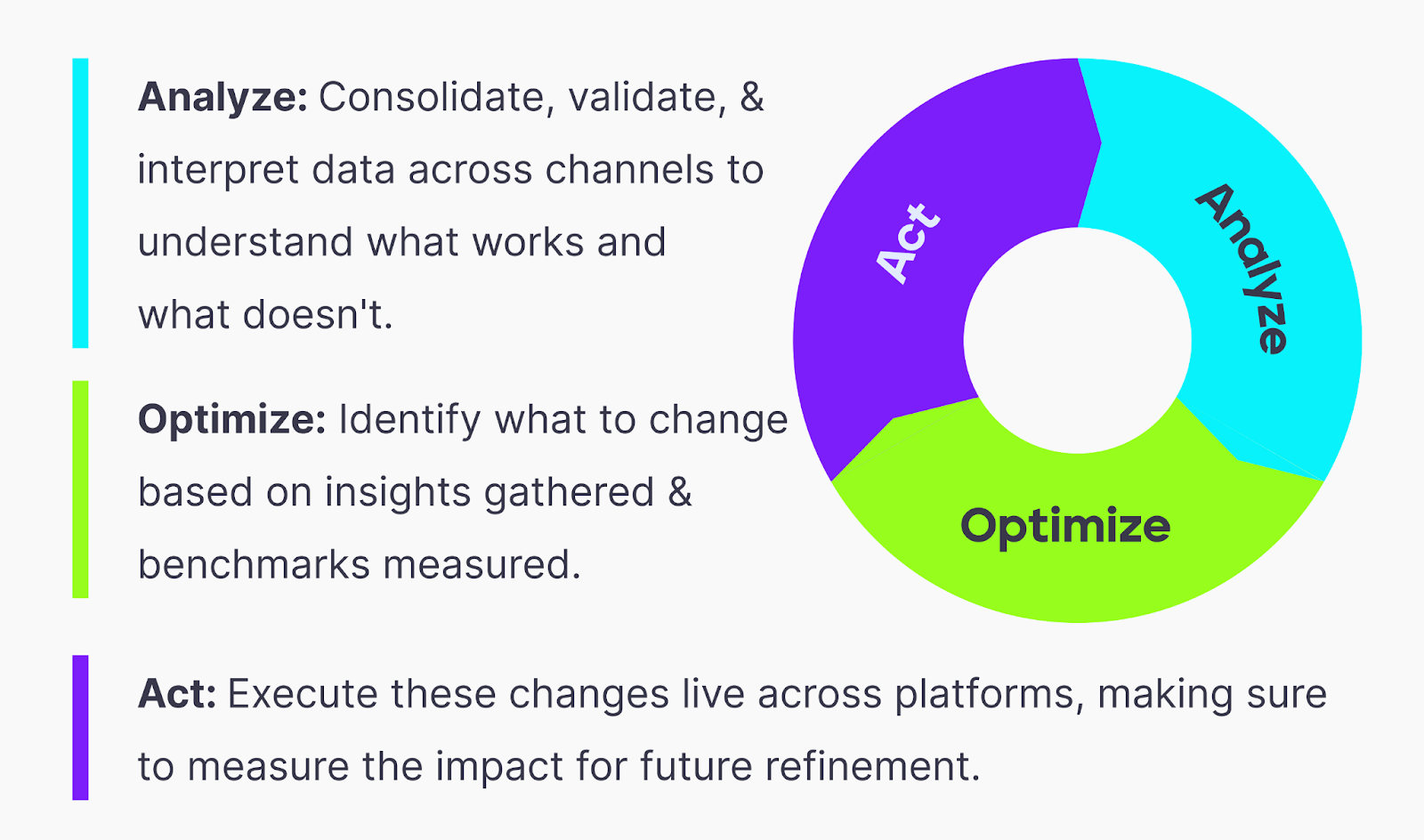
AI is beginning to transform pieces of that cycle, but rarely the whole system. Here’s what we found when we looked deeper.
On the surface, enterprise marketing teams feel confident in their ability to analyze marketing performance.
In fact, 83% of respondents say they’re satisfied with how quickly they can analyze marketing data and understand what’s working.
But once we dug into the operational reality behind that confidence, a different picture emerged. 57% say it’s difficult to get a timely, unified view of marketing performance across channels. And 78% say their performance data is fragmented across multiple platforms and spreadsheets.
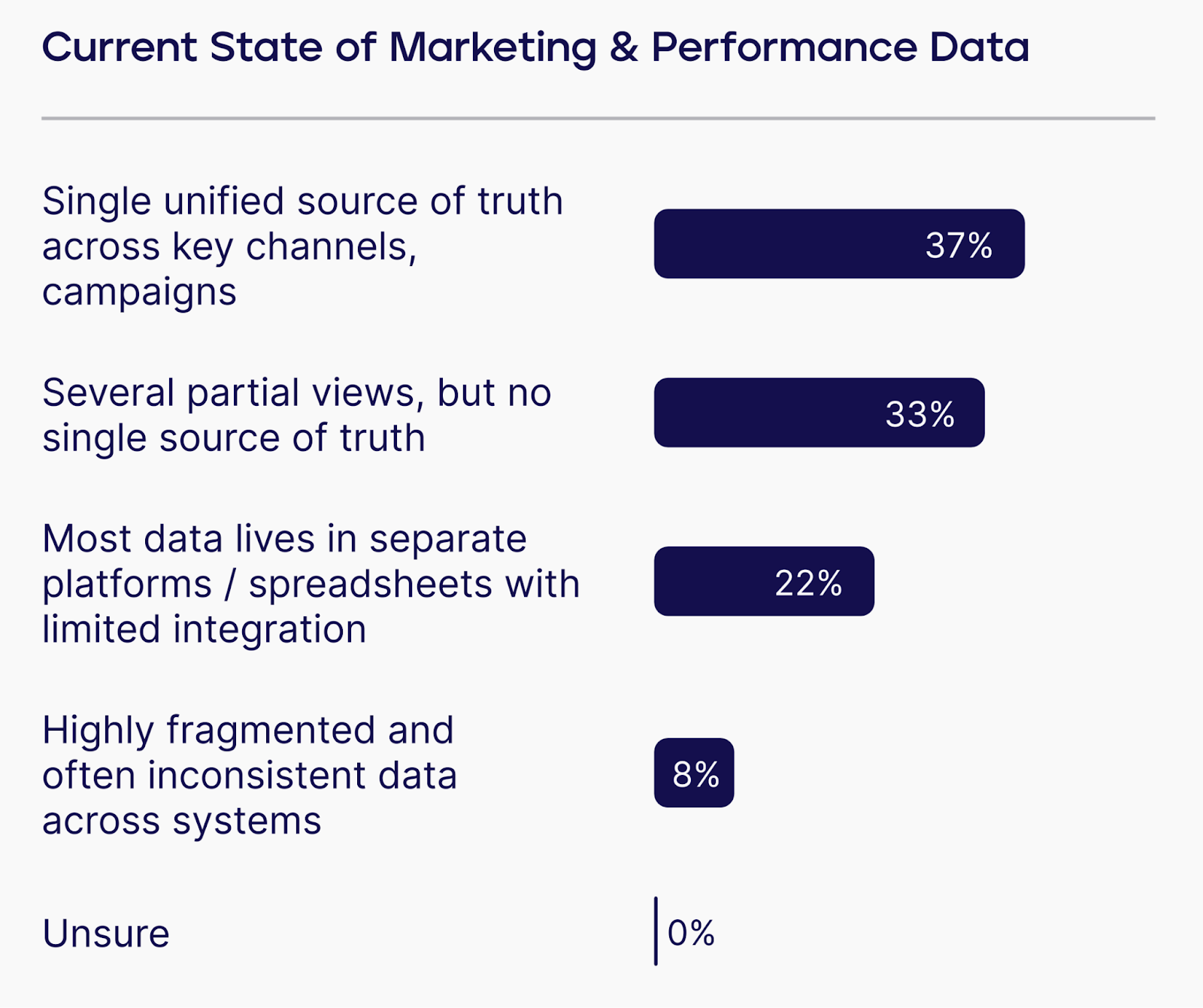
This tension shows up everywhere in the analysis phase of the Analyze–Optimize–Act cycle.
Teams often generate insights inside individual tools—analytics platforms, advertising dashboards, reporting systems—but those insights rarely live in the same place. Data must be consolidated, reconciled, and normalized before teams can trust it.
The result is a strange form of progress: AI is making analysis faster inside individual tools, but it hasn’t unified analysis across the marketing stack.
Teams can generate insights quickly. But turning those insights into coordinated action still requires significant manual work.
The full report breaks down exactly where fragmentation shows up in the analysis workflow, and what a unified intelligence layer looks like in practice.
Once teams identify what needs to change, the next phase begins: optimization.
This is where AI adoption is already widespread. 57% of marketing leaders say they use AI to identify optimization opportunities, such as underperforming campaigns or wasted spend.
But identifying an opportunity and acting on it are two very different things.
In many organizations, the optimization process still looks something like this:
Each step introduces friction.
Our research found that 89% of teams rely on at least three different tools to identify performance issues and implement campaign changes. Nearly half use five or more.
That complexity slows down the entire Analyze–Optimize–Act cycle.
Even more striking: only 8% of organizations are orchestrating multi-step AI workflows across multiple tools and teams. This gap isn’t primarily a skills problem. It’s an architecture problem. Most AI today lives inside individual platforms. Very little of it operates across them.
Without a centralized intelligence layer connecting systems, insights remain trapped in the tools that generated them.
The biggest maturity gap appears in the final stage of the cycle: execution.
Despite widespread AI adoption, many marketing teams are still operating with heavily manual reporting and execution processes.
72% of respondents say their reporting process is highly manual. On average, it takes five days to consolidate performance data into a report ready for stakeholders. By the time that report is finished, nearly 25% of the next reporting period has already passed.

That means many organizations are consistently making decisions on stale data. Execution lags behind opportunity.
Teams aren’t slow because they lack insight. They’re slow because turning insight into action still requires multiple manual steps.
But the data also shows what happens when organizations close this gap.Teams using centralized AI layers reduce reporting turnaround time by 20% and are significantly less likely to describe their reporting process as highly manual.
And organizations piloting AI agents for marketing—systems capable of acting across workflows rather than simply generating insight—are 15% less likely to report highly manual reporting processes.
The goal isn’t simply faster report creation, but increasing the speed of execution across the entire Analyze-Optimize-Act cycle.
A small but growing group of organizations has moved beyond embedded AI features toward a more coordinated approach.
Instead of relying on isolated AI capabilities inside individual tools, these teams are building centralized intelligence layers that connect data sources, insights, and execution workflows.
The result isn’t just faster marketing reporting software, but a step-change function in capacity and the operating model that powers these teams.
Marketing teams with this kind of orchestration are more likely to coordinate changes across tools, automate portions of the optimization workflow, and act on fresher data.
For example, teams using centralized AI models are 30% more likely to recommend specific changes to bids, budgets, and audiences.
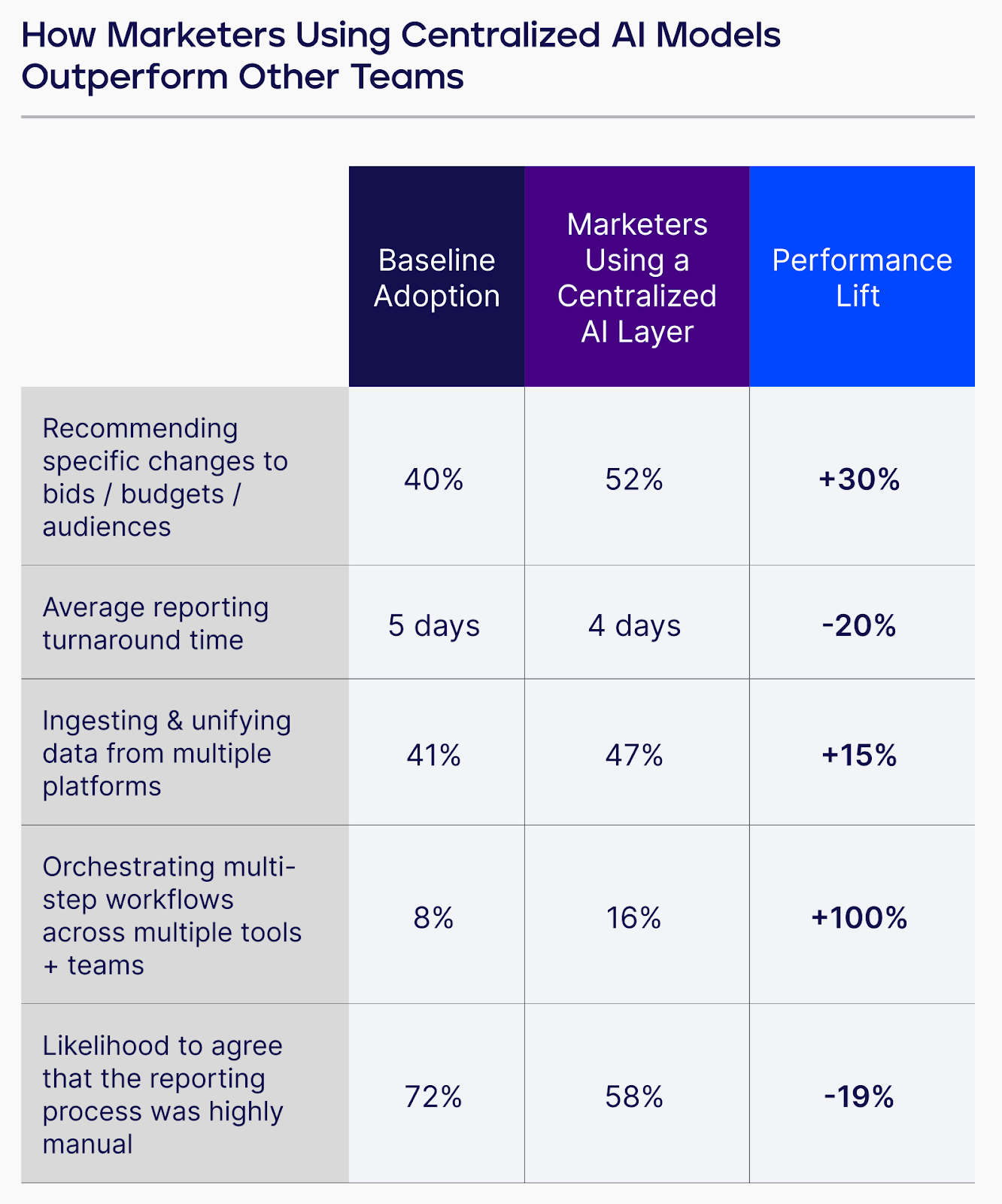
AI mature marketing teams have switched from analyzing performance, to operationalizing it.
This shift marks the transition from data-driven marketing to execution-driven marketing, where insights don’t just inform decisions, they trigger coordinated action across systems.
The full report explores how organizations are making this transition, and what it takes to move from fragmented AI adoption to operational AI maturity.
Marketing leaders can assess their current maturity by looking at where manual handoffs still occur across the Analyze–Optimize–Act cycle.
Ask:
The more work required to move information from one stage to the next, the larger the maturity gap.
AI adoption in marketing is no longer the question. AI maturity is.
Our research reveals a widening gap between teams experimenting with AI tools and those transforming the full Analyze–Optimize–Act cycle.
The Next Phase of Marketing Intelligence: 2026 Research Report includes:
Grab your copy of the full report to see the benchmarks and breakdowns, dig into the data on AI maturity, and find out what the highest-performing organizations are doing differently.
Download the The Next Phase of Marketing Intelligence: 2026 Research Report — Free