Team NinjaCat
Your dashboards tell you what happened. AI Agents explain why, and do what's next.
For years, the marketing data workflow has looked the same: pull data, build a dashboard, stare at charts, manually investigate anomalies, write up findings, and if you have time, actually do something about it. It's slow. It's labor-intensive. And at scale (hundreds of accounts, dozens of channels), it's unsustainable.
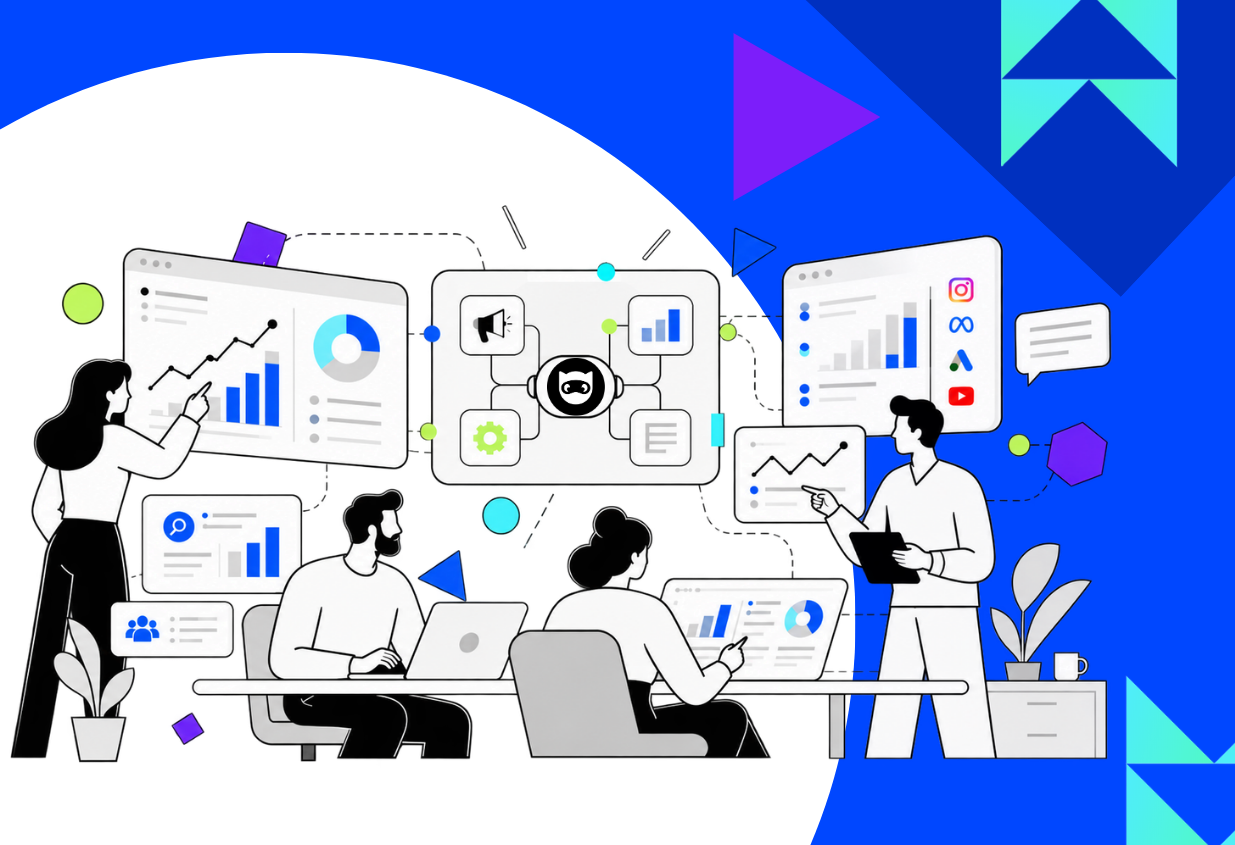
AI agents for marketing are changing that equation entirely. Not chatbots or copilots that rephrase your emails. We're talking about purpose-built, data-grounded autonomous workers that monitor performance, surface insights, take action, and report back, without waiting for you to ask.
Here's what that looks like in practice, and why the smartest agencies and marketing teams are already making the shift.
Let's clear up the confusion first. An AI agent is not ChatGPT with a marketing skin on it. It's not a chatbot bolted onto your dashboard.
An AI agent is a persistent, task-focused worker with:
Agents, and the orgs with high levels of AI maturity utilizing them, operate in a continuous cycle: Perceive (ingest live data from 150+ marketing channels) → Plan (map goal-oriented actions) → Act (execute changes, send alerts, generate reports) → Reflect (evaluate outcomes and adapt).
That's a fundamentally different animal than a chat window.
We hear this a lot: "Can't we just use ChatGPT/Claude/Gemini directly?"
You can — for ad hoc questions and brainstorming. But for real marketing operations at scale, direct LLM access breaks down fast:
The data problem. You're manually copy-pasting or uploading CSVs that are stale the moment you export them. There's no live connection to Google Ads, Meta, GA4, LinkedIn, TikTok, or any of the other platforms your campaigns run on.
The security problem. You're uploading client data to a public AI platform. Good luck explaining that to your enterprise clients during their next security audit.
The scale problem. Managing 500 accounts? You'd need 500 separate conversations — each starting from scratch with zero memory of your business context.
The action problem. Even when you get a great insight, you still have to tab over to another platform and implement it manually. The loop from insight to action stays broken.
The consistency problem. Every conversation is a blank slate. No persistent instructions, no defined workflows, no repeatable outputs.
Purpose-built AI agent platforms solve all of this by wrapping frontier AI models with live data connections, enterprise security, specialized tools, and the ability to close the loop from analysis to execution — automatically.
Every effective AI agent system is built on four layers. Understanding them helps you build for agentic marketing models that actually deliver value instead of impressive-looking demos that fall apart in production.
The AI models (Claude, GPT, Gemini) are the engines. They've become remarkably capable — and increasingly commoditized. The real differentiator isn't which model you use; it's what you build around it.
That said, model selection still matters:
The best platforms give you multi-model flexibility — pick the right engine for each task rather than being locked into a single provider.
Tools are what separate an AI agent from a very expensive autocomplete. They define what the agent can do:
That last one — Custom Actions — is where the magic happens. It's the bridge between "here's what the data says" and "here's what we did about it."
Smart prompting turns a good agent into a great one:
This is the layer that matters most — and the one most people underestimate.
AI agents are only as useful as the data they can access. Unified, governed, live marketing data from 150+ native connectors (plus custom connectors, AI connectors, and direct warehouse connections to Snowflake, BigQuery, and Databricks) is what separates production-grade agents from toys.
And the non-negotiables: data encrypted in transit and at rest, RBAC and MFA, full audit trails, and a hard guarantee that customer data is never used to train models.
These aren't theoretical use cases for AI. These are examples of NinjaCat AI agents running in production at marketing agencies and in-house teams today.
The problem: Wasted ad spend on irrelevant search terms is the most common and most expensive PPC issue — and manual review across hundreds of accounts is impossibly tedious.
The agent: Analyzes search term reports across all accounts, identifies high-spend/zero-conversion queries, quantifies potential savings, and pushes negative keyword lists directly to Google Ads. Agencies report cutting optimization time by up to 90%.
The problem: How does Account A's cost-per-lead compare to similar accounts? Without benchmarks, you're flying blind.
The agent: Compares Google Ads metrics (CTR, CPC, CPA, ROAS) across your entire portfolio, groups accounts by industry/budget tier, highlights statistical outliers, and flags underperformers with specific recommendations.
The problem: A campaign overspends its monthly budget in a weekend. Nobody catches it until Monday.
The agent: Monitors spend against targets daily (or more frequently), detects unusual spikes or pacing issues, and immediately fires Slack/Teams alerts with context — before the damage compounds.
The problem: Account managers spend 30–60 minutes before every client call pulling data, identifying trends, and building talking points.
The agent: Analyzes all campaign data for the client, identifies wins and concerns, calculates key metrics and trends, and generates a structured briefing document with data-backed talking points — in minutes, not hours.
The problem: High-performing search queries are buried in massive reports and never get promoted to dedicated keywords.
The agent: Analyzes search query data to identify queries driving conversions that aren't currently targeted as exact/phrase match keywords, quantifies the opportunity, and recommends campaign structure changes.
The problem: Budget is allocated by channel based on gut feel or last year's plan, not actual performance data.
The agent: Analyzes performance and spend across Google Ads, Meta, LinkedIn, TikTok, and other channels, runs regression and decay models, and outputs three recommended plans: ROAS-optimized, balanced, and diversified — with projected outcomes for each.
The problem: Inconsistent naming conventions across hundreds of campaigns make reporting unreliable and filtering a nightmare.
The agent: Audits every campaign, ad group, and ad name against your defined taxonomy rules, flags violations, suggests corrections, and generates a cleanup priority list.
The problem: Great results happen, but nobody tells the client in a timely, personalized way.
The agent: Identifies statistically significant wins (record conversion weeks, CPA improvements, ROAS milestones), generates personalized client emails with specific data points, and — with Custom Actions — can send them directly or queue them for review.
The problem: You're ranking on page 2 for dozens of high-value keywords but don't have a systematic way to identify and prioritize them.
The agent: Analyzes keyword ranking data, identifies "striking distance" keywords (positions 5–20), scrapes top-ranking competitor pages, and proposes content briefs with structure, target word count, and key topics to cover.
The problem: Creating custom proposals and case studies is high-value work that takes hours of data gathering and writing.
The agent: Pulls relevant performance data, structures it into compelling narratives with specific metrics, and generates draft proposals or case studies ready for human review and brand polish.
For a real example of how AI Agents in NinjaCat are changing the game, watch this 4As partnership webinar recast, "What Great Client Reporting Looks Like in 2026" with an actual case study with an actual client. We're also in the process of adding over +300 additional marketing AI Agent starter packs, so keep an eye on our AI Agent Showcase for updates.
The most powerful pattern isn't any single agent — it's chaining them together to close the loop from detection to resolution:
Detect → An anomaly detection agent spots a 40% spike in CPC across three accounts overnight.
Alert → It sends a structured Slack message to the paid media team with affected accounts, metrics, and severity.
Diagnose → A second agent analyzes the root cause — a competitor entered the auction on your top 5 keywords.
Recommend → It generates three response options: adjust bids, shift budget to lower-competition campaigns, or expand to alternative keywords.
Act → With approval, the agent pushes bid adjustments and budget reallocations to Google Ads.
Report → 48 hours later, a reporting agent measures the impact and generates a summary.
That's not science fiction. That's a workflow you can build today with chained agents, Custom Actions, and scheduled triggers.
Forward-thinking agencies are already productizing AI agents as a premium service. Build vertical-specific agents, package automated monitoring and optimization, and create a new revenue stream powered by continuous insight delivery.
Dashboards answered the question: "What happened?"
AI agents answer: "Why did it happen, what should we do about it, and — with your permission — it's already done."
The shift from passive data visualization to active, autonomous intelligence isn't coming. It's here.
NinjaCat's AI Agent platform gives marketing teams access to frontier AI models from Anthropic, OpenAI, and Google — connected to 150+ live data sources with enterprise-grade security, specialized marketing tools, and Custom Actions that close the loop from insight to execution. Book a demo today.