Team NinjaCat
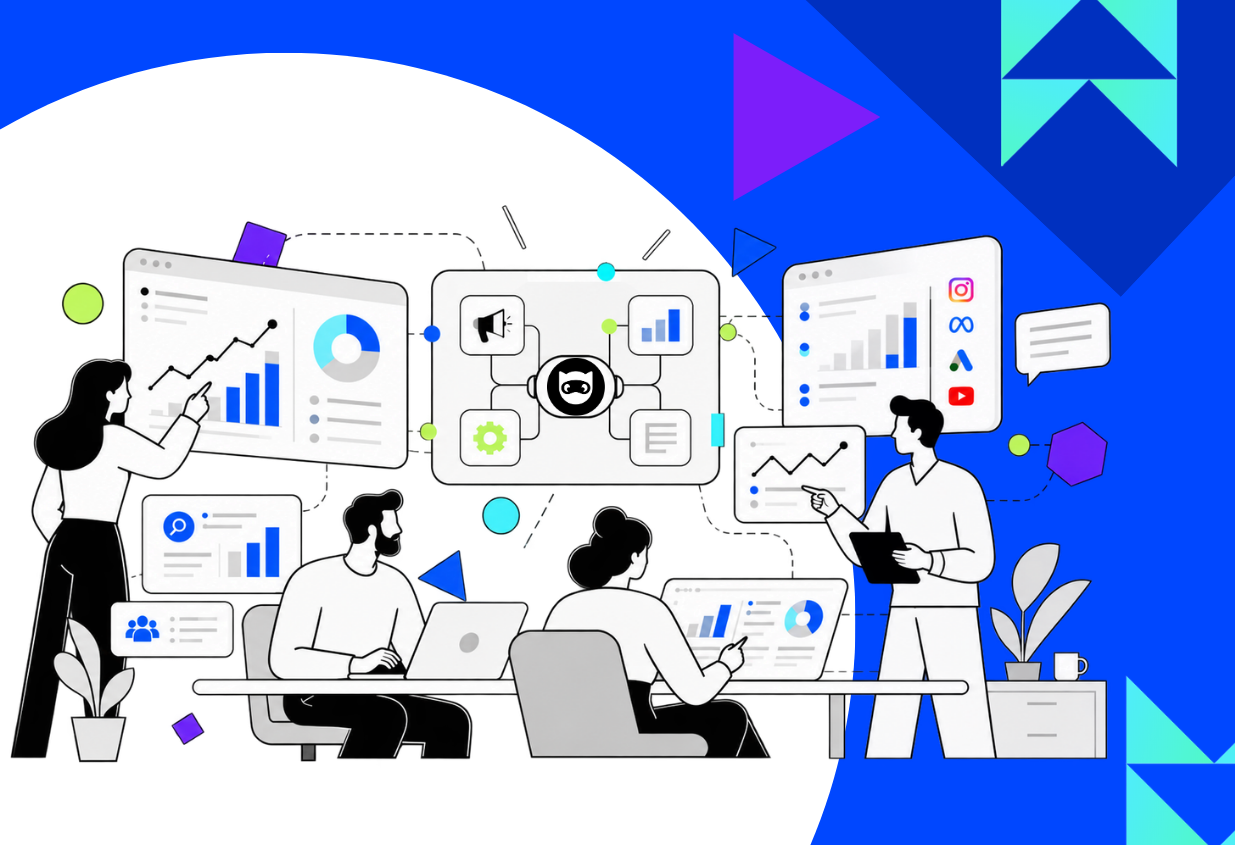
Marketing teams are being asked to put AI to work across an increasingly complicated operation: multiple channels, disconnected data sources, and clients with different priorities. As teams adopt AI agents for reporting, campaign monitoring, and analysis, they also need a way to manage how those agents work together.
That’s where an Agent Operating System, or AgentOS, enters the conversation.
What is an Agent Operating System? An Agent Operating System (AgentOS) is the environment where AI agents for marketing run on governed, connected data, with the account context, permissions, approvals, and spending limits needed to put an agent on every client account.
AI can flag an underperforming campaign, summarize the data, or recommend a budget adjustment in seconds. A marketer still has to verify the numbers, investigate the cause, check the client’s priorities, decide what to do, and communicate the recommendation. Multiply those steps across dozens of platforms and hundreds of client accounts, and the operational burden of scaling enterprise marketing AI becomes clear.
NinjaCat’s AI maturity research, a survey of 532 marketing leaders, shows the tension. While 91% say AI has streamlined their workflows, 72% still describe their reporting processes as highly manual. [Confirm the 91% against the source report before publishing; earlier PR guidance cited 88%.]
AI is making individual tasks faster, but people are still doing most of the work of connecting those tasks into a reliable process. That raises the question this guide is built around:
If your team hands more work to AI agents, how much work will people still have to do to make the output trustworthy enough to put in front of a client?
An Agent Operating System, or AgentOS, is a software environment for running and coordinating AI agents. It connects agents to data and tools, maintains the business context they need, and manages how work moves between agents, teams, and the larger organizations they work within.
Think of an individual AI agent as a marketing specialist with a specific assignment. One monitors campaign pacing. Another investigates performance anomalies. A third prepares recommendations based on what the first two discover.
An AgentOS provides the operating environment those specialists need to work together consistently.
The terminology can get confusing because the AI industry uses several overlapping concepts:
The name is a useful metaphor. A computer’s operating system doesn’t do your work. It manages the resources every application depends on, so the applications can run safely side by side. An AgentOS does the same for AI agents:
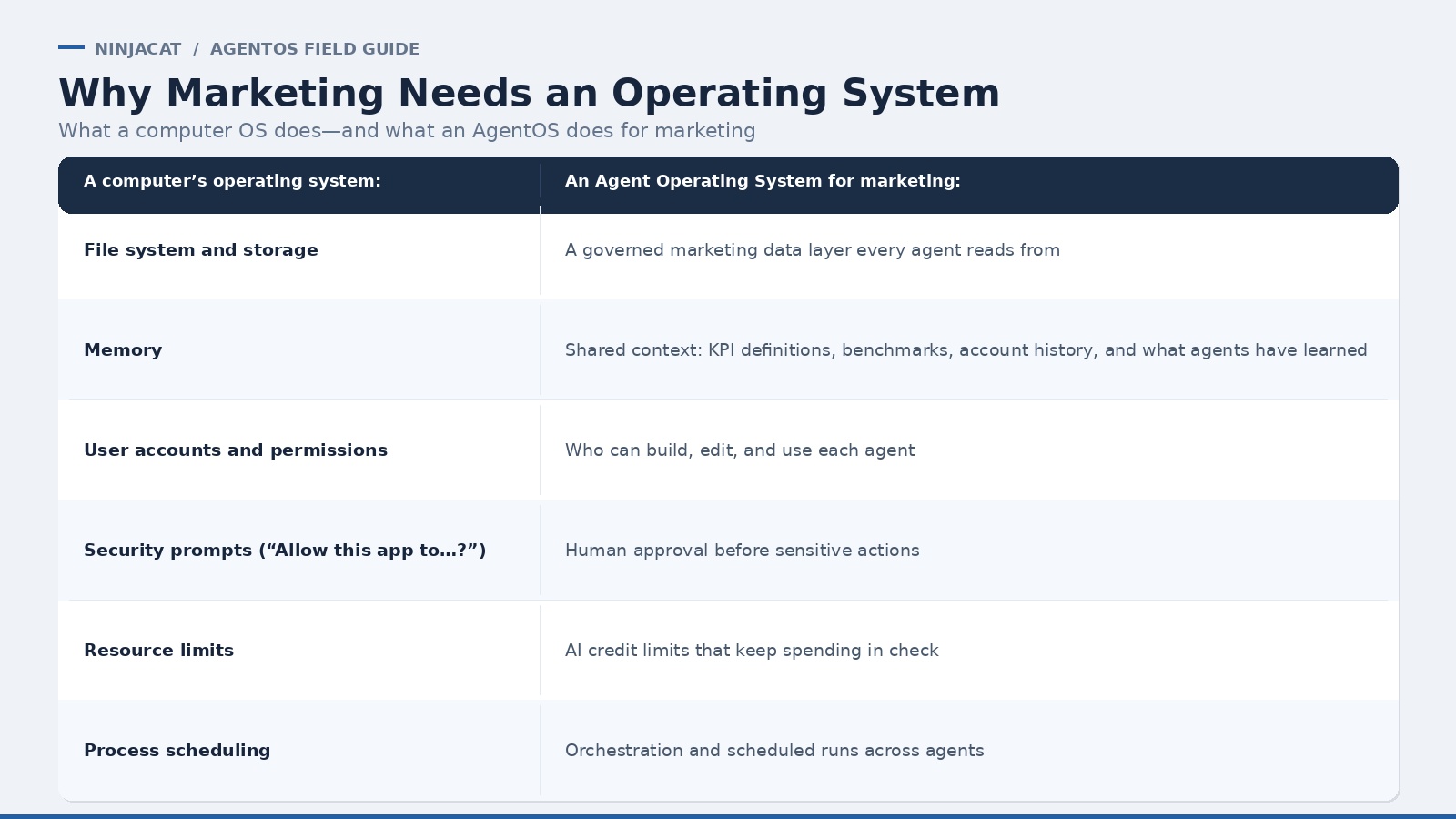
Without an operating system, every application would have to manage its own storage, security, and resources, and nothing would work together. Marketing teams adopting AI one tool at a time are running into the same problem.
For marketing teams, an AgentOS typically brings five capabilities together:
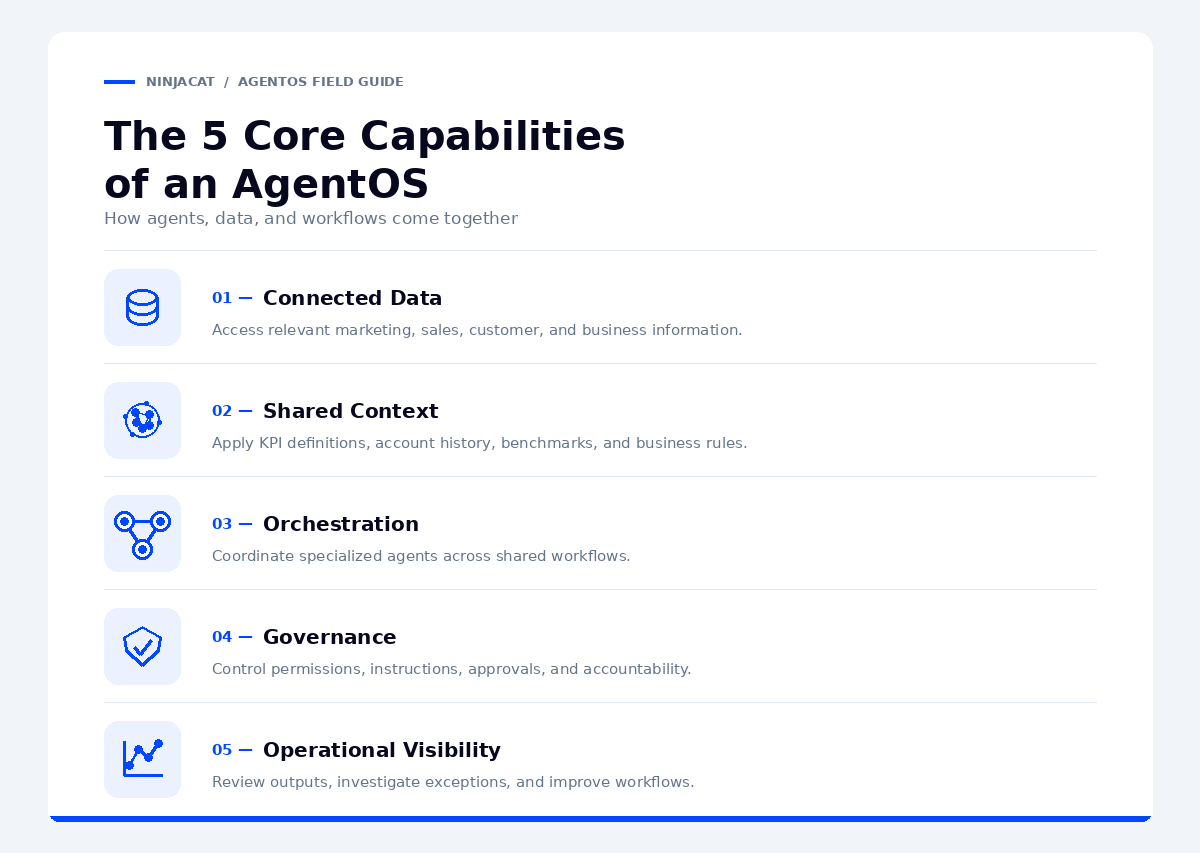
NinjaCat approaches AgentOS as an operating environment built around marketing data, specialized AI agents, and the workflows agencies and brands already manage.
Within NinjaCat, AgentOS brings agents together on a governed marketing data foundation, with client-specific memory, configurable permissions, human approval controls, and AI usage limits.
Rather than requiring teams to assemble every data connection, analytical process, and agent workflow independently, NinjaCat provides a common platform for building AI-powered services around existing business information and expertise.
The exact capabilities of an AgentOS vary by vendor. Marketing leaders should evaluate what a platform can demonstrate in a real workflow, particularly around permissions, approvals, monitoring, and ongoing maintenance.
Here's an ordinary Tuesday at a marketing agency.
A campaign's conversion rate drops 18% week over week.
Someone notices the decline. Someone checks whether tracking is working. Someone investigates inventory, landing-page performance, or changes in media costs. Someone drafts a recommendation, finds the right approver, and explains the proposed response to the client.
The example is illustrative, although the sequence will be familiar to anyone managing campaign performance across multiple accounts.
A typical investigation involves seven steps:
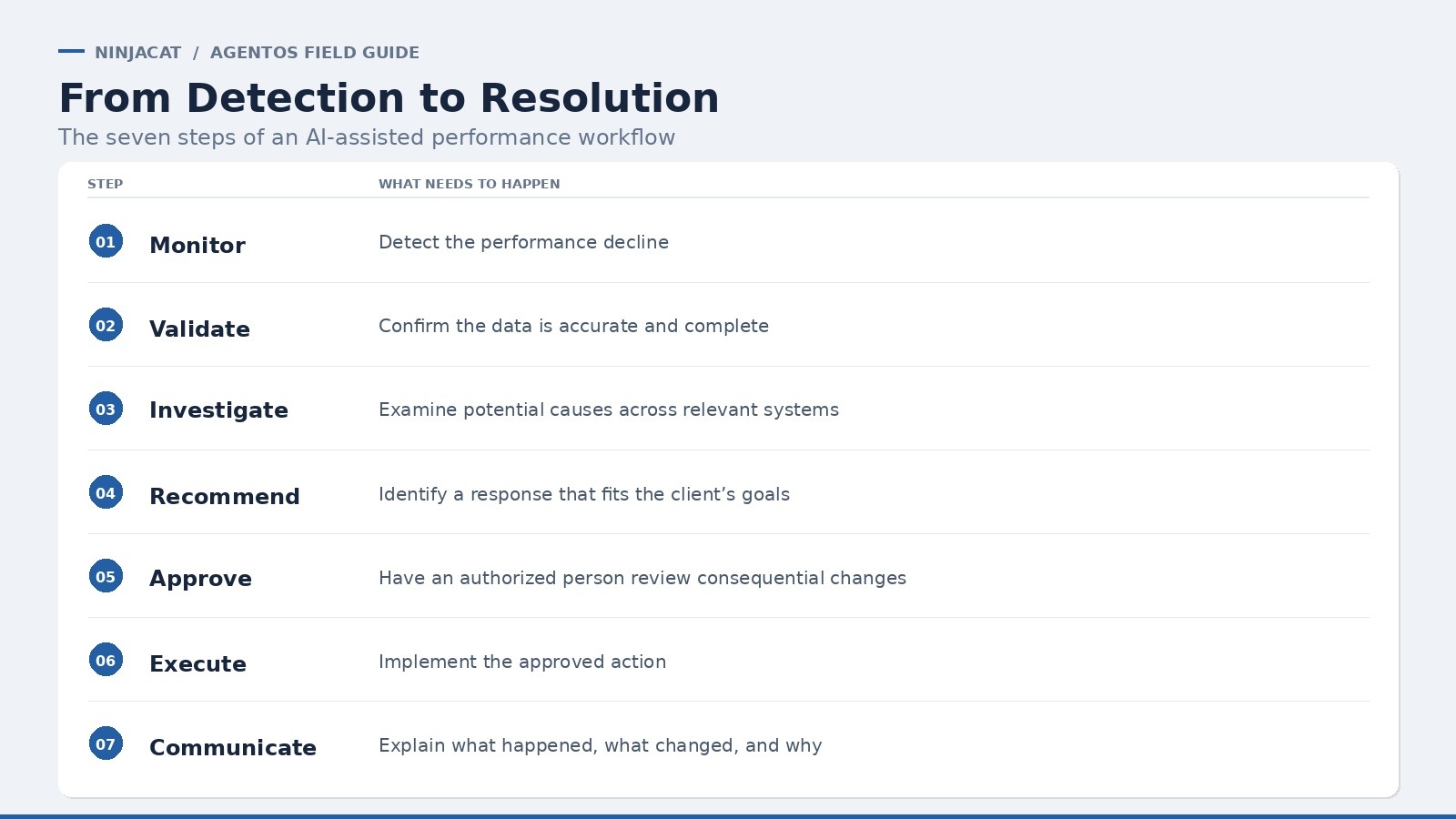
A standalone AI tool might summarize the conversion decline or suggest possible causes. The remaining steps still require coordination across people, systems, and business processes.
Without connected workflows, people become the glue holding everything together. They move information between platforms, repeat instructions, check assumptions, and make sure the right person knows what happened.
Connected data gives a team access to information. Applying that intelligence consistently across a growing client base requires repeatable processes for evaluating performance, identifying opportunities, and deciding what deserves attention.
When every analysis depends on someone initiating it, the workflow still relies on manual coordination.
NinjaCat's research reinforces the broader operational problem. In its survey of 532 marketing leaders, 77% reported spending three to ten hours preparing data for each report.
Automating individual tasks can deliver meaningful productivity gains. Coordinating the complete workflow is a larger opportunity.
An AgentOS can help reduce manual handoffs by connecting repeatable steps, maintaining business context, and allowing agents to contribute to shared processes.
Orchestration introduces responsibilities of its own, including workflow setup, data maintenance, exception handling, and quality review. The value of an AgentOS depends on how much coordination work it removes relative to the effort required to operate it.
Daye North America offers one of the clearest examples of agent orchestration in practice.
Sandra Oono-Thomas, Vice President of Enterprise Growth & Digital Commerce at Daye North America, manages an operation spanning national retail partners, location-level inventory, and omnichannel demand.
Before implementing NinjaCat's AI agents, Sandra's team relied on a manually populated Excel workbook with 15 tabs. Point-of-sale figures, inventory information, and geographic performance data required significant effort to analyze together.
The team had access to the information. Building a complete picture across more than a thousand retail locations was the challenge.
Daye's first AI agent brought together point-of-sale data, geographic information, and inventory levels into a unified view.
"For the first time, we could actually see what's going on."
The unified view helped Sandra's team understand what was selling, where products were moving, and which retail locations had inventory available.
Connecting business data also opened the door to more sophisticated analysis.
Lawnmower demand depends on more than advertising performance. Precipitation, drought conditions, regional yard sizes, and local weather patterns can all influence purchasing behavior.
Daye developed an agent that analyzes weather conditions by location, helping the team anticipate demand and inform regional advertising decisions.
A media strategy informed by weather and inventory conditions can respond to opportunities that a conventional campaign dashboard might miss.
Daye's implementation progressed beyond a single agent analyzing multiple datasets.
Sandra's team began building a network of specialized agents, with different team members developing agents for particular analytical functions.
Sandra uses a primary digital strategy agent. Her senior e-commerce manager works with agents focused on point-of-sale performance, geography, and other analytical functions.
The specialized agents contribute information to broader workflows inside NinjaCat.
Sandra describes how the team coordinates the agents:
"My one agent is the digital strategist and her sub-agents are all of his. So they feed into that — and he does the same thing with his, where he'll have a POS one, but he'll have a geo agent that feeds into his main agent. So we are creating this network."
Sandra's description makes agent orchestration tangible.
Different agents handle specialized work while contributing their findings to broader business analysis. Team members can develop expertise in different areas while benefiting from the intelligence produced by their colleagues.
The connected architecture also extends the value of the e-commerce team's work. Daye has shared agent-generated outputs with internal sales teams, product teams, and retail partners.
According to NinjaCat's Daye North America case study, its inventory intelligence implementation generated more than $1.5 million in reported sales impact, measured mid-season.
Daye's implementation demonstrates what an operating environment can make possible when specialized agents work from connected business information.
A sales analysis agent can contribute findings that inform media strategy. Inventory intelligence can influence decisions about where advertising dollars should go. Product feedback can support teams outside the marketing department.
For agencies, the same principle applies across client accounts.
An automotive agency may need to connect media performance with dealership inventory. A healthcare agency may need to combine lead generation with appointment outcomes. A retail agency may need to consider promotions, stock availability, and regional demand.
The specific data changes from client to client. Every implementation requires enough business context to interpret performance accurately and coordinate a useful response.
Connected data can help explain what's happening in a business. Deciding what good performance looks like, which problems deserve attention, and what actions make sense requires domain expertise.
For years, much of that expertise has existed in the minds of experienced analysts, account managers, and strategists.
Experienced marketers know which metrics matter for a particular client. They recognize suspicious patterns. They understand why a conversion rate that looks healthy in one industry could signal a problem in another.
An AgentOS creates a way to translate some of that knowledge into repeatable instructions, benchmarks, and workflows.
Our case study with Dental Revenue using AI agents to transform marketing, provides a practical example.
For 15 years, the agency has specialized in marketing for cosmetic and restorative dentists. Its proprietary data integrations connect marketing activity with practice management systems, allowing the team to trace advertising investments to patient revenue.
Dental Revenue brought its data infrastructure and industry expertise to NinjaCat, then began developing agents around work its team had previously handled manually.
One of the agency's most significant implementations is Carl, its Call Analysis and Reporting Liaison.
Every Dental Revenue client uses tracked phone numbers, generating hundreds of recorded calls each month. Reviewing those calls manually is time-consuming, especially when the agency needs to identify patterns across multiple practices.
Carl processes the recordings, filters out irrelevant calls, and evaluates patient-facing conversations using Dental Revenue's methodology.
The agent grades criteria such as greeting quality, objection handling, and closing techniques. Carl also produces staff-level performance breakdowns, with call recordings and coaching notes that practice managers can use to improve patient interactions.
Dental Revenue developed the evaluation criteria based on years of experience helping dental practices convert marketing leads into appointments.
Brian Burns, founder and president of Dental Revenue, describes the combination behind the agency's progress:
"It's a combination of our data, the NinjaCat platform, and AI weaving together."
Dental Revenue supplies the industry knowledge, proprietary integrations, and evaluation methodology. NinjaCat provides the platform for connecting data and building AI-powered workflows around that expertise.
Carl applies the agency's standards across a volume of calls that would be difficult to review manually.
Dental Revenue's experience illustrates an important advantage for specialized agencies: proprietary knowledge can become a repeatable service delivered across more clients.
The agency is also developing a cross-client benchmarking system that aims to identify successful patterns using revenue per click and apply those findings to recommendations for other clients.
Sean Stansell, who leads technical operations at Dental Revenue, describes the direction:
"Everything we've been doing up to this point has been reporting what has happened. We're getting into preventative care and actually improving things."
VML’s AI agent case study with NinjaCat, demonstrates how the same principle applies to performance benchmarks.
The agency developed specialized agents for creative monitoring and commerce analysis, including Meta Creative Carol and Commerce Funnel Felicity.
Carol evaluates placement-level creative performance against established metrics and benchmarks, helping the team identify potential creative fatigue.
Felicity analyzes commerce funnel performance, combining behavioral information with customer feedback to identify potential friction in the shopping experience.
VML's agents are designed around specific analytical questions and performance standards.
The value comes from combining automated analysis with the agency's understanding of which metrics matter, what constitutes a meaningful change, and which findings deserve attention.
For marketing leaders, the implementation challenge becomes more specific.
Which KPIs define success? What benchmarks are relevant? Which data sources are trustworthy? What should trigger an escalation? What evidence is required before recommending a change?
The answers become part of the agent's operating instructions.
Agencies with well-defined methodologies have a foundation for translating their expertise into AI-supported work. Maintaining those instructions is an ongoing responsibility as client priorities, market conditions, and business requirements evolve.
The importance of human expertise connects to a recurring theme from the NinjaCat podcast, What Gets Measured.
In his conversation about the problem with data-driven marketing, Robert Van Ossenbruggen, a Marketing Strategist, Analyst, and Partner at The Commercial Works, an evidence-based commercial advisory firm based in the Netherlands, explores the importance of questioning, contextualizing, and synthesizing data to support better decisions.
"“We try to jump from information to decisions, so we skip the understanding layer—and that is just impossible," says Robert. "There is this journey between data and decisions that takes a lot of effort—debating, synthesizing, contextualizing, and hypothesizing. … But that is actually where the value is created: in the debating, in the hypothesizing, in the struggle over where the friction is and what the trade-offs are.”
Robert's perspective becomes especially relevant when AI can produce analytical summaries almost instantly.
A plausible explanation is easy to generate. A useful explanation must account for the business context, the quality of the evidence, and the decisions the team is trying to make.
AI agents can help surface patterns and prepare recommendations. Marketing professionals remain responsible for defining the standards that make those recommendations useful.
Monitoring, recommending, preparing an action, and executing it represent four different levels of delegation.
Marketing teams should evaluate each level separately.
Consider the difference between detecting a budget pacing problem and automatically reallocating thousands of dollars in client spend.
Both tasks can involve AI agents. Their consequences are very different.
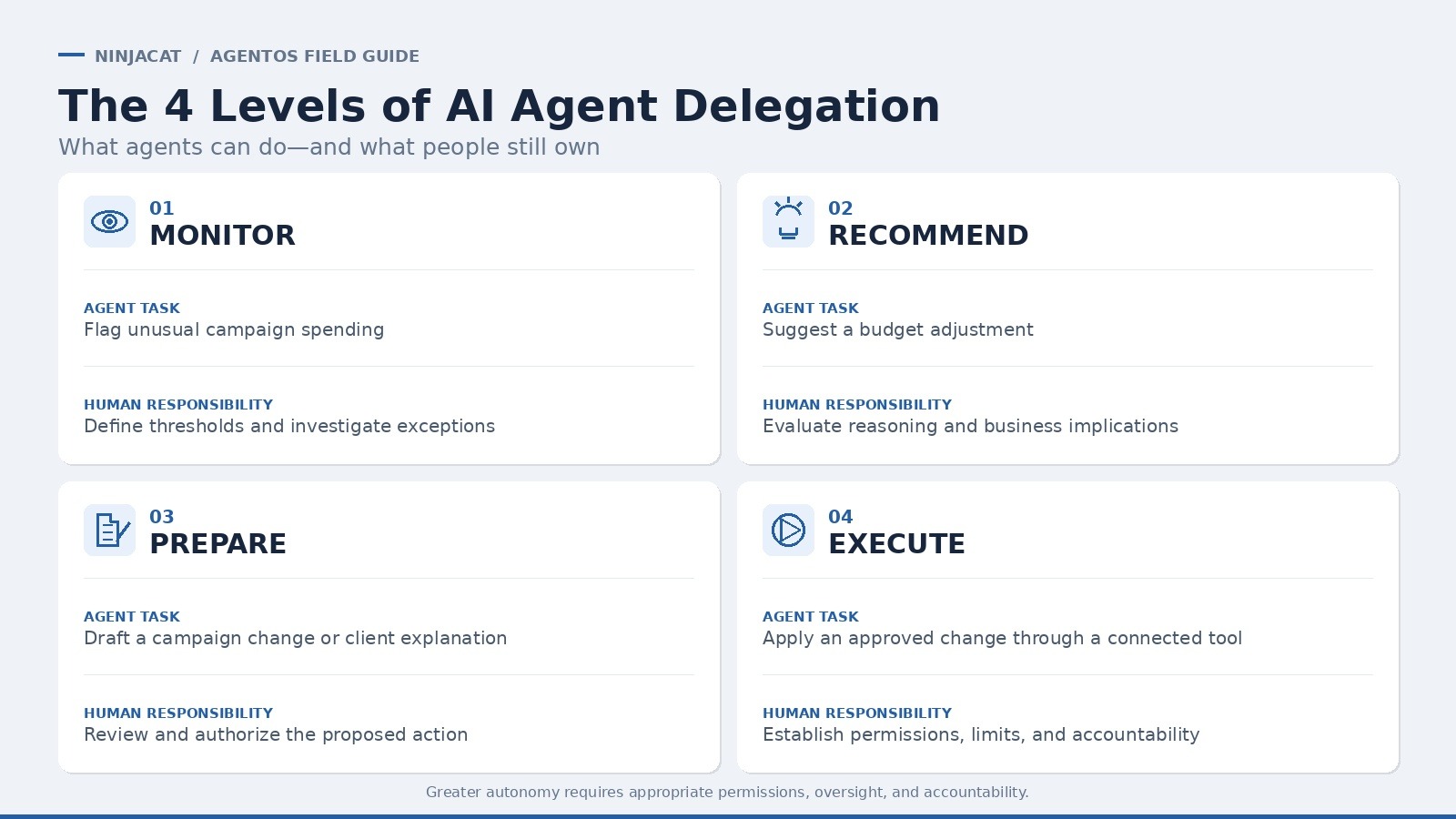
Routine monitoring may require relatively little intervention once validated. A major budget change, sensitive client communication, or modification to a production system may warrant explicit approval.
The appropriate level of delegation depends on the risk of the task, the quality of the underlying data, and the team's confidence in the workflow.
Marketing teams have seen the problems caused by fragmented technology before.
For years, agencies and multi-location brands struggled with reporting sprawl. Every location, channel, and agency partner had its own spreadsheets, dashboards, logins, and version of the truth.
NinjaCat helped bring those reporting operations under one roof, connecting data sources and establishing consistent reporting standards across accounts and stakeholders.
AI agents introduce a similar challenge.
An agency might have one agent monitoring campaign pacing, another investigating performance anomalies, and a third preparing client reports. As the number of agents grows, managing data access, permissions, approvals, and operating costs becomes increasingly complex.
NinjaCat's AgentOS brings agents into a shared operating environment with governance controls designed for multi-account marketing operations.
Here's what governance looks like inside NinjaCat's AgentOS:
Client data and memory stay separate. Agents can retain context from previous conversations, helping teams avoid repeatedly supplying the same account information. Agent memory is isolated by client organization at the database level, keeping information learned about one client separate from other organizations.
People control which actions require approval. Agent builders can designate specific tools and actions that require human authorization. When an agent reaches a protected action, execution pauses until someone explicitly selects Allow or Deny. Teams can automate routine steps while retaining approval over more consequential activities.
AI usage has defined spending limits. Organizations can configure daily AI credit limits across the organization, for all users or agents, or for individual users and agents. Agent runs stop when the applicable limit is reached, helping teams manage AI operating costs as adoption grows.
Access is managed agent by agent. Agents can be configured as team-public, chat-only, or private, with editing and chat permissions granted to specific users. Agencies can control who builds, modifies, and interacts with individual agents.
Agent activity can be reviewed. NinjaCat records agent conversations, tool usage, and generated outputs. Teams can revisit conversations and scheduled runs to investigate what happened. NinjaCat is expanding these views to provide deeper visibility into agent decision-making.
For agency operations leaders, the governance model addresses a practical concern: how do you scale AI across dozens or hundreds of client accounts without losing control over who can access information, authorize actions, or consume resources?
Shared infrastructure provides a foundation for scaling agents while preserving client boundaries and operational oversight.
The real test of AgentOS governance is whether teams can delegate more work while maintaining clear control over the data, decisions, and costs involved.
Marketing leaders should still evaluate how a platform handles incomplete data, conflicting agent recommendations, failed actions, and recovery. Access controls and activity records provide important safeguards, while reliable exception handling remains essential to running complete workflows.
The challenge of AI integration extends beyond technology.
In her What Gets Measured episode The Judgment Gap Between MarTech & Talent, Jacey Berg, the SVP of Strategy and Planning at Mediabridge Advertising, a women-owned, full-service advertising agency, raises an important issue for AI-enabled organizations: the people reviewing increasingly sophisticated outputs need the skills to evaluate them.
"The output of generative AI can look really competent-looking and real good,” admits Jacey. “For people who don't know what they're looking at... will the person evaluating it even understand what 'good' or 'working' looks like? We first have to value our own expertise... don't assume it's right, don't assume it's smarter than you because it's a computer, and push back on generative AI the way you would with a peer or a junior employee."
As agents take over repetitive analytical work, teams need opportunities to develop and maintain their own judgment.
Marketing organizations should teach people how to question recommendations, recognize weak evidence, understand business context, and know when to intervene.
The people responsible for an AI-supported workflow still need to understand what good work looks like.
An agency can save hours of manual reporting, automate performance monitoring, and accelerate analysis. Clients experience the benefit when those efficiencies produce clearer explanations, earlier warnings, and more useful recommendations.
Consider a client who previously received a monthly report explaining that a campaign underperformed three weeks earlier.
With a well-designed agent workflow, the agency may be able to identify the issue sooner, investigate potential causes, and prepare a recommendation while there is still time to respond.
Earlier intervention gives the client a more proactive agency relationship.
A recommendation needs to reach the person who can use it.
For some clients, a dashboard showing which creative assets need attention may be most useful. Others may need a presentation explaining an emerging trend or a data application that lets stakeholders explore a specific business question.
The delivery format should fit the decision.
In Building Your Alpha with AI Agents, we discuss how AI-powered services can connect to agency differentiation.
When many organizations have access to similar AI models, competitive advantage increasingly depends on how teams combine their data, expertise, workflows, and client experience. An agency that understands its clients deeply can use AI to make that understanding more accessible and consistent.
The operating environment supports the work behind the scenes. Clients experience the quality of the recommendation, the usefulness of the deliverable, and the agency's ability to respond.
Skip the broad platform demonstration and start with a recurring problem your team already understands.
Campaign pacing checks, monthly performance analysis, lead quality reviews, and client reporting are all potential starting points.
A useful evaluation should follow the workflow from the first signal through review and delivery.
Document how the workflow operates today.
How long does it take? How many people participate? Which tools are involved? Where do errors, delays, and handoffs occur?
Include the time spent reviewing and correcting work, rather than measuring only the initial task.
Identify the relevant data sources, KPI definitions, account context, benchmarks, and business rules.
Determine who owns those definitions and how they will be updated.
Workflows that depend on incomplete or inconsistent information require additional safeguards, regardless of how capable the AI model appears.
Decide what the agent can monitor, recommend, prepare, or execute.
Specify which decisions require approval, what should trigger an exception, and who is responsible for reviewing the result.
Test the process on a representative set of accounts or business scenarios.
Include normal cases and situations involving missing data, unusual performance, conflicting information, or recommendations that fail review.
The evaluation should determine whether the person responsible for the outcome can approve the agent's work faster than they could have completed the work manually.
A successful agent run does not automatically equal a successful business outcome.
Measure the work that passes review and can actually be used.
Useful metrics include:
A workflow that runs quickly but requires extensive correction may provide limited operational value.
Conversely, an agent that reliably prepares high-quality recommendations for human approval may create substantial value without executing changes autonomously.
The strongest evaluation measures how much useful work the system completes while preserving the team's standards.
No. An AI agent performs a defined task using AI models, data, instructions, and tools. An AgentOS provides a broader environment for running, coordinating, and managing agents within business workflows.
Traditional marketing automation typically relies on predefined rules and triggers. AI agents can interpret information, investigate conditions, and generate context-sensitive recommendations. An AgentOS coordinates these capabilities across connected workflows, with boundaries and oversight appropriate to each task.
Not necessarily. Agencies can often build agent workflows around existing data infrastructure and reporting processes. The underlying data must be sufficiently connected, reliable, and governed for agents to use it appropriately.
An AgentOS can automate portions of the work marketing professionals perform, particularly repetitive monitoring, data preparation, and analysis. People remain responsible for defining business objectives, setting standards, reviewing consequential decisions, and managing client relationships.
Yes, when the platform and workflow are designed to support multi-account operations. Teams should evaluate how account-specific context, permissions, instructions, and data boundaries are maintained.
Ask for a demonstration of a complete workflow, including how agents access data, share context, handle exceptions, obtain approvals, and deliver outputs.
Three questions deserve especially clear answers:
Marketing teams have spent years building processes around dashboards, spreadsheets, reports, and disconnected platforms.
AI agents create an opportunity to rethink how marketing work gets done.
An Agent Operating System provides an environment for coordinating agents across the data, tools, and business workflows that support everyday marketing decisions.
The strongest implementations will reflect the expertise of the teams using them. They will make established methodologies repeatable, surface opportunities earlier, and help people focus their attention where judgment matters most.
Marketing leaders evaluating AgentOS should return to the question that started the conversation:
How much work will our team still have to do to make the agent's output trustworthy enough to use?
Choose a workflow your team knows well. Follow the process from initial analysis through review, decision-making, and delivery.
Measure the time saved, the quality of the result, and the effort required to keep the workflow running.
The value of an AgentOS becomes visible when marketing teams can consistently turn their expertise into useful work across more accounts, campaigns, and clients.
Book a NinjaCat demo to explore how connected marketing data, specialized AI agents, and coordinated workflows can support your team's operations.