Jake Sanders
Content Strategist
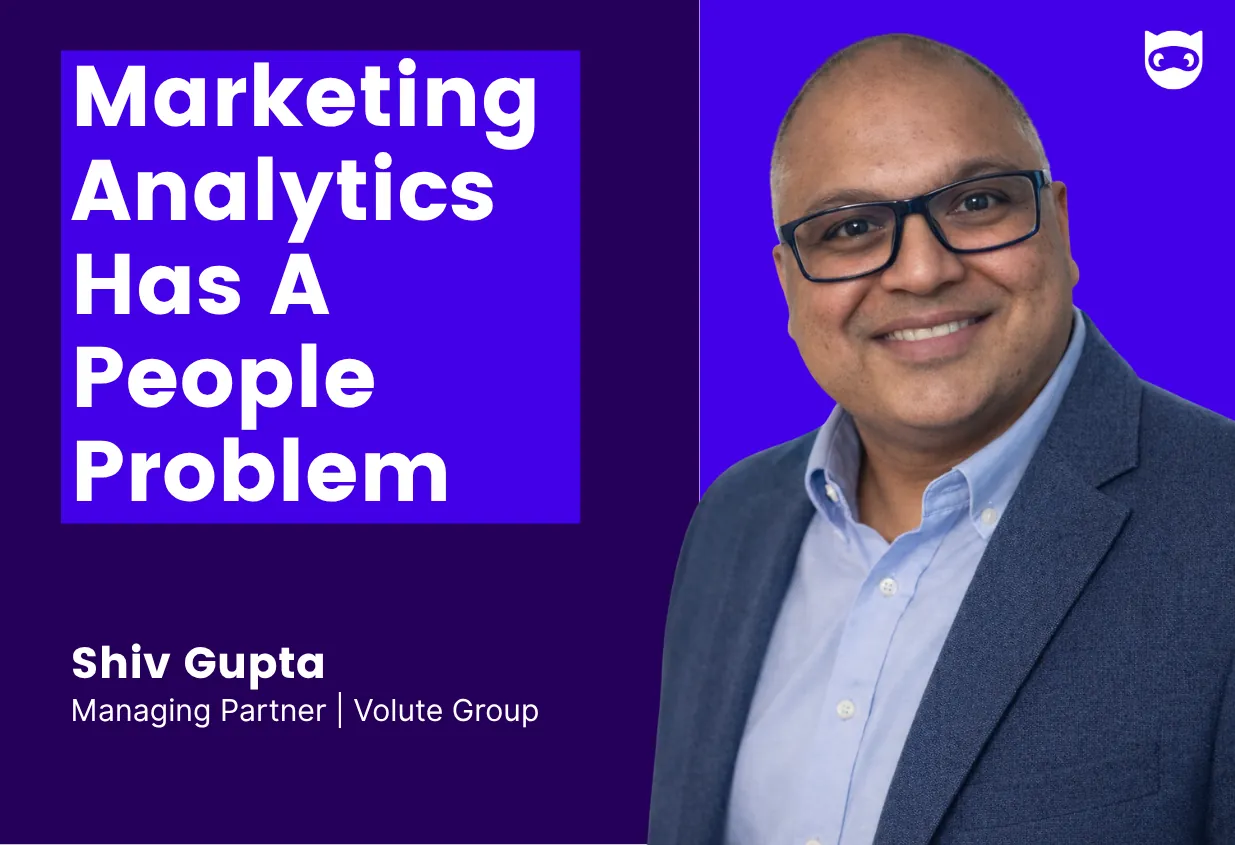
Shiv Gupta has spent 25 years at the intersection of data and organizational decision-making — starting as an econometrician and later building Quantum Sight into a consultancy that was acquired by The Volute Group, where he now serves as Managing Partner. Shiv has driven more than $30 billion in revenue impact for Fortune 100 brands across insurance, healthcare, energy, and retail, and regularly contributes to AdWeek and MarTech.
After all of it, his working theory is not about technology. It's about people.
Most business problems, Shiv argues, are not data problems. The data is usually telling organizations exactly what they need to know. What fails is the willingness — and the organizational structure — to act on it.
The distinctions between data, people, and processes, and what they mean for anyone trying to use analytics to drive decisions at the org level, runs through every thread pulled in this episode.
When Shiv started in data analytics, the function lived in a room on the side of the building. A small team of statisticians ran models, surfaced findings, and passed them up to managers who decided what, if anything, to do with them. Whether the analysis was right was almost secondary. Whether the organization was willing to act on it was the real variable.
Twenty-five years later, the room has moved to the center of the building. The technology has evolved from borrowed enterprise databases to purpose-built marketing stacks to AI layered on top of all of it. But Shiv's central question — the one he keeps returning to across Fortune 100 engagements in insurance, healthcare, energy, and retail — remains stubbornly open.
"Great, you have more data, or more segmented data," he says. "Each database is segmented for a different purpose. But at the end of the day, are you making significantly better decisions as a result of it?"
The answer, Shiv has discovered more often than not, is no. And the reason isn't the data.
Shiv draws a clear line between two modes of analysis that most organizations treat as interchangeable, recurring and deep dive analysis.
The first is repeatable analysis. KPIs and metric families a company has committed to tracking, the steady pulse of the business rendered visible. The second is ad hoc, deep-dive analysis. The probing, cross-database work a strong analytics team does when something in the dashboard demands explanation.
The confusion between these two modes produces both bloated dashboards and under-resourced analysis. A good dashboard, in his view, is not supposed to satisfy.
"A dashboard by its very nature is designed to be unsatisfactory 60 to 70% of the time," Shiv says. "It's gonna pose more questions than answers if it's a good dashboard."
A trend line drops. A close rate shifts. The dashboard surfaces the signal; the analyst team goes looking for the cause — across platforms, into the POS system, back into the enterprise database. That cross-database, probing work is where the real analytical value lives — and it requires a team with room to actually pursue it.
"I don't think any of the advancements done in data management have truly taken the place of what a crack analyst team can actually accomplish," Shiv says, "when set free to just play in the data."
When a repeatable question gets answered ad hoc every month, it should be in the dashboard. When a dashboard question gets treated as unanswerable because it isn't already in the system, a capable team is being wasted.
Shiv notes that over his career, as data analytics moved from the side room to the center of the organization, something else happened alongside it. "As data's become more accepted," Shiv says, "it has actually become a vehicle of political discourse in a company. And a power source."
The metrics a team chooses to report are not a neutral technical decision.
They are a statement about who the audience is. Most marketing organizations, Shiv observes, are building dashboards for themselves, and the gap between what they're reporting and what the rest of the organization actually needs is wider than most teams realize.
"The CFO doesn't care about your click-through rates," Shiv says. "The CFO doesn't care about which campaign had which conversion. It's irrelevant to them."
What the CFO understands is incremental lifetime value — a number that connects marketing activity to business outcomes in a language that governs budget and resource allocation.
"That's probably the greatest way to communicate to a CFO," says Shiv, "tel them, 'This is the incremental lifetime value we've generated through our campaigns.'"
The failure to make that translation is not solely a data problem. It’s also a failure to ask a more fundamental question: whose incentives are these metrics actually serving?
"The ability to use metrics to speak to the incentives that the person across from you has," Shiv says, "and to give them confidence that their needs and their incentives are actually aligned with what you're doing — that part is still very much misunderstood."
The technical capacity to measure things has outpaced the organizational capacity to use measurement as a tool for alignment. Most teams are still reporting inward rather than outward.
Shiv is direct about the central pattern he has watched repeat itself across 25 years and across every sector he has worked in: the data problem is almost always a people problem.
"A large part of the challenges in data are not technical challenges," he says. "They are organizational and people challenges." The data surfaces something uncomfortable — a strategy that isn't working, a product the numbers don't support, a direction someone senior has already committed to publicly. The organization's response is rarely to act on what the data says. It is to question the data.
The tell, in Shiv's experience, is a specific phrase. "We've all been in the scenario of someone saying, 'Let's do another study,'" he says. "And what that usually means is, 'I don't wanna do what the first study told me to do.'" Self-preservation is real. Turf is real. "It's easier to avoid a change than it is to avoid a bad study," Shiv says.
This isn't cynicism but a structural observation built from years of sitting in rooms where data has to survive a political gauntlet before anyone acts on it.
"The data is telling you something," says Shiv. "It's the willingness of the people in that organization to accept that message and make the changes necessary."
When data becomes a power source, it also becomes a target. The organizations that use it well are the ones that have built enough trust across the entire team, so findings don't get routed through self-interest before they reach a decision.
In this context, dashboards take on a different meaning. Shiv isn't among those who think they're dying. He thinks they're being misunderstood.
A dashboard, properly used, is an institution's defense against its own distraction.
"There's always these things — a new opportunity, a new technology, a new customer, a new product that goes into the market," Shiv says. "If you want to be neurotic as a business, you can be."
Dashboards are the counterweight to that neurosis. They hold the original question in place.
"Back in fall of last year, we decided this is our strategy," he says. "How is that playing out? How are the top metrics working, and can we see that we're making progress against our original thinking?"
Dashboards aren’t dead but, as Shiv puts it, "your last savior from distraction."
Organizational amnesia that accumulates over time — the gradual loss of institutional knowledge, the forgetting of why a metric was chosen or why an initiative was launched — is rarely a result of data failure, but institutional memory.
"That amnesia is not a function of the fact that the data isn't there or the documentation isn't there," Shiv says. "Sometimes it's a function of the people who are in charge constantly chasing new shiny objects, and that in itself doesn't allow the institution to carry that legacy of understanding."
Shiv admits that no technology closes that gap. "Not AI, not anything is gonna save you from that background reality,."
Shiv's closing argument is a practical one about where the field goes from here.
The job of data analytics has historically been bundled between governance, infrastructure, and sophisticated analysis, all living inside the same role or the same team. AI is unbundling it. Access to data is being democratized. The analytical questions that once required a specialized team can increasingly be answered by the technology. What cannot be automated is the judgment about what those answers mean for the organization.
"You're gonna either decide to take the path of data governance," Shiv says, "or you're gonna take the side of being what I call commando analytics — analytics designed where you take the data infrastructure and you use it to answer very sophisticated, complex questions with large organizational implications."
The two paths require different skills and different temperaments, neither is better or more preferable, both are necessary. Shiv is clear at the end of the chat, that most people will have to choose.
For those on the management side of that fork, the nature of the job is changing in a specific way. "Your moat around your relevance is no longer access to the data and having a data team that can answer those questions," Shiv says. "It is now being able to understand how this impacts the organization." That means understanding the lineage of the data, knowing where an analysis is overreaching, and being able to translate findings into decisions at the level where they actually get made, which means navigating the politics, and politics means people.
The hardest part of data analysis was never the data. It was always the people. And now that AI is democratizing access to information, people are no longer the bottleneck—they're the solution.
If there’s one takeaway from this talk with Shiv, it isn’t that people are the problem in data analysis, but orientation and action. Shiv’s takeaway is that the future of analysis belongs to those who can translate data into decisions and lead organizations to act on them.
Listen now: Spotify | YouTube | Apple
Connect with Scott: LinkedIn | Website
Subscribe to What Gets Measured for more conversations like this.
Jake: [00:00:00] me giving a bio of you so people know you, so we'll just start straight out. Um, and then, but I'll give you a chance to do some bio. You ready?
Shiv Gupta: Good. Start
Jake: here we go. Shiv Gupta, welcome to What Gets Measured. How are you, sir?
Shiv Gupta: I'm doing well. How are you?
Jake: How's DC?
Shiv Gupta: DC is not as muggy as it should be this time of year, so I'm grateful
Jake: These small, tiny blessings.
Shiv Gupta: Yeah
Jake: the data, the weather data don't lie. we were talking about data analysis before we hit record, um, sort of about decisions, um, just in this modern moment. But before we get into all that, I wanted to just give you a chance to give us a retrospective. You've been in the game, marketing data analysis, for over 25 years. what do you think has changed since the beginning, and what do you think has remained true? I know it's kind of broad, but I just want to see what you, you, you- your [00:01:00] experience has to say.
Shiv Gupta: Yeah. Yeah, I know. So a-a lot has changed. I think, uh, at the beginning, analytics was treated as this sort of, uh, laboratory on the side that came up with ideas potentially. Whether those ideas made sense or not was, you know, up to the judgment of, of the managers who were running, you know, the various projects and campaigns.
Shiv Gupta: So from that very nascent stage, now we're at a point where data analytics is pretty much central to every operation that is of any, you know, significant volume within, uh, a company. So, um, it's been a, a big change. I think we started off with things such as, like, just c- just a database, customer database or enterprise database.
Shiv Gupta: You were sometimes borrowing to do marketing from an enterprise database. You didn't even have a customer database, right? Uh, and now you have the evolution of customer databases, then you have the e-evolution of [00:02:00] automation that came in. A lot of marketing technology, uh, you know, s- came with its own separate database that allowed you to really concentrate and focus in on what you needed to do from a marketing perspective.
Shiv Gupta: Um, and so, you know, the evolution's been pretty good. And obviously, today we're at the evolution where, where AI is now tacked on top of, of this to, to really accelerate things. So it's been an interesting journey. Um, I tell a lot of folks, um, I started when the term big data s- was just data. And now the big, term big data doesn't even matter anymore.
Jake: it's so pointless. It's so sad 'cause I enjoyed that. I wrote a musical called Big Data Day, um, a couple, a couple years ago, and
Shiv Gupta: I'd be interested in seeing it
Jake: Oh, well, you'd love it. It, it's audio drama. So anyway, I'll put a link in the show notes. Everybody wants to know about this musical. Um, no, but it's out of touch. You're like, "Okay, yeah, big data." thing you said was interesting is that it starts as a lab, then it's table stakes. Then [00:03:00] i- I... 'Cause I remember this. I remember... So I mean, I've been in the game for 12 years, so, but, you know, I, I was sort of in that post-big data thing. Like, this is what we need. We already know we need it.
Jake: Just get it. Um, a database, a third-party database, and then automation shows up with all those platforms, and then there's another database layer. And then AI is tacked on top of this. So I think it's... Uh, do you see it now as of database layers, or are you starting to see some sort of flow in between the databases that wasn't possible?
Jake: Like, how, uh... Is the, is, is it still sort of apt to say, if it isn't big data, that it is a stack of databases? I don't know if that seems... I don't know why that's interesting to me
Shiv Gupta: Yeah. Well, no, I, I think it is an interesting question because what it's really leading to is the larger question, which is are we just stacking databases on top of databases and not making progress, [00:04:00] right? So yes, there are more databases. Yes, every platform either will work with your database or your data lake, or will come in with its own native, you know, data solutions in there.
Jake: Right. Integrations. Yeah
Shiv Gupta: exactly. But at, at the end of the day, I think the challenge comes out to, um, great, you have more data or more segmented data, if you will. E- each database is segmented for a different purpose. But at the end of the day, are you making significant, significantly better decisions as a result of it? And I think that's
Jake: the
Shiv Gupta: the problem, right?
Jake: I mean, that's the thing. So do- speak specifically to analysis, not so much the infrastructure that was happening, but the analysis at those stages in the journey from the beginning. You know, it was a laboratory. That analysis maybe was like, "Oh, you crazy data people with your crazy analysis." now, um, analysis seems to... It has to happen across those databases, or does it just happen in one place? I mean, I'm just, like, how has data [00:05:00] analysis sort of evolved since the beginning of your tenure?
Shiv Gupta: So I'd say from an analysis perspective, let's really start to lay out two buckets of analysis, right? You have your repeatable analysis where you've, as an organization, decided this is the type of monthly analysis I need to see, right? Sometimes that's just as simple as KPIs or a family of KPIs that, um, you know, lead to a larger business decision.
Jake: Love it
Shiv Gupta: Yeah. Um, the other side of it is your deep dives or your ad hoc analysis, right? Uh, and the ad hoc analysis, I think, is really the place where you go across databases if you have a great analytics team. Because what they're doing there is they're asking more and more probing questions, and sometimes the answer doesn't sit inside the platform that generates your dashboard.
Shiv Gupta: It sits in another platform. It may sit inside the enterprise database. It may sit inside the POS system. A- and that team then is able to [00:06:00] dig into that. So, um, I don't think any of the advancements done in a- in, uh, data management have, have truly, uh, taken the place of what a crack analyst team can actually accomplish, uh, when set free to, to go and, and just play in the data
Jake: Man, you know, it's interesting because I've been, uh... You know, you got your marketing data analysis, you put it in your report, and then you share it with people, and it's interesting because maybe we're looking at a recurring data set, but we're asking deep-dive ad hoc questions, which requires another set of analysis.
Jake: How often do you see people, uh, m- kind of misattributing the level of analysis that's required based on those two buckets that you're saying? Because I think everybody wants to take a deep dive on a dashboard, and [00:07:00] people maybe look at ad hoc deep-dive stuff, which is really interesting, as just sort of a dismissible recurring thing. Maybe can you speak to sort of that sense of data analysis? Did you get my question?
Shiv Gupta: I, I think so. You could rephrase it if I missed this, but, um, you know, um, so I think if it's a repeatable deep dive, then it really needs to be in the data, in, in the dashboard, right?
Jake: oh,
Shiv Gupta: you
Jake: deep dive. Well, that's what I'm saying. Like,
Shiv Gupta: Yeah
Jake: saying? When you're in the analysis phase and you're s- and you're talking about it with people, do you see how maybe some people are asking deep dive questions of a dashboard that doesn't need to be there? But your point is, if it is, then that should be in there.
Shiv Gupta: Right. Then you're gonna have to add it in there, right? Uh, absolutely. And yes, a, a dashboard by its very nature is designed to be unsatisfactory 60 to 70% of the time. And what I mean by that is it's gonna pose more questions than answers if it's a good databa- if [00:08:00] it's a good dashboard.
Jake: Sure
Shiv Gupta: it's s- s- trend lines are moving up.
Shiv Gupta: You have a huge blip all of a sudden, a key metric dropped. Like, what happened there, right? Or, you know, so sometimes it's bad data, but sometimes it's actually a business event of some sort. Sometimes it's an event that's completely exogenous to the company, and they say, "Well, th- they, you know, a competitor dropped their price.
Shiv Gupta: Could this be the reason we're not seeing, you know, certain, uh, uh, um, um, uh, close rates or,
Jake: Right.
Shiv Gupta: click-through rates because a new product came out," right? So tho- tho- those things are always going to be part of what a good da- a, a, a good dashboard delivers is it, it tells you what you need to know on a systematic basis, but it also points to opportunities to dive into what's actually happening at that moment or at that point in time
Jake: I mean, w- and I'll get to dashboards later because I have a very specific and pointed question about it. Um, but that's a good point. W- I wanted to talk a little bit more about kind of the different ways [00:09:00] that, uh, data analysis happens quantitatively, qualitatively. Um, th- you know, it's not that it's a difference, it's just a kind of a degree, you know, you need both is what I'm trying to say.
Jake: But you've, in your 25-year career, you've been working with m- a bunch of different data sets in healthcare, in insurance, advertising, like what you were saying, that family of KPIs. They're laddering up to different things in these different instances. Um, and I'm wondering if there's a qualitative approach required to different types of data analysis that quantitative people might miss, something about context and downstream application of the analysis. Um, i- what way is it one size fits all, you look at the data and it says a thing? And how is it unique and bespoke? I guess this sort of gets to that question of the buckets. Um, but do you know what I mean?
Shiv Gupta: Yeah
Jake: data ain't the same as advertising data isn't the same as pr- like a, you know, [00:10:00] work in time factory thing, which is where, or ROI came from, uh, the factory floor.
Jake: It's
Jake: not related to advertising, but we use it all the time. d- tell me about the quant, the qual
Shiv Gupta: Yeah, so I'm gonna get a little bit esoteric here
Jake: Go
Shiv Gupta: qual side of it,
Jake: exogenous. You've, you've blown past the, the f- that thing. Keep going
Shiv Gupta: Okay. Uh, yeah, that's the economist in me. Uh, I started off as an econometrician, so exogenous
Jake: said econometrician. Get out of here, Shiv. Okay, keep
Shiv Gupta: there. I'm dating myself. Uh, yeah, so here's what I'd say about the soft part of it, and it actually goes back to the earlier story you asked about as well, like how, how these analytics groups got started.
Shiv Gupta: They were sort of this, you know, this R&D lab on the side, right?
Jake: Yeah
Shiv Gupta: Um, part of the problem was also the people that spoke data didn't understand the business oftentimes. You hired a bunch of statisticians, right? And there was a huge disconnect. Now, over the years, that's resolved itself. [00:11:00] I think you have now business experts with analytical chops, um, that have grown over the years, and that's, that's, that's a great evolution.
Shiv Gupta: Um, what I think is still missing, and where I find our most interesting challenges come from, is when there's a larger political and, uh, organizational conte- you know, context to the data. Because as data's become more accepted, it has actually become a vehicle of political discourse in a company. Um, and, and a power source, right?
Shiv Gupta: Let's, let's face facts. Um, well, I, I didn't mean that as a pun, but, uh, facts, facts are helpful when you're trying to make arguments and when you're trying to gather resources
Jake: yeah
Shiv Gupta: and, and really, in essence, the power to do something interesting in an organization.
Jake: Right
Shiv Gupta: Um, and I think a lot of that is still missing.
Shiv Gupta: People don't quite understand the value of data and metrics in [00:12:00] helping guide, um, uh, the interpersonal and the political landscape in an organization. And what I mean by this, just give you an example. Uh, you could create a dashboard, but that-- many times you'll see a dashboard, and we should get off of dashboards 'cause there's so much more happening in analytics beyond dashboards, but yeah, yeah.
Shiv Gupta: But for now, we'll stick to, to dashboards.
Jake: Okay
Shiv Gupta: Um, the metrics you choose
Jake: Mm-hmm.
Shiv Gupta: Are, are they metrics that matter to you, or are they metrics that matter to your audience? Many times I find that marketing organizations will create a wonderful dashboard. Fundamentally, 80% of the dashboard has absolutely no meaning to the other leaders in the organization.
Shiv Gupta: The CFO doesn't care about your click-through rates. The CFO doesn't care about which con- you know, which campaign had which conversion. It's irrelevant to them, right? Um, lifetime value, oftentimes it's not there, but that's probably the greatest way to communicate to a CFO and say, "This is the incremental lifetime value we've generated through our campaigns."
Shiv Gupta: [00:13:00] Um, so, you know, that part is still very much, I think, misunderstood, um, when it comes to analytics and marketing, is, is the ability to use metrics to speak To the incentives that the person across from you has. Um, and to, and to give them confidence that their needs and their incentives are actually aligned with what you're doing, or your, your, what you're doing is aligned with your incentives
Jake: Oh, uh, you, uh, it's so... Yes, the interpersonal thing is just, uh, completely missed because it's business. Um, and when you're at the airport, I made this, you know, observation. They tell you, "Is it business or is it personal?" And so when a lot of in business make some whack decision, they're like, "Don't take it personal, man.
Jake: It's just business." know? And you're like, "Okay." So you're sort of encouraged to not be personal, bull, in a way. uh, "Don't take it personal. [00:14:00] It's just business." But then we miss this interpersonal angle of what I think is the fifth P of marketing. The four is price, product, promotion, placement, but this fifth is a small P, politics. Man, I don't know, uh, how to... Sometimes it works. It depends on if the audience, the stakeholders are in a good mood. You know what I mean? And they're like, "Good stuff here." And you're like, "Great." And if they're in a bad mood, they don't like anything, you know? And I, I, I think that click-through rate is another harsh dashboard truth that marketers have to sort of deliver is like, you might like traffic, but what does it mean?" then you're like, "Well, uh..." And then you have to do that work. And, and, and I, I think it's, it's difficult because we're at this stage where, uh, it, it's hard to hand things off or to know what I'm supposed to be doing [00:15:00] and to feel like I should be doing more when I should be asking better questions and focusing on how to work the interpersonal relationships, not manipulating things. But what do they want? do they need to see it? And then how can I work it? So I want to know you, um, Shiv, uh, you must have had a chance to experience this, where you had some data and you got a political win. Can you maybe just... You don't have to name names or anything, but I just want people to give a sense of like, how is that possible? 'Cause have you had that moment where you're like, "Man, the interpersonal stuff is going bad. I'm gonna use this data to sort of create some..." Is there an
Jake: example from your life that you have?
Shiv Gupta: Yeah. Well, uh, uh, yes, there is, uh, several of them. I mean, it's pretty much been the, the, the crux of my career, uh, in terms of what I've been doing, right?
Jake: gems
Shiv Gupta: Yeah. Yeah, well, I mean, let's, let's, uh, so there's, there's one early on in my career actually. We were, um, you know, [00:16:00] working on, um, a project where we were trying to estimate lifetime value for a,
Jake: E.
Shiv Gupta: insurance product, right?
Shiv Gupta: Um, and I think the sales organization never fully grasped the value of lifetime value because they said it's some crazy metric being generated in, in an analytics department, the corporate side of it. I need to have more policies sold. I need to generate more, uh,
Jake: yeah,
Shiv Gupta: po- policy revenue.
Jake: Right
Shiv Gupta: Um, and so we had to sit there and say, "Okay, we could, we could talk about lifetime value with them, and it'll just be, you know, completely over their head, or we could talk about it from the context of retention and the actual value of stability that it's providing for policies under force."
Shiv Gupta: So the sales team did care about having enough of a, a, a stable book of business, right? If you have people leaving every, you know, every six months or every year, that's, that's problematic. So we s- you know, you, you've, you translate that into the language that they will understand. [00:17:00] So, uh, define to them and say, "Look, if I can get this type of a segment with this lifetime value, you're gonna be able to not have to write as much business to replace this.
Shiv Gupta: You'll be able to have a more stable book of business." Um, that resonates. When you start to identify the segments, you can identify the segments, and they kind of get it, or you can go right into their book of business, take out 20 customers and say, "According to lifetime value, this is gonna be your best customer.
Shiv Gupta: This is your second, your th- third." And their sales intuition kicked in, and they said, "You, you know, I never looked at it analytically, but you're absolutely right. That is, that is my best customer. I, I already know that will be my best customer. I got them because I already had their dad's policy, and therefore I know that I have that family," right?
Shiv Gupta: Um, so what that analytics was showing only made sense and actually was able to deliver momentum when it was translated into the language of what [00:18:00] mattered to that team
Jake: I'm writing something down because I was like, man, I wish I could rewind this conversation. Um, incentives blind people's actions and analysis of things from the interpersonal relationship again, which you're just like, "Who is your best customer?" And salespeople would be like, "Anyone with a pulse." And you're like, "Well, of course." know, and any b- any product person is like, "Who do you want? Who's this product for?" "Anyone with an internet signal." And you're like, "Well, of course." You know. They'd be like, "Who's this drink for?" "Anybody with a mouth." Okay. But the incentives, you don't figure out those long-term, again, interpersonal relationships.
Jake: It seems like it comes back to a lot of analysis getting to the relationships between data points. This next question was, and I think you've answered it a couple different [00:19:00] times, um, regardless of that, you just said, you know, the data management, you know, stack and all of that, the, the talent, there's always the issue of getting people to actually look at the analysis and not their interpretation of it. And we talked about those different buckets and, you know, how you can sort of analyze, rejigger LTV to be something, you know, so we talked about this. But is there a, o- do you have a different or something more strict or data-specific piece of advice for making data points sticky in a presentation? Like s- sometimes you want people to hear this great line, and then they blow through it, and you're like, you get people to set their kind of presentations up to be like, bam, oh, ah
Shiv Gupta: I, I, I think it, it, it begins with an understanding of who your audience is gonna be that day, right? Um, then you have to understand what are they incentivized to deliver. And if you have a good senior manager on [00:20:00] staff, that senior manager understands not only the explicit but also the implicit metrics that this person would care about
Jake: Hmm.
Shiv Gupta: So, um, when that happens, um, you put that forward.
Shiv Gupta: And so your presentation, if it's the same presentation to every person in the organization, you're probably missing the boat. You're not personalizing your presentation enough. Which is funny, 'cause marketers should be the first people in an organization who understands personalization.
Jake: has no shoes.
Shiv Gupta: Exactly the problem
Jake: don't. Okay, anyway
Shiv Gupta: That is exactly the issue.
Shiv Gupta: You're, you're absolutely right. The cobbler has no shoes. Um, and, and so, you know, think about that, right? Who's your audience?
Jake: Yeah
Shiv Gupta: you also have immensely, you know, especially with analytics, you have these deep d- you know, data-filled presentations,
Jake: Jam-packed
Shiv Gupta: Exactly. And, and the person actually just cares about two or three metrics that are relevant to them.
Shiv Gupta: And if you [00:21:00] can excite them and say, "This is how it's moving," or, "This is how we plan to impact it," you have their attention because tomorrow, the next day, and the next day, they're worried about moving that metric as well. And if they see an ally helping them move that metric, they're in. If they see an ally talking about 100 other things, then you've already told them, "You take up about 5% of my mind space," and therefore how much cooperation and how much in sync are you going to be with that individual?
Shiv Gupta: Um, so it's, it's, it's super critical to think about your audience, and then don't s- don't have the same presentation for everybody
Jake: W- uh, because they're not gonna understand it, you know? And, and, and, but that's why it requires a ton of work, all we're being sold is automation. And so you're like, man. Do you remember? 'Cause you, you, you mentioned at the beginning, I, you know, I remember, you know, you were working with third-party databases, and then automation came in. [00:22:00] We've been through automation. Digital transformation is what I think it was called. Um, we've been here before. Like, how, uh, do you feel that people are learning lessons faster with AI, or are we forgetting long-term truths quicker?
Shiv Gupta: I, I don't know if I'd phrase it that way, but you're right. You're definitely right. Um, what I'd say is I don't think we're forgetting long, long-term toots
Jake: I, I, I got a
Shiv Gupta: faster
Jake: I got a g- question about that later, but yeah, keep
Shiv Gupta: Okay. I think what we're doing is we've never acknowledged some long truth, long-term truths or challenges that have always been there, and we've constantly tried to push them to the side, right?
Shiv Gupta: Um, and the advent of AI does not make that problem go away. In fact, it now makes it more acute because AI has the ability to take every one of your, your, your shortcomings and, and [00:23:00] escalate them at a higher, you know, velocity.
Jake: Damn it
Shiv Gupta: and so you, you do have to start to acknowledge it. Just, just even having good data governance
Jake: Mm-hmm.
Shiv Gupta: a company.
Shiv Gupta: Data governance has been the hardest... If, if anybody who leads data governance, and I've never led that for a reason, because it is a thankless, difficult job in most organizations. It's painful, just face it.
Jake: It is
Shiv Gupta: and, and you're, it's herding cats, and then everybody wants in on whatever this project is so they can have priority.
Shiv Gupta: Um, it, it's, it becomes unwieldy, and we still as, as organizations haven't, haven't deci- you know, figured out how to make that a more disciplined, um, a- approach. Um, and, and so yeah, you know, that's one of those truths, if you will, that we just never acknowledged or we acknowledged but never wanted to really tackle
Jake: Yeah. And, uh, yeah, I, I have a, I have an image, uh, I, I draw cartoons every once in a while, and I had an image of somebody sweeping dirt under the rug. F- [00:24:00] uh, and pick your, uh, tech debt, uh, favorite meme. You know the one with the Jenga and all of it, and they're like, "This is, like, the code, the, that we're trying to work around." You know? Mm-hmm. Like, we all have that, but you sweep enough rug, you know, dirt under the rug, now the floor is dirt. Uh, you're not hiding anything. You've just actually changed the floor, you know? So it's like that's why those, those questions and those kind of concerns and thoughts and the evolution of data analysis from 25 years to today, hasn't been a change to the requirement of having a governance respect role.
Jake: Maybe it was knowledge management. You know, maybe it's QA. I hear QA's coming back. But anyway, um, really quick, dashboards, uh, they're dead or are they dying? Just kinda just give me a hot Dashboards, dead?
Shiv Gupta: I, I, I, I think that that's [00:25:00] more a clickbait title. I would say that they're, they're not dead. They are, though, being put in a proper place. Um, in that... N- n- not put in their place, but in a proper place, let's put it that way.
Jake: nice to Dashboard, Chip
Shiv Gupta: I am- I'm being very nice to dashboards. They are actually the spine of how a company makes better decisions, right?
Jake: I know I don't want him to die because man, what are we looking into? But you've already met s- made some really good, like it's kinda gonna be a letdown unless you figure out that intent, package it right. mean, am I right?
Shiv Gupta: Yeah, but here let's, let's, let's now praise dashboards for a minute. What they do is they offer continuity in a business environment where you are constantly being distracted. Distracted by a new opportunity, a c- a, a new technology, a new customer,
Jake: time
Shiv Gupta: a new product that goes into the market.
Shiv Gupta: There's always these things if you want to be neurotic as a business, you can be, right? And some [00:26:00] organizations are more neurotic than others. Dashboards are the sense of continuity to say, "Back in fall of last year, we decided this is our strategy. How is that playing out? How are the top metrics working, and can we see that we're making progress against our original thinking?"
Shiv Gupta: They are your last, you know, savior from distraction, which is very, very easy to do, um, i- in business. So from this perspective, I, I praise them. Um, and then they can be better designed
Jake: Without a doubt. And but it, it, it kinda like when does the tweaking end, you know? And that's, that's where I think it never ends. And then you're like, well, think that's where a lot of people get off the bus, you know? I think a lot of people are like, it... I, I wrote something about a- analysis amnesia. Um, I d- or maybe like workflow amnesia.
Jake: They're like, why did we... You [00:27:00] made a good point about managers being this sort of necessary filtration mechanism between the desires of the high and the performance and capabilities of the team. Um, I, I just kind of like is, is there s- or what ways can we prevent the amnesia that happens when you automate things, um, and sort of you sort of disassociate from those, the, the, the function? Like, why did we even really do this in the first place? Um, do you... Have, have you experienced people like that? It seems like if the governance is strong, they're carrying that historical knowledge with you, but unless somebody's doing that, it does feel like there's a lot of amnesia, you know, that,
Shiv Gupta: Yeah
Jake: kinda goes throughout organizations.
Jake: And that dashboard is a great touchstone. Like, "Come around, children. Let's at [00:28:00] the thing. It's going up," you know? What, what's your thoughts about amnesia and the importance of workflows? Is it about, im- improving your interrelationships, uh, bringing up the politics, strengthening up that game? What, what's your thought here?
Shiv Gupta: Yeah. Uh, uh, I, I think there aren't always cookie cutter answers to some things like these. A- a- and so there's no systematic way to say this except to say, look, if it was worth doing and there was a manager that led this, it showed up in the dashboards as these are the activities we'd wanna do, that manager's responsible for maintaining consistency,
Jake: Mm-hmm.
Shiv Gupta: That manager's there to deliver on what that vision was, and if that vision needs to change, fine, you change that vision. Now, if you're changing it every three months, every two months, then maybe something's wrong, right? You're not, you're not thinking about the problem properly. Um, so at, at that stage, I'd say, uh, it is on the human [00:29:00] being.
Shiv Gupta: A- and I think in a distracted world, we're becoming more and more distracted by things, and we-- That amnesia is not a function of the fact that the data isn't there or the documentation isn't there. Sometimes it is. Sometimes it is, but it's not always. Sometimes it's a function of the people who are in charge are constantly chasing new shiny objects, and that in itself doesn't allow the institution to carry that, that legacy of understanding and, and that knowledge.
Shiv Gupta: And, and that's, that's where it's important to have some managers who say, "Look, you know, every year we'll review this. We'll think about our plan. Certainly maybe even every six months if it's appropriate and, and the dynamics are, are pretty rapid. But at the end of the day, um, you know, if we don't measure what we're doing, and if we don't keep an eye on those dashboards, we're not going to be able to achieve our goals."
Shiv Gupta: And, and that's, that's basic. It's, it's really basic and not [00:30:00] AI, not anything is gonna save you from that background reality
Jake: And, and you're bringing up a good point, man. Like, a, a, a lot of, you know, I s- we, NinjaCat, we're deep into data governance, deep into AI agents, like threading across unstructured data. I've seen some amazing things happen. I have. I have seen awesome things. But I also understand that at the end of it, it doesn't have anything to do with the software, the data, the tech.
Jake: It has everything to do with the people and the processes. And that it, it sucks because you wanna sell a technical solution, but it only works when the people have it together, they have their processes together. And that's why I think there's th- it's so great that it starts with marketing data analysis, but it ends with a respect for interpersonal, like, relationships, that, that small P of politics. And, and realizing that maybe if you're a [00:31:00] cobbler, make yourself a pair of shoes and, and go out there and sell some of this analysis to people and get some buy-in. Uh, man, it- you said some amazing things, but we gotta wrap it up. I want to know if you had to give one piece of advice about marketing data analysis in the age of AI, what would it be?
Shiv Gupta: I'd say, um, a job of data analytics has been sort of combined historically. It's going to separate. You're gonna either decide to take the path of data governance, or you're gonna take the side of being a, what I call commando analytics. And this is analytics designed where you take the data infrastructure and you use it to answer very sophisticated, complex questions with large organizational implications, right?
Shiv Gupta: Um, and I don't think the skill set is going to be the same. So you have to pick a path going forward. Where do you wanna be? And I think there's value in both, [00:32:00] tremendous value in both, but I do not think it's, uh, a skill set that, you know, one can have. Some may have both, but mostly I think people have to split
Jake: Yeah. Well, and it feels like that, that, um, there's a manager track to the governance. Like, if you like sort of organizing teams and sort of seeing the tournament angle and the, the, the trees and the respecting the different players, a great skill set. But most people are horrible managers. Like, you know what I mean?
Jake: Like that... God, I've, I've, you know, who's... I've had a couple great managers that I've
Shiv Gupta: Yeah
Jake: and most of them just are haplessly in there hitting on those incentives, hitting on the most present number. man, I think it maybe is that another piece of advice is just sort of maybe think, uh, right now about what your skill is.
Jake: Is it more towards [00:33:00] analysis or is it more towards management? Do you think, is that a fair assumption to-
Shiv Gupta: I think that's a fair assumption as well. Absolutely. Uh, you're gonna need more sophisticated managers. You know, uh, from a manager perspective, so let's just say one skill, let's say, for the managers to think about is, um, because AI is going to democratize the access to data and information, what you need to now be able to do is to be able to manage and convey that information, the implications of that information, at a higher plane.
Shiv Gupta: So it's, it's... You no longer... Your, your moat around your relevance is no longer access to the data and having a data team that can answer those questions. It is now being able to understand how this impacts the organization. Because you understand the data and where it came from, you understand the lineage of that data, what the implications are, how much you can actually do with that data, and where you might be overstepping because the [00:34:00] data isn't really m- set up to measure that, that outcome or that, um, uh, bit of information or insight, right?
Shiv Gupta: That's where you're gonna have to spend more of your time. And then, then the politics, right? Then understanding how do you, uh, you know, um, make this, uh, relevant to the organization. That, that's really where management needs to step up, and not about optimizing a campaign or optimizing, um, you know, your click-through rate or something like that,
Jake: stay out of
Shiv Gupta: that's gone.
Jake: Yeah,
Jake: stay out of there. quit
Jake: quit backseat drivi,ng
Shiv Gupta: AI's job now.
Jake: Let the Waymo handle it. Yeah.
Shiv Gupta: Exactly
Jake: I, I love it, man. This has been so wonderful. Tons of insightful commentary. I, I love that it's, it's, it's landing at the personal level, um, but keeping us sort of visible of what's possible with technology. Ugh, you're so great, Shiv. People wanna connect with you, learn more about you online, how can they do that?
Shiv Gupta: Sure. Uh, absolutely. I'm on LinkedIn. [00:35:00] Uh, Data Brand Le- it's Data Brand Leader.
Jake: Yeah
Shiv Gupta: it's an interesting, uh,
Jake: Go
Shiv Gupta: LinkedIn, but yeah. Or, uh, you know, uh, Shiv Gupta, uh, at Volute Group. Volute GRP. Sorry, cancel that. Sgupta,
Shiv Gupta: [email protected]
Jake: Send an email. All right, cool. All right. Well, I'm not gonna let you go until we play a game really quick called Cheese or Chocolate, where I ask you two questions, give you two options, and you gotta choose one. Are you ready?
Shiv Gupta: All right
Jake: Cheese or chocolate?
Shiv Gupta: Oh, both. Uh, chocolate
Jake: I know I stress you out. I don't wanna stress you out. Maybe the next one's easier. And this dates me. Dan Marino or Joe Montana
Shiv Gupta: Montana. I thought Montana was definitely, um
Jake: something [00:36:00] cheese ball about Dan, right?
Shiv Gupta: I don't know. I, I don't know about the personalities. I let the personalities sit, o- otherwise I let the, the game
Jake: in a
Shiv Gupta: f- Yeah.
Jake: fashion,
Shiv Gupta: Yeah
Jake: uh... Shiv, you're better than us, okay? But you're right, it's Joe Montana. Okay, moving on. Um, facts or figures
Shiv Gupta: Figures
Jake: Hmm. He had to think
Shiv Gupta: Yeah. Well, the, the answer is, again, figures are used to paint a story, and at the end of the day, nobody actually has the facts. They're always incomplete. Um, figures though, help you move organizations. They help you... And, and you know, one, sort of the sarcastic way to view it is to say, "Oh, liars lie, and liars use to..."
Shiv Gupta: You know, what is it? Uh,
Jake: You're right. Words
Shiv Gupta: yeah. I forgot the, the, the, the old saying, like statistics use statistics. But,[00:37:00]
Jake: Right
Shiv Gupta: nevertheless, um, it's, it's not that. It's, you know, when you have figures, you can start to paint the full story, and some of that story has to be filled in with your intuition, your business understanding, things where you won't be able to really get data or facts around, right?
Shiv Gupta: So I think facts are, are limited. They just are. And, and figures are more powerful
Jake: I love it. I love the philosophical angle. It's required, kids. It's required. Um, okay, here we go. Uh, window seat or aisle seat?
Shiv Gupta: Oh, I'll feed for sure
Jake: For
Shiv Gupta: day of the week
Jake: because what? You gonna put your legs out or you wanna
Shiv Gupta: Claustrophobia. I can't, I don't wanna be... At least in one side of that, of that trip, I'm not being smooshed against another person. So yeah, definitely.
Jake: I, I love it. But
Shiv Gupta: Yeah
Jake: you get to Cincinnati, you know? Okay. Anyway, or beignet?
Shiv Gupta: I can't tell the difference between a good donut, [00:38:00] not a, not a mass pro- produced pa-
Jake: donut. These crazy
Jake: donuts that have bacon on 'em
Shiv Gupta: r- uh, yeah, or, or, or even, like, even these, you know, mass produced donuts are one thing. But if you, like, go to a proper bakery where they're, you know, they... I, I, I know, I know people from Louisiana are gonna get ticked, but I can't tell the difference between a really great well-made, uh, donut and a beignet
Jake: Oh, man. Well, one of them's gonna be covered in powdered sugar, you know? Um
Shiv Gupta: Both of them can be
Jake: Let's not fight. We do- we've done so well, Shiv. Oh, we got into a horrible fight about donuts at the end of this one
Shiv Gupta: It went so well. This was, this was our red line. Who knew when we started this, this was gonna be the red line?
Jake: I should have sent the, you know, the, the
Jake: disclaimer
Shiv Gupta: you.
Jake: time. Why
Shiv Gupta: It will teach you
Jake: the donut que- I was
Shiv Gupta: I- it'll teach you to ask provocative questions like that. I mean, come on
Jake: I d- there's a third rail, bro. I'm sorry. [00:39:00] Everyone's like, "Jesus, have some decency." Okay. Anyway, on. Last question. Um, robes, they necessary or are they useless?
Shiv Gupta: It depends on where you are. If you're in public, wear a robe.
Jake: Well, wait. There's a lot of assumptions happening in this story.
Shiv Gupta: Well, I mean, if you need a robe, wear a robe.
Jake: Yeah, and if you need a robe and you're in public, what are you doing? Who invited you to this donut convention? And that's not a beignet. And did you fly on a window seat or an aisle seat? Oh, I hope you-- it's a signed "My Joe Montana" poster. Stop. It's over. It's over. Oh my God. right, done. I'm closing it
Shiv Gupta: All right. Well, this is