Jake Sanders
Content Strategist
Automation is the default AI strategy.
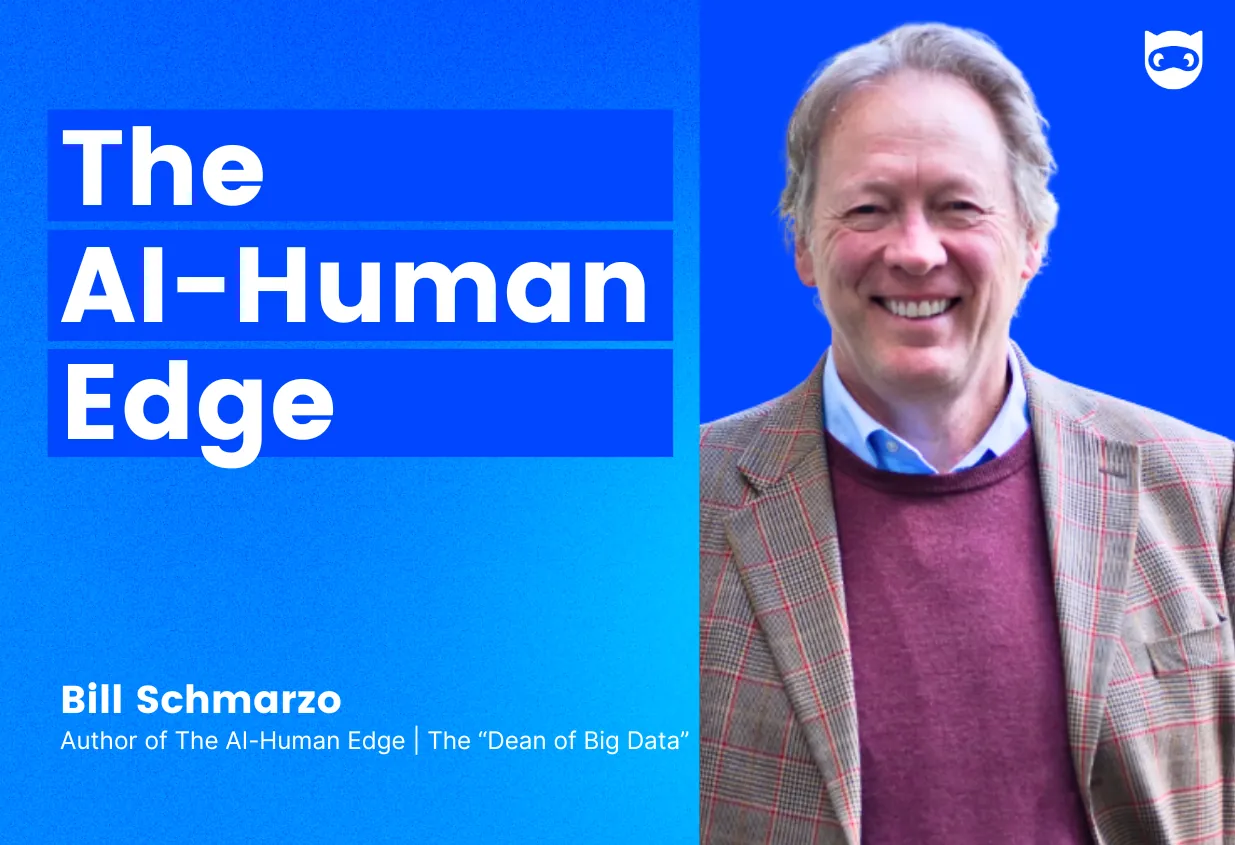
Bill Schmarzo believes that’s a failure of imagination.
In his latest book, The AI-Human Edge, the longtime data executive and seven-time author reframes the conversation around AI: the real competitive advantage isn’t the model itself. It’s the intelligence system you build around it, one that systematically develops human capability.
“This book runs counter to everything everybody’s saying about AI; ‘we’re gonna use AI to automate processes and push people out of their jobs.’ This book says bulls**t. Your most valuable asset is your humans; their intuition, their experience, their ability to develop and grow.”
Bill’s perspective didn’t emerge from theory, but from decades of experience operating inside large-scale data systems and….baseball cards?
Schmarzo traces the origins of his book back to Strat-O-Matic Baseball. The game didn’t rely on last year’s batting averages. It showed probabilities in specific situations.
“Instead of looking at the back of a baseball card and seeing what a player had done for a year, this showed you what a player was capable of doing—the probability of players in certain situations. If you understood the situations, it gave you a huge advantage.”
That distinction of averages versus propensities followed him into his role as Vice President of Advertiser Analytics at Yahoo.
At Yahoo, the scale was enormous. Hundreds of millions of visitors. Massive behavioral data trails.
“We built propensity models in every one of our 200 million visitors. We knew what sites you went to, how long you spent there, the sequence of sites. We could track your mouse movements, what ads you clicked on, your keyword searches… We had a really high understanding of what you were likely to do next.”
The business implication was direct. Different clicks carried radically different economic value. Travel and automotive clicks generated meaningful revenue, commodity clicks did not.
Propensity modeling allowed Yahoo to bid precisely in ad exchanges and allocate resources based on expected value, not historical averages. It's a use case that remains highly relevant today, with AI-powered marketing analytics platforms applying similar behavioral modeling logic to help marketers understand not just what happened, but what's likely to happen next.
Schmarzo initially wrote The AI-Human Edge for professional athletes and sports teams, which made the argument easy. With performance and outcomes tied to firm objectives, the value of an athlete is highly visible.
Working with professional baseball organizations and large college programs, he explored how entity-level propensity models could shape decisions around recruiting, NIL investments, workload management, and in-game adjustments.
In high-pressure moments—bottom of the ninth, two outs, bases loaded—decisions shouldn’t rely on last season’s averages. They should incorporate fatigue, spin rate changes, rest days, matchup context.
Then a colleague challenged him after reading the manuscript:
“Everything you’ve written about athletes pertains to doctors, nurses, teachers, engineers: anybody who works with knowledge.”
That reframed the entire book.
Knowledge workers also have propensities. Patterns of strength. Contextual performance differences. Growth trajectories. Organizations simply don’t measure them with the same rigor they apply to athletes.
And in the current AI cycle, many are trying to automate talent instead of develop it. But how do you develop alongside AI?
Schmarzo outlines three phases of growth in the AI professional: Rookie, All-Star, and Elevation.
In the Rookie phase, AI expands exposure, helping you “look more broadly at problems” and spot patterns at a level of granularity humans can’t see.
In the All-Star phase, the focus shifts to mastery: “How do I understand the cause and effects that allow me to be the best I can be?” Here, AI enables counterfactuals. Testing variables, simulating pressure, understanding how context shapes performance.
In the final stage, Elevation, performance becomes collective. “You elevate your team. You elevate your profession.”
When asked about the concern of cognitively offloading to the AI, Bill pushed back, stating that AI should function like “Yoda sitting on your shoulder.” Not replace judgment, but expand awareness.
“I am never turning over my responsibility to continuously learn and adapt to the machine. It’s only Yoda sitting on my shoulder… whispering, ‘You may want to look at this.’”
The edge with AI isn’t automation, but an elevated, guided approach to discernment and learning development.
One of Schmarzo’s most practical points: models must be grounded in real decisions.
He doesn’t begin with dashboards. He begins with the choice someone is trying to make—and what’s at stake.
“Propensities have to come from what customers are trying to do. Understand the decisions they’re trying to make, the context of the decision, the value of the decision… and then ask what kind of scores can I build to help them make better choices.”
That requires more than a stakeholder interview.
“I’m not talking about a courtesy interview… I mean going out in the field. Walking through the muddy fields with the operators. Sitting with the nurses. Creating journey maps. Understanding the decisions they have to make.”
In one class during COVID, his students built a mortality propensity model by calling caregivers first. Through qualitative research and interviews, they identified the real drivers (age, medication timing, BMI, support systems) before touching the math.
The sophistication was in identifying what actually drives outcomes, at the front lines, where value is created and decisions compound, not in some spreadsheet in a computer.
The sharp tension of the AI-Human edge isn’t about technology or modeling, but optimization.
If AI is measured by cost reduction, we’ll build systems designed to replace labor. If AI is measured by performance growth, we’ll build systems designed to develop people.
Schmarzo’s thesis is that the winners in the AI era will be those who treat human capability as a measurable asset, and design data-driven marketing strategies, and intelligence systems that expand them deliberately.
“Let AI do some of the heavy lifting for you. But not do any of the heavy thinking for you.”
That’s the edge.
Listen now: Spotify | YouTube | Apple
Connect with Bill: LinkedIn | Website
Subscribe to What Gets Measured for more conversations like this.
Jake: [00:00:00] I was like, is this guy for real? Am I looking in a mirror? Because I'm, I'm so into play. I'm so into creativity. I'm so into improv, but I'm also into rigor, hitting the woodshed, playing the lines.
Bill: Well even in improv you you there are there are you know there are there are you know scales and there's things you can do right If you if you go outside that if you're playing a C Sharpie you're playing a you know a c normal it's like you know you can catch the difference So there There there there are are frameworks in place and I I
Jake: Yes.
Bill: guideline guardrails but I there are frameworks and we can talk about that
Jake: I love that. And that, that is my thing. I'll, I'll send you a whole bunch of stuff I've written up treatises about jazz, jazz standards, jazz thinking, creative, like pivots, like I'll, I'll bother you. You bother me. Um, okay, so before this I will have, uh, introduced you and stuff. So I'm just gonna bring you on and say, bill sch Marzo, welcome to the show.
And then we're gonna jump in. Is that cool?[00:01:00]
Bill: Just do it Yeah
Jake: All right, now. I know, I know. Let's get outta here. God. Um, no. Take all the time. Okay, here I go. Um, bill sch Marzo, thank you for joining us today. How are you, sir?
Bill: Thank you Jake Thanks for having me on the show I'm I'm eager to see what we talk about here
Jake: Yeah, I'm all, I'm also eager, I sent Bill the questions beforehand. He says, I don't wanna look at 'em. And I said, well then we'll both get we'll the, everyone of just is in the audience today. Um, no thank you so much. Uh, we were talking about jazz music before this. We'll get into that. Bill. You're an amazing person.
You have a new book coming out. Um, the AI Human Edge. Winning with intelligence technologies on the field and beyond. Um, as I was doing research for this show, uh, there was something that popped up and the genesis for this comes to a strata baseball, uh, playing cards from the seventies with propensity scores instead of summary statistics, I, I have to know.
Tell us a little bit about the book. You know, the intro, why'd you [00:02:00] write it? And then what is this connection with the baseball card game? Let's start there.
Bill: Well let let's let's start with the with the baseball card game cause I I was just totally infatuated with Medic Baseball which is kind of the early versions of Sabre Metrics or a different version right That that what they had done instead of looking at the back of a baseball card and sawing what a player had done for a year This showed you what a player had capable of doing the probability of players in certain situations And if you understood the situations right if you understood the situations it gave you a huge advantage in knowing what players to go get So I mean I dominated my friends in this game because I didn't tell em of really understanding probabilities and be able to look at a
Jake: All of that.
Bill: And putting together you know like a pitching roster knowing what kind of pitcher to have or what kind of situations So I that whole concept of understanding individual players performance propensities carried carried over throughout life And [00:03:00] it it really cemented when I was at Yahoo where I was the vice president of advertiser Analytics and we we built propensity models in every one of our 200 million visitors Right
Jake: Was that, was that your doing? Did you say, Hey, we need propensity models, or they had something
Bill: was being done by someone a lot smarter than me But I I I saw the pattern
Jake: Oh, nice. Okay.
Bill: know
Jake: Yeah.
Bill: and I know what kind of data you're gonna need and I know how we're gonna use it right We you think about it the 200 million people coming to our site there's probably even more than that knew what sites you went to I how long you spent there I knew the sequence of sites
Jake: All that. Yeah.
Bill: could track your mouse movements I could track what ads you clicked on your keyword searches your social media activity Sorry but I knew what you wrote in in on your in email right If you read the fine print folks Right And so what we did is we had really high understanding of what you were likely to do next
Jake: Hmm.
Bill: could serve the right ad And it was a it was a really big difference because You were coming to a site and sometimes we made a bid for you right We would bid to other other providers right Content providers and [00:04:00] your propensity for things such as interest in cars or interest on vacations Those are big ticket items If you were to click
Jake: Hmm.
Bill: an ad for a car or vacation we got like 18 $19 for that click You click on an ad for a cup of coffee We got a fraction of a penny
Jake: Hmm.
Bill: So understanding propensities like in Strat Medic Baseball
Jake: Mm.
Bill: propensities allowed us to make very precise decisions based on what we thought from a from a probability perspective what that customer was likely to want and what they're likely to do next
Jake: Wow. Okay. So, so, yes. Start there. That's good. Amazing. Um, how, how did it translate into this book?
Bill: Very perfect lead in So
Jake: Oh.
Bill: um I was I was fortunate to be working with a couple of professional baseball teams and um couple uh uh an athletic director at a large college football program and
Jake: Wow.
Bill: And I was sharing with her this idea that this idea about how you [00:05:00] could take and take these propensity models and apply em at an athlete level Both cause we were doing this now we were doing this already across a number of different organizations We were doing this for nursing and for and for for financial services and credit cards right We're building these entity propensity models that capture both performance and behavioral propensities I was showing these talking to em showing them the models for how you could do this for understanding you know making um NIL decisions regarding what players to go out and acquire How much should I spend workload management educa training and development uh injury recovery in So all these use cases where if you have these very detailed profiles in each and every one of your players You could make much more precise decisions that help to win more games And one of the one of the baseball executives goes that's like that's like Moneyball on steroids
Jake: Right. I was just about to say, yeah.
Bill: He said that's Moneyball Don't use the term steroids but it's Moneyball on steroids And I was like you're exactly right It's about really understanding In this situation you know it's the [00:06:00] bottom of the ninth There's two outs I got the bases loaded my pitcher's on the mound he's struggling I can see from the numbers from the data that his fastball is down his arm angle is dropped the spin on the ball is down
Jake: Wow.
Bill: out there
Jake: Wow,
Bill: right person to bring in bring in a a left-handed flame thrower Who's at bat What's the situation right And and making
Jake: wow.
Bill: look at the back of a baseball card and say on average they did this
Jake: Last year.
Bill: Last year I had to know you know how many days rest this person has what's the spin on their uh for the so I might have three relievers I can pick from Anyway so I
Jake: Wow.
Bill: whole book really targeting sports And the thing about sports that made it so easy is that in sports it's easy to understand the value of an athlete
Jake: Wow,
Bill: system for professional and college athletes
Jake: without a doubt.
Bill: It's very easy to attribute value to it And then then I also have what I call observable act objective observable outcomes he threw a pitch was it a strike or or a ball Did the ball move or [00:07:00] not Where did he like if you shot the basketball right Did you did you Ms Short Ms Long would mean I had all this information and I could merge this this real time observable data with the value of an athlete to figure out which athlete's more valuable So I wrote the book and I got it all done and I head up I had a friend of mine reviewed it and she read it and it was Renee Lottie She read reads the book She goes Marzo you're an idiot I'm like well I know that But she goes everything you wrote everything you've written about athletes pertains to doctors nurses teachers um secretaries engineers
operators,
Jake: right. All that.
Bill: anybody who works with knowledge says it's all about basically this very simple concept what people can do Develop em to their fullest and put em in situations where they can be most effective And one of my favorite examples is you have um A woman an older woman's coming in for cancer treatment just
Jake: Hmm.
Bill: for the first time
Jake: Hmm.
Bill: have her entire [00:08:00] history of her health but you also know about a lot of things about her from your years of working with her and talking to her and capturing all the conversations you have understanding her propensity for for pain You
Jake: It propensity.
Bill: family's support system You
Jake: Hmm.
Bill: you understand a lot
Jake: Mm-hmm.
Bill: that patient What's the right doctor has the right experience and skills to work with this particular patient Who are the right nurses who have the right experiences and attitude and capabilities to work And what are the right treatments Right Because I have a bunch of treatments I can use given her propensities and I when I bring the patient propensity with the doctor the nurse and the treatment propensities AI called AI in the middle can actually figure out who are the right people in the right situations It's kinda like in sports right You don't want a whole baseball team full of shortstops a short stop you want a first basement You know shortstop is a catcher not a good idea right And so it's really the same concept but applied to every other you know teachers working with students that uh [00:09:00] detectives trying to solve a case Um so the the concept was like she she woke me up and said these people have value It may not be as clearly quantifiable as an athlete your best nurse your best doctor your best detective your best social worker they are better They're they're more valuable because they produce better high quality more effective outcomes
Jake: But hold on. So is that true? Because No, uh, bill, no. I, um. There's drafts like, like sports. There has a celebrity model where in some way greatness has definitely been quantified as best as it can. There's been talent scouts, you know, there's like, but there are no talent scouts.
Bill: you know from music that sometimes these these people judge on the wrong things Right Just
Jake: No, I'm Bob. My thing is, I'm just [00:10:00] wondering, there, there was, there was such a great need and use case for you to use this in sports 'cause it was obvious. But the best of us doing knowledge work are not celebrated. Like a, like a, you are lost in a system. You are a part of a winning team. They didn't know that they're winning because of you.
Do you know what I mean? Like there's a,
Bill: exactly right This book runs counter to everything everybody's saying about ai
Jake: hmm.
Bill: gonna use AI to automate processes and push people out of their jobs This book says bullshit your most valuable asset Is your humans their intuition their experience their ability to develop and grow And when you couple them with ai you can accelerate them through the three phases I talk about three phases of development There's the Sort of the rookie phase the
Jake: Mm.
Bill: you're sort of learning competences and you're you're building some basic skill sets Then the second phase is really I call it the sort of the [00:11:00] Allstar phase
Jake: Nice.
Bill: your face right And by the way what AI does in that first phase is it helps you to look more broadly at problems helps to identify patterns at a level of granularity Humans can't see It helps to build you know customized training For us in the mastery phase it's all about you know what if counterfactuals and and and
Jake: Escaping.
Bill: It's really about understanding how do I master my skill How do I understand the cause and effects that allows me to be the best I can be And by the way AI is great at that And then later on I go into I call the third phase This is the elevation phase You elevate your team you elevate your profession right It's about cross domain exper mastering how you are helping other people become more effective is a great partner for helping the humans to accelerate and maximize their value from a from the beginning rookie to that all star mastery to that Hall of Fame elevation level But AI can't replace em
Jake: No.
Bill: the if your partners your Yoda sitting on your shoulders saying I think you should look at this I think it should [00:12:00] do that Right And you can bounce a question You say what if I try this And you can build a simulation that says well if I try this what happens And you can build a simulation with it
Jake: So, so, but uh, yeah, but that's not the first thing you do. That's the last step. I love that you have a sort of guidance here. I think, uh, my, my brain stopped when you said propensity models. 'cause I was like, wait, propensity models feed the recommendation algorithms without good. Propensity, you don't have good recommendation, you know, so I, let's, let's go back down to the data practitioner levels, because some of these people are, are wanting some of that sauce.
So, uh, you know, if, if they wanna get their hands around entity propensity models, 'cause that was really hot. Um, they're running analytics just like you were doing at Amazon. What, how, walk us around. How does that actually, how would I know? Like, oh, that's a propensity. Like how, you know what I mean? Give us some keys here.
Bill: I'm gonna I'm gonna another book thinking
Jake: Oh, good.
Bill: a Data Scientist right And so what I [00:13:00] teach at the university is how do you identify The the the propensity scores that
Jake: Hmm.
Bill: propensity model because the propensity model is a series of propensity scores what you're likely to do in what situation
Jake: Mm-hmm.
Bill: the best way to do that is to walk design thinking baby walk in the shoes of your customers understand the decisions they're trying to make the context of the decision the value of the decisions the impediments of decisions and then understand what kind of scores and recommendations can I build to help that customer make better choices really simple
Jake: But it empathy though, I, nobody's walking the floor, man. You know what I mean? Like, like I was just, I, I mapped out the places. Here's your business, here's your consumer, and here's all of the things the intermediaries. The platforms, the middleware, the places you have to go to reach this person. There's so much in between us.
Does this put more stuff between us or, or [00:14:00] it seems like it could, it seems like somebody might get lost in the sauce trying to find propensities and not landing the plane.
Bill: No no Propensities have to come from what customers are trying to do And we say
Jake: Observe it.
Bill: decisions and decisions right So customer pro persona profiles I love customer journey maps We do a lot of customer journey mapping
Jake: Yeah.
Bill: because you understand the customer's trying to this is what they wanna do They wanna go on a vacation are the decisions they have to make across the five stages of that journey map and how do I help them through propensity models make more effective decisions if I'm focused It's a really simple point Jake fuel a person in the whole equation that defines how value is created Is the customer but yet every organization says well we're gonna I we're gonna sell value Well you can't sell value if you don't understand what your customer define as valuable
Jake: gonna generate demand too, just so you know.
Bill: yeah So [00:15:00] a total total sort of backward approach that we're gonna push these products that people we're gonna push these things and then people are gonna buy No This is why this again I I think design thinking is the is the secret sauce It's
Jake: Yeah.
Bill: where you really spend the time and I'm not talking about a courtesy interview and I'm gonna spend 30 minutes with you I mean going out in the field to we're doing a project on um uh reducing uh on I'm playing downtime for these giant wind turbines
Jake: Hmm.
Bill: do we go We go out in the field We're walking through the muddy fields with the operators understanding what are they looking for what kind of decision that they made what are the situations we're working with Nurses we're in the rooms when the hospital the nurses walking through or creating these journey maps with them understanding the decision you have to get in with those stakeholders to understand where and how value is defined delivered
Jake: Ah, so, so I mean, I, I love that. I absolutely believe that if you just pick up the phone [00:16:00] and have maybe an unscripted conversation with someone, a customer, someone who you need to establish and maintain a relationship with. Why aren't people doing this bill? I mean, like, I, I, I, I think the best of us, the most aware of us are doing, why aren't we all pushing towards this?
Why does it feel like we have to tell people to get out behind from the dashboards?
Bill: First off we are totally infatuated with technology
Jake: Love
Bill: We're totally infatuated with the fact we can make a dog walk on a hind lakes We're like wow look at this Isn't that great
Jake: Check that out.
Bill: impressive but I don't want that dog bringing my beer to me Right No thank you Right And so we we forget that the real part of the again technology should deliver value
Jake: Hmm.
Bill: Right I think everybody would nod their head Yeah Technology
Jake: yeah, yeah.
Bill: there's a A great flaw in the fact that a lot of organizations under don't understand where value is created
Jake: Hmm
Bill: the front lines of customer engagement and the [00:17:00] front lines of operational execution
Jake: hmm.
Bill: Front lines is a key word
Jake: Front line.
Bill: don't wanna spend talk to the vice president of logistics or vice president of marketing They don't know shit Pardon my bluntness right They did at one time but they got promoted out of knowing shit
Jake: Right.
Bill: about stock prices and balancing budgets and and surviving all
Jake: All fine. All fine. Please do your stuff. I.
Bill: Lemme give an example So um during during COVID I was teaching at Menlo College and um I was living in Palo Alto in Menlo College just down the street And there the dean of the school said Shamar I need you to do a favor I have I have foreign students who can't leave campus who
Jake: Hmm.
Bill: go home because of the COVID They may not be able to get back
Jake: Oh.
Bill: I need to have some classes In person do you mind doing an in-person class He said we'll put you in a large conference room a lot of open windows Everybody will wear masks We'll make sure everything's safe And I'm like I'm
Jake: Hmm.
Bill: it So we this was a bunch of and sophomores who were there and most of em were athletes by the way
Jake: Hmm.
Bill: they they they had been got they're there on scholarships blah blah blah
Jake: [00:18:00] Mm-hmm.
Bill: And they were great They were really smart bright We were scattered across the room We did a little experiment middle of COVID I said what we're gonna do is we're gonna build a COVID propensity score
Jake: Hmm.
Bill: score to measure the likelihood of someone dying if they catch COVID like an important concept in the middle of COVID right We're trying to make decisions about vaccinations and and social
Jake: time. Yeah,
Bill: And we're making decisions on averages Oh if you're 65 or older
Jake: big time.
Bill: if you're six feet is this but we everything is based on averages So I
Jake: Uh, right.
Bill: actually build these are a bunch of freshmen and sophomores And so what what we did we said we need to figure out the variables the causal factors that drive COVID deaths are we gonna talk to
Jake: Hmm.
Bill: Right They called the nurses they called the not doctors they called the caregivers And they found there were basically about 12 or 13 high impact variables no obesity and body My uh uh BMI and um you know uh age It's a bunch of things And if you took all that information you plugged it [00:19:00] in and we did it in enough Frigging spreadsheet you could put these variables in do some transformation and come up with a score from zero to 100 And if you're 100 high propensity of dying you know what You're staying home you're wearing a mask you're not going anywhere You're getting the first shots right I don't care your age you're gonna get a shot if your propensity is like 10 Go out wear a mask but do this I did this with with freshmen and sophomores who were not data scientists but the secret sauce is that they talked to the nurses gave em a call and
Jake: Wow.
Bill: with and asked them They asked a question about prioritization and waiting which one is it more of this or more of that and there was a
Jake: Wow.
Bill: Information wasn't clean but that's what AI models can do And I was doing this spreadsheet was hard but AI model is great at managing those trade-offs about this situation this and that And so propensity scores are actually very very simple if you know the decision you're trying to make
Jake: And talking to the stakeholders that matter, people that are involved on the [00:20:00] field Oh and beyond. Okay. I, we have time delays, but I, I, I, I want two, maybe three more, but I, predictive AI versus causal ai. Causal AI has been, uh, a word out there. Mark Stew's, previous guest of the pod has talked about it at length.
I had another person, um, James Ward. Um. Very interesting stuff. Walk us through this because I still feel like causal AI is a new sort of thing. A jigy, people are working off predictive. Can you break those things off and, and then just tell us what causal ai, is it a thing or is it a, a, a, a way of thinking?
Bill: Oh it's both That's a good question Let so let let's talk about what what does what does predictive ai AI takes a look at trends patterns and relationships and things that happened in the past them forward
Jake: It sounds like the old baseball cards.
Bill: Bingo Right And it works as Mark Stouts would say it works straight in a closed loop [00:21:00] system
Jake: Sure,
Bill: you put it in the real world where by the way the weather changes the climate changes is
Jake: I've heard about that.
Bill: of the model immediately drifts right Machine learning models one of the biggest issues how do you manage drift Because there the minute you release it it's out of date right Because
Jake: Ow. Ow.
Bill: on correlations on on averaging
Jake: Mm-hmm.
Bill: a large data set to figure out on average who does what right On
Jake: Right.
Bill: This guy for example he shoots 45 from three point range That's pretty great Right In high stress situations he's a bricklayer Right right I wanna know the context and what causal does Causal gets down into understanding as we talked about with the nurses What are the factors and the prioritization or the weight of those factors that are likely to drive certain outcomes If I understand the factors not the correlation right As as Mark famously says you know correlation is not causation If I understand the factors that drive that For example we did a project with a hospital and we were looking at Uh reducing hospital risk Hospital fall risks right Hospital [00:22:00] falls cost a lot of money And so causal factors were things like age um right How stable they were in their walking uh medication uh lighting um clutter There there was a handful of variables If you talk to the nurses you talk to the doctors they said these are the situations by the way you know if you know if you know the causal factors Now I can start making intelligent decisions such as when do I give someone their medication Right Not before they're gonna go for a walk
Jake: well, I was just thinking time of day would be a key factor to know, not just that the fall happened. When is it happening at this time? A couple more questions.
Bill: and
Jake: Yeah. Why? Yeah.
Bill: it Is it is it lighting Is it when they took their medications Is it when they how long they've been awake Are they tired So again it's about getting past Predictive AI can see those trends and patterns like what time of day causal says why
Jake: Hmm.
Bill: about it And if I understand why then I can do interventions [00:23:00] can do
Jake: Hmm.
Bill: I well what if I give them their medication here and I have their hospital room here and I have the lights here and I right I can do all this What if thing and what if was what makes causal so powerful cause I can do these interventions and then I can do counterfactuals after the fact this person fell My model said they shouldn't have fallen Why And you can go through look at well you know what I missed I didn't weigh this variable high enough or I missed this other causal factor here So the ability in the front end to do interventions and the back end to do counterfactuals allows me to do what If that's the power That's the power of causal ai
Jake: And so causal, but so is, is it a mechanism or, or like, I mean, 'cause 'cause you know, mark told me about it and I was like, dope. So you, it really involves a lot of mapping beforehand. Hands, you really.
Bill: our build our propensity models we build them off causal ai we identify we identify the decision we're trying to make The causal the the propensity model we're [00:24:00] gonna have to build And then we go through the process of talking to the experts and we use some of the AI to help us flesh out that process But talking to the experts understand what are the causal factors what are their weights and and the context of this right So we actually start with again we start with decisions We identify the causal models or the propensity scores and then we use causal techniques Like structured causal models and dags and such to actually not only build it but we use continuous DAG process to make sure these things are staying up to date again all models drift
Jake: Right
Bill: stay up to date right How do I stay up to date on that individual
Jake: that.
Bill: for example was frail at one time maybe I put em on a weight program They're lifting a little bit of weight they're doing some minor sort of things right And their and their fragility score improves so they're likelihood to fallen has dropped quite a bit factors can tell me where to invest my time with that patient to reduce the probability of falls
Jake: That's so amazing. Um, wow. Is somebody [00:25:00] doing this right now? Right now with this thing doing it and they've been doing it? Who, like what, what's an example of an industry that's already done this and it looks like we are fools because we're not participating in this awesome bandwagon?
Bill: Well I mean mark is the best example cause he he
Jake: Right,
Bill: it for a living
Jake: right.
Bill: I really track a lot is Amazon If and it's not Amazon does all this kind of causal stuff all around logistics They have to make they have to understand I mean how does how does Amazon give you one day delivery are they able to pull that off they build very detailed models propensity models on every one of their customers They know what they're likely to buy and they're and those propensity models are based using causal causal by you know weather time of year
Jake: There's tons of data.
Bill: Tons of data They know all about us and they use that information to pre-populate in distribution centers that are close to those customers [00:26:00] they they're they're the masters They've they've released they've got a ton of um of open source causal models out there I think Doy Doy Doy Select Doop but Doy is one of their one of their tools So they're a lot of these very leading edge companies have already embraced causal cause you can do this you can do this simulations you can do what if
Jake: Can I, can I ask a question? Because K-Pop demon hunters came out last Christmas, and it was a big success. All the children loved it. It was a wild success, but there were no Halloween outfits. The market was surprised. Everyone was surprised. No one had, and it reminds me of when the Mandalorian took off and they didn't have those baby Yoda toys and everybody lost their damn minds.
Bill: Yeah
Jake: So, so like, I mean, I'm not saying that you could tell me what happened there, but just try, try to connect pop culture to this thing. How is it in a world where the highest, you know, prepared of us have propensity models that you missed? K-pop, [00:27:00] demon hunters being a, you know what I mean? Like how did, how did that miss?
Bill: well we're in a world of constant transformation
Jake: Hmm. I hate that.
Bill: we know from technology we know from social pressures we know from politics we
Jake: Hmm.
Bill: we never know what other crazy crap's gonna come outta Washington dc right
Jake: Sure. Yeah, sure.
Bill: and and the same thing with fats right
Jake: Hmm.
Bill: Gay pop even hunters popped up uh Mandalorian Um
Jake: Labu Boo? Yep.
Bill: Things popped up right And so the the best you can do is basically have a real time monitoring system in place that's tracking all this Understands this information Smart ones not only are they tracking but they have a proxy They know that when this
Jake: Mm.
Bill: of situation happens this is why by the way I think it was South Korea was so effective in handling COVID when COVID hit Right That was one of those surprises No one knew that
Jake: Oh yeah, that was a big one.
Bill: right South Korea for some reason had a much lower death rate Right Well they proxied off of I think it was swine flu or something knew from swine [00:28:00] flu how this thing was gonna spread And they had all the causal models for that and they preempted it They did all these things and their and their death per thousand numbers were a fraction of what we had here in the us Right And so again so it's it's there's gotta be real time monitoring of things that are going on but the ability to find proxies really quickly and say I think it's gonna grow like this or things like that And by the way if you build those proxies on causal models Then you had the ability to
Jake: Mm-hmm.
Bill: to see well if it takes off on this pace we should do this It takes off like that but you've still gotta have real time monitoring You gotta be watching OB instrumentation and observability I talk about both those in the book are critical to make certain you know what's going on I
Jake: Oh my gosh. So, so I jazz, a jazz aside really quick, and then I have one question and then, and then, um, and, and then we'll get you back. Um, I, when you're talking about feedback loops, observability, back propagation and temporal difference learning, I was like, did he just describe a jazz jam session? I think he did.
Bill: That's it That's exactly [00:29:00] right Riffing off everybody else feeling to fear what's going on Looking at you know sarcastic gradient descent and back propagation is knowing about you know what's what's happening And sort of when you start it's your turn to start to start to riff You pick it up and you're and you're and you and you got the rhythm You got the it's like it isn't like you're playing a different song You gotta be you gotta play the same song And by the way depending on who you play with you probably know this better than me depending on who you play with The the the whole jam session could go a wholly different direction And
Jake: Yes.
Bill: shared and we have proxies in our head as jazz players
Jake: Right. Oh my God, you're right. I wanna sound Charlie Parker. I'm gonna pull out this line, right? Oh my God.
Bill: go you gonna go this way And so you have those in your back pocket That human mind does that already
Jake: All the time
Bill: trying to do is is to basically put that into an AI model that can help us to identify these situations more quickly can help us figure out that looks like one of these you might wanna be Charlie Parker in this situation or Clark Terry or wherever
Jake: I.
Bill: wanna be
Jake: At this speed. You wanna do this at [00:30:00] this speed, you probably want like cannonball, adderley a little slower. Definitely Charlie Parker. If we're cooking, um, oh my God, I love that. But also, who cares? The general audience is like, whatever. My other question with this was if you put all of this awesome work into a machine, um, what if the main machine shuts off?
Does the edge get dulled? Or if you do it right, it seems like the edge stays with you even if the machine stopped.
Bill: I am never turning over my responsibility to continuously learn and adapt to the machine
Jake: Hmm,
Bill: It is only Yoda sitting on my shoulder Your own digital assistant Yoda You get it Sit on your shoulder Who is looking at the situation Who can see Trends and patterns and a level of granularity we can't see
Jake: that's true.
Bill: probably spot these changing trends faster than we can see it and who can help us to you can whisper in our ear and guide us say Hey this is something happening You may wanna look at this It kind of looks like one of these [00:31:00] but it's I wrote an ebook about I call it a cognitive workout The
Jake: Oh, I saw that. Yeah.
Bill: About how how AI can actually help us be more creative in our thinking how we leverage these AI tools to think more broadly You know when I when I teach my students we we use a lot of my class at Iowa State was the first class to mandate the use of gen ai And what I taught my students was as you're going through exercises always ask for what are other industries who are doing something like this What were their results What worked What were
Jake: right.
Bill: Give me the sources I wanna see the sources for what you've got there right And so can teach people to be more creative to to let AI do some of the heavy lifting for you but not do any of the heavy thinking for you Because I still want this thing to be cranking and thinking about if I bring this together and bridge this it's the human mind It's the human mind Our ability to manage the complex trade-offs with to make certain situations that allows [00:32:00] it allows us to Unleash that natural human imagination and curiosity to create new things Right I that's where we wanna focus in on
Jake: That's, but no, I, I, we wanna focus in on that, but I was thinking, damn. I bet Bill labels his files real good. I bet Bill is serious about file management, you know, and I'm thinking like sometimes my files are a little messy and I'm like, I should probably break that into a folder. Where was that thing? I have 60 tabs open.
Um, how can we, how can we get this thing in order? You know what I mean? Like, I love the AI's gonna help you, but. Do you have your data house in order? Like are you really about that file management? Are you really rigorous with this stuff? Or how do you behave as a person to this?
Bill: Um I I think I behave We've talked about it like a jazz musician in that I've got I don't [00:33:00] have a lot of files but I I live around frameworks But thinking like a data side is a is a framework for
Jake: Hmm.
Bill: you use design thinking and data science and economics to derive value operate around frameworks My
Jake: Hmm.
Bill: is a is a framework for how you train it I'm a frameworks kind of guy
Jake: Yeah.
Bill: Um my files I could give a shit if they're organized or not right
Jake: Okay.
Bill: They but but I but I do keep em somewhat organized and I got a search function They can help me find things Right But what I my my my secret to success is I've always thought about life as a series of frameworks to guide and to help me understand If I have a framework AI fits right in and can help me to expand that and to help me We talked earlier about how sometimes you gotta kind of push to the edge of things
Jake: Yeah. Yeah, yeah.
Bill: to push me And so for example one of the things we do in I teach my classes is we upload the Socratic method into our Yoda
Jake: Cool.
Bill: don't answer me with questions me with questions right You can't build a system [00:34:00] that thinks well if you don't first build a system that questions well And so so I want I want Yoda Embrace Socrates and not just give me answers but say what are your rationale for that question What are your perspectives What do you I also to get really I also upload the Bible the books of Luke and
Jake: Mm, why not?
Bill: That's It's got the golden rule in there So are are my are my response is Respe reflecting and
Jake: I love it.
Bill: for the respectful others respecting the the other to perfect other people And it's got really important in the Book of Luke it's got the Parable of the Good Samaritan
Jake: Mm.
Bill: huge difference between do no harm and do good Right And I don't
Jake: Big difference
Bill: no harm that ignores you know the person sitting hurt on the side of the
Jake: walks right by him. Yeah.
Bill: sure it does good
Jake: Ah.
Bill: That we are We are programming and training these models to do good for all for all of us and there's no reason why it can't benefit all of us
Jake: Exactly. Oh my [00:35:00] gosh. Well, I, we could spend forever here, but you, you, you're speaking to our hearts, you're speaking to us as people and I feel like it ends up, when I talk to a lot of ai, you know, deep in the weeds data, people, it ends up being about mindset. It's about how you approach things. You have a great approach.
That framework thing. I feel like I've just been given a, a blessing from the Pope. You'd be like, it's all good, man. You're a framework guy. Yeah, I'm a framework guy. No, um, you are amazing. This book. Gotta get it. I'm following, uh, bill on YouTube. I'm, I'm constantly showing up to webinars, unannounced where he's at.
You can do it too. Um, how can people connect and learn more about you, bill?
Bill: Follow me on LinkedIn
Jake: Yeah,
Bill: very active on LinkedIn Ask me questions Um I I I I use my LinkedIn audience like I use my students their Guinea pigs I had them testing a a new
Jake: I, I saw that.
Bill: this weekend
Jake: Yeah.
Bill: Um I [00:36:00] wanna introduce my students and so um I'm a firm believer that we are better together um I have gotten to where I am cause I've surrounded myself with people who are not afraid to push me Who are I I don't wanna say they're better than me but they certainly are smarter in certain areas
Jake: Hmm
Bill: I I wanna surround myself with people who make me better
Jake: hmm. And you can do that. Connect with Bill. Um, alright. Wait. Before you go, I have to ask you a game. Uh, no, I have to ask you questions. It's binary choices, but you have to choose one. It's a game called cheese or chocolate. Are you ready?
Bill: I like them both
Jake: Well, cheese or chocolate? You better choose.
Bill: Me
Jake: Yeah, do it.
Yeah. So I was like, what's a propensity scar for cheese? Because that could go up or down.
Bill: It could depend time of day right Dinnertime I want cheese My dinner's done I
Jake: Ah.
Bill: chocolate[00:37:00]
Jake: You can't get a straight answer from Bill. Oh my God. Okay, here, um, choose one of these. Donald or Daffy Duck.
Bill: Uh I like Daff He's more out he's more um wacko He's not afraid to be crazy Yeah he's not quite all together and I kind of like that sometimes I'm Daffy I
Jake: I was wondering, is he a thinker? Not so much. Um, okay. Yeah. Right. Uh, okay. Ruler or a yardstick stick.
Bill: Ruler um I like precision
Jake: Yeah. Yard aren't sick, it's just to hit people with, um, not that I've ever been hit. Okay. Uh, Woodstock the event or Woodstock, the bird.
Bill: Oh that's a good one Um Woodstock the event was a real game changer and many people who watched this video this podcast are gonna go what was Woodstock [00:38:00] But
Jake: I see
Bill: that that that changed an entire generation generation So I I'm Woodstock I like Woodstock the Bird but Woodstock the event was much more impactful
Jake: In huge. It's, uh, it's, yeah. That, that was, uh, all right. Uh,
Bill: whole new kind of music and and and comradery was amazing
Jake: you know, I, I'm interested. You got two more? This is interesting. I wonder what Bill's gonna say. Tableside music. Do you love it or do you leave it.
Bill: Tableside music what is what is
Jake: They're just, they just walk up to your table and just start playing music. Of course.
Bill: that
Jake: Do you,
Bill: I'm a music fan I just I if somebody wants to come and play something I'm all I'm all in
Jake: what if it's too loud? What if it's too loud, bill?
Bill: Tell leave I'm not afraid to say leave down
Jake: It's just,
Bill: admire I admire someone is willing to put themselves out there
Jake: I, I, you're right, you're right.
Bill: a great short video Uh it's got a it's got a uh academy Award It's [00:39:00] a nominated called The Singers It's on Netflix about 15 minutes long Watch it
Jake: I will. Okay.
Bill: It's great how always admired People are not afraid to put themselves out there like karaoke sign me up I don't care if I'm an idiot or not You know what Don't be afraid to say yes
Jake: Yes. Yes. To life. Yes to joy. Okay. And here I'm ending it. I don't know. I think this is the hardest one. Get fully loaded, baked potato, or fully loaded nachos. Choose one.
Bill: Baked potato I'm a I'm a Tater guy
Jake: I'm a tater guy.
Bill: I love baked You put all the goodies on there bacon and sour cream and too much butter Uh and the nachos You can put meat You you can oh potatoes Potatoes
Jake: nachos. You can get away with whatever, but I think a fully loaded baked potato has some more. Is that a framework?
Bill: anything you can put on a nacho you put on a baked potato and a baked potato's got a lot more meat And plus I can put a lot of butter I'm not gonna put butter on nachos but I can put butter on a [00:40:00] baked potato
Jake: You heard it here folks. We're giving you the best updated takes on what's fully loaded and not pay attention.