Team NinjaCat

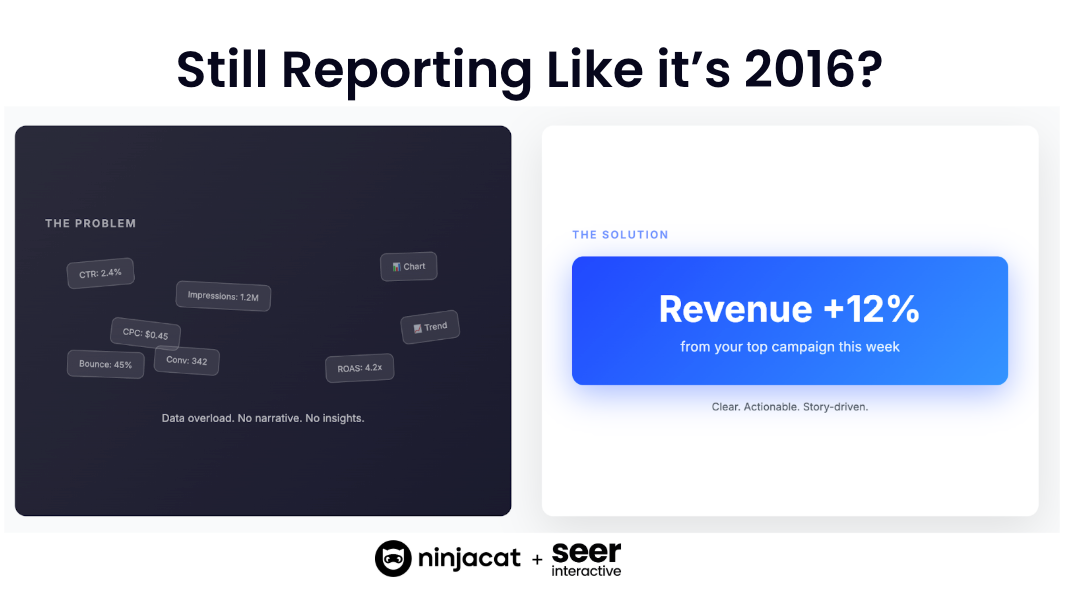
Client reporting has long been one of the most painful parts of agency operations. It’s often bloated, late, and underused. Yet it remains the single biggest lever in proving value, driving retention, and expanding client relationships.
That’s why forward-thinking agencies like Seer Interactive are reimagining reporting from the ground up: replacing dashboards and decks with modular data models, AI agents, and push-based delivery systems that meet clients where they are.
In a recent 4As-hosted webinar, Seer and NinjaCat unpacked what this transformation really looks like.
You can watch the replay above, and for the TL;DW, here’s what you need to know.
At a systems level, most agency reporting stacks aren’t broken, they’re just misapplied.
The issue isn’t dashboards themselves. It’s the assumption embedded in them: that if you give clients access, insight will follow. But that turns reporting into a pull model—log in, explore, self-serve—when most clients operate in a completely different mode.
Decision-makers consume information in fragments, under pressure, and through the channels they prefer, not the tools agencies choose.
The result is usually reporting that technically works but strategically misses.
As NinjaCat CEO Paul Deraval noted in the session:
“The medium matters so much. You have dashboards, PDFs, decks, videos—but if you’re not delivering in the medium your client actually uses, the insight won’t land.”
What works consistently is not more access, but clearer delivery: reporting that arrives already shaped into a story.
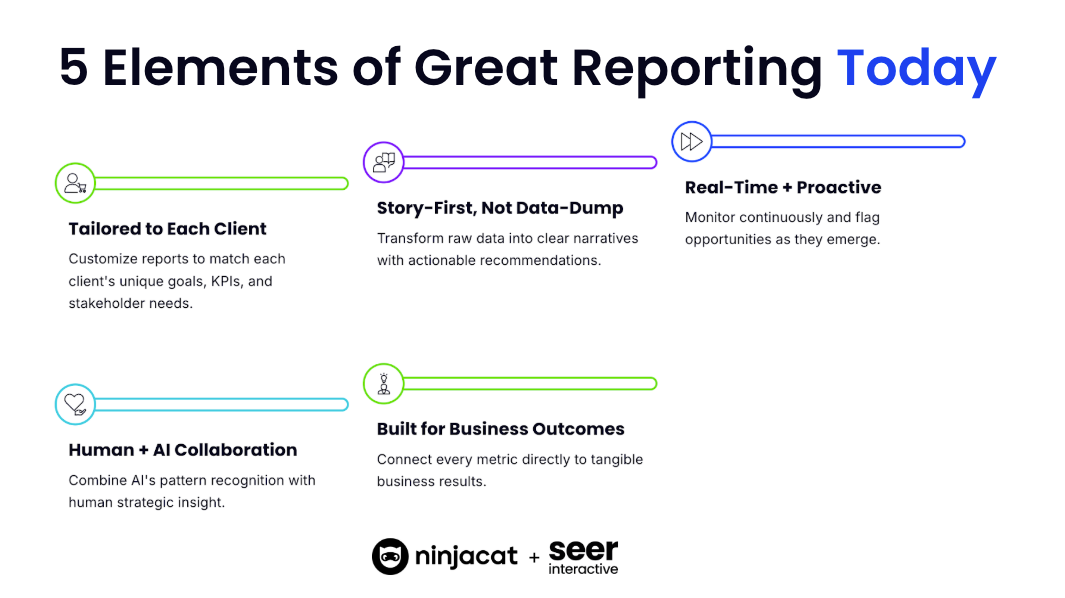
When reporting actually changes the conversation, it tends to follow a recognizable structure. Not because it’s templated, but because it mirrors how people make decisions.
The most effective reports capture these five elements:
The problem most analytics teams face isn’t a lack of rigor. It’s over-delivery without narrative. Great data, no story. That’s where even top-performing teams start to feel reporting drag on strategy instead of enabling it.
As VP of AI and SEO at Seer, Alisa Scharf has always valued, and invested in, aggregated, cross-channel insights, especially the kind of insights clients can’t get on their own. Questions like:
These are the stories clients care about most. They’re also the hardest to answer.
Before NinjaCat, answering one of those questions followed a familiar, heavy process. Someone would ask a question. Data would be pulled through tools like Fivetran. That data would be transformed, normalized, and modeled. A dashboard would be built. Findings would be written up.
And then—almost inevitably—someone would ask a follow-up.
“That’s where everything broke,” Alisa said. “Now you’re back to re-pulling data, re-transforming it, and pushing timelines out another week or two.”
At Seer, this challenge surfaced in a way many agencies will recognize. A senior data leader with their hands in the data, in Seer’s case Tracy, could do it all: utilize appropriate tools, pull data, normalize it, apply marketing data models, and translate findings into insight-rich, client-ready outputs. Internally, she became the connective tissue between performance data and insight.
The value was undeniable. But the process didn’t scale.
“Every follow-up question meant starting the process over,” explained Alisa. “That’s why snapshot analysis breaks. It can’t handle curiosity.”
Seer kept doing it anyway. Because the results were too important not to. But with a timeline from ingestion to proper analysis that might stretch past two weeks, it was clear something had to change.
The breakthrough came when Seer stopped treating reporting as a deliverable and started treating it as a system: one designed to compound insight over time.
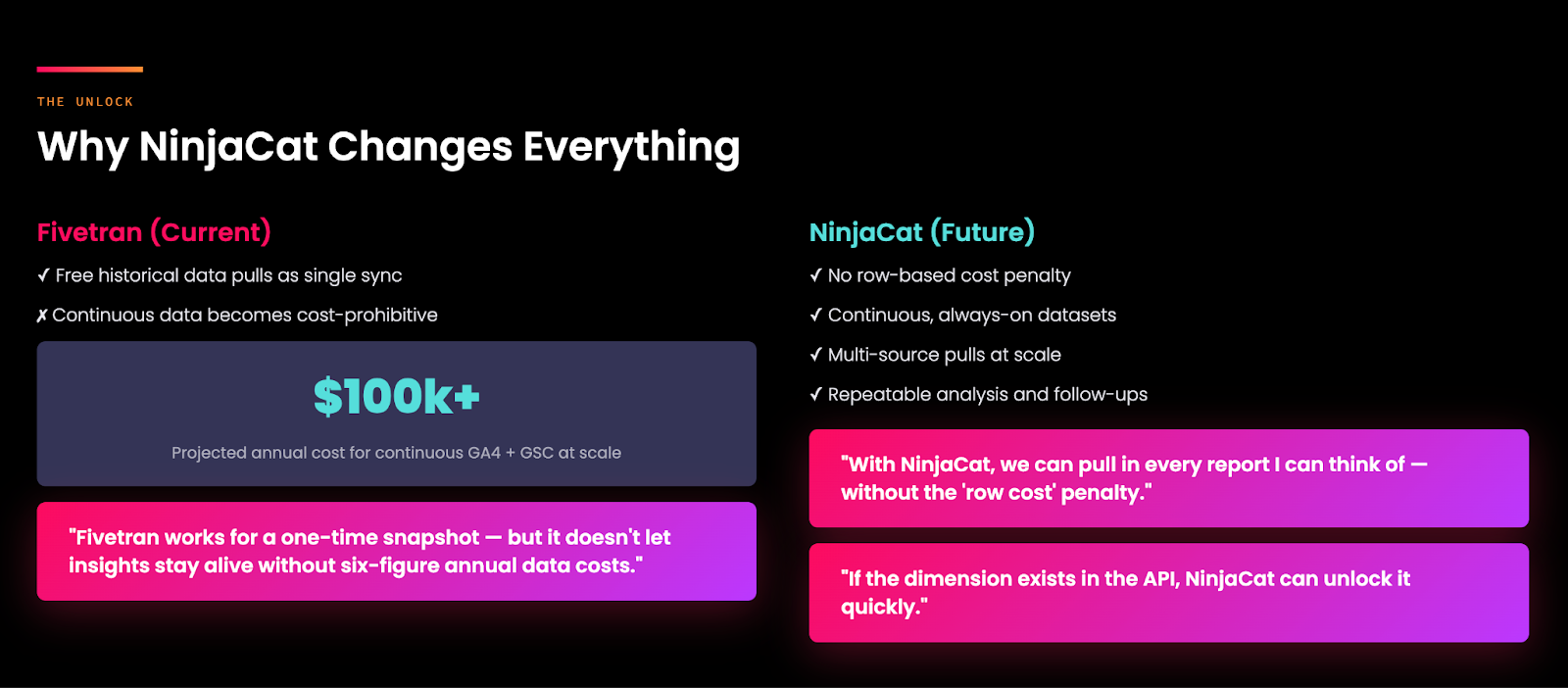
Instead of rebuilding dashboards for every new question, they invested in reusable, AI-friendly data models, accessed through NinjaCat, aligned to the questions they knew would keep coming:
The shift was exponential. Reports that once took weeks were now delivered in a day.
“That was the moment our CFO said, ‘I don’t care about the other slides. Let’s invest in this,’” Alisa shared.
That’s the power of insight velocity: when answers become frictionless, everything downstream accelerates: sales conversations, content creation, retention, even how agencies price their value.
One of the most revealing moments comes when Paul shares a real Seer client deliverable produced through this new system (data has been anonymized).
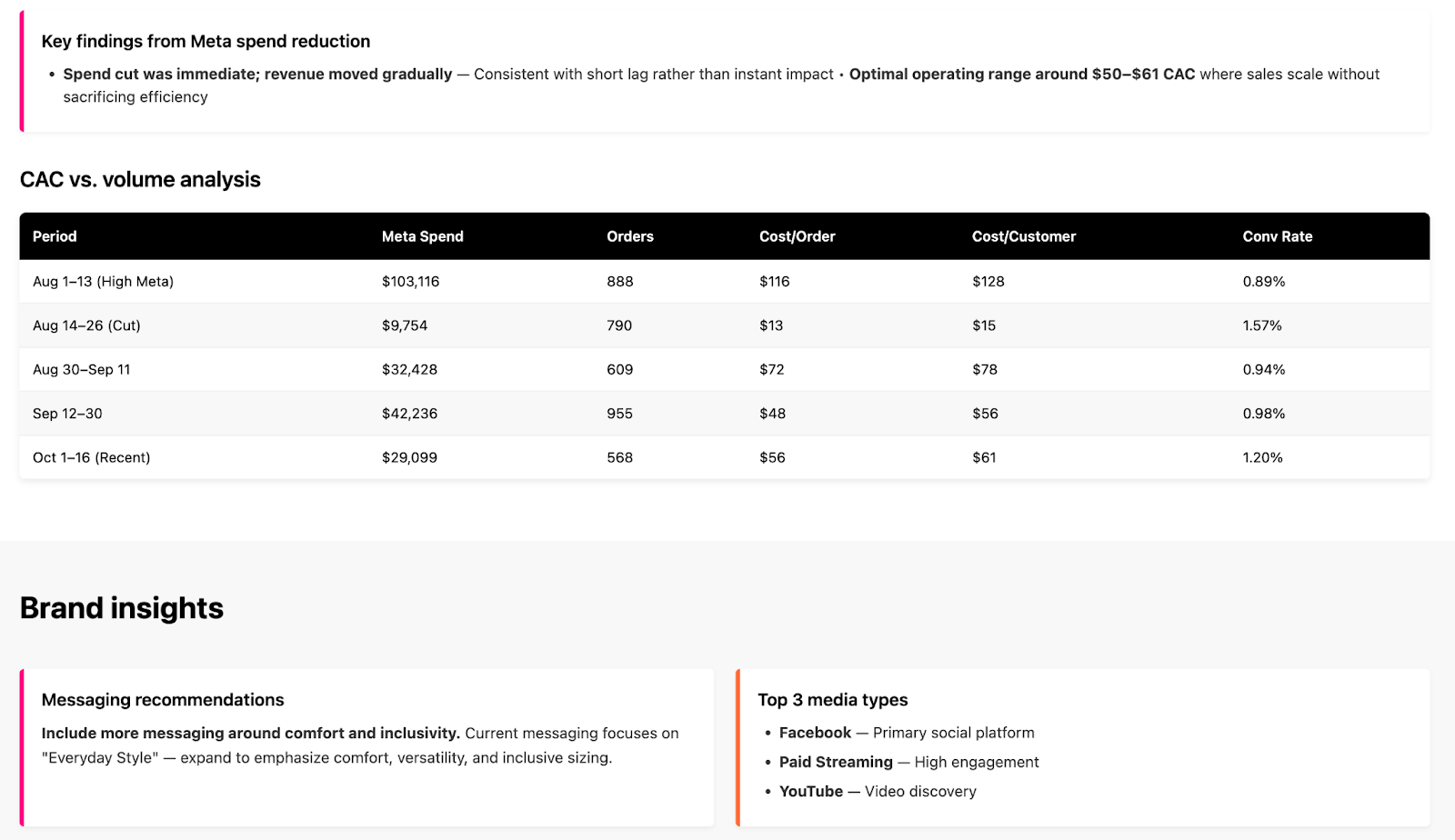
“This looks slick, and more importantly, it doesn’t look like AI slop,” Alisa noted.
The distinction Alisa makes here matters. What Seer is looking at isn’t a rigid dashboard or a recycled template. It’s a narrative that can start fresh each month, shaped around what matters right now for that client, while still anchored to consistent, trusted data logic underneath.
That’s where NinjaCat changes the equation. By separating the data foundation from the storytelling layer, it allows Seer’s team to adapt the narrative without reopening the entire marketing data pipeline. The data stays governed. The story stays flexible. And the medium finally supports the message Seer is trying to deliver.
Another powerful theme in the conversation is context.
Seer is actively working to bring call transcripts and client conversations into their reporting workflows. The goal isn’t automation for its own sake, but continuity.
“There’s so much context in those conversations,” Alisa says. “And clients expect us to remember it, even when teams change.”
By piping that context into NinjaCat alongside performance data, Seer can begin reporting from a place of shared understanding: what the client cares about, what they’ve already said, and what they never want to see again. Reporting becomes less about recounting metrics and more about demonstrating that the agency is paying attention.
This isn’t a session about futuristic reporting. It’s about making reporting finally do the job it’s always been meant to do.
As Paul puts it early on, “If you do client reporting really well, the outcome is retention. And beyond that, expansion.”
Seer’s experience shows what happens when reporting stops being a static deliverable and becomes an active system for AI agent builders, built on unified data, reusable models, and agentic workflows that work with the data, not around it. That’s what great client reporting looks like heading into 2026.
If you've ever wondered if there are AI-powered solutions for analyzing the performance of marketing campaigns, or you want to see what this looks like in practice, let’s talk.
We’ll walk through the same agentic reporting system Seer is building—how the data models are set up, how agents sit on top of them, and how teams use NinjaCat to move from questions to insight without rebuilding the workflow every time.