
Jake Sanders
Content Strategist
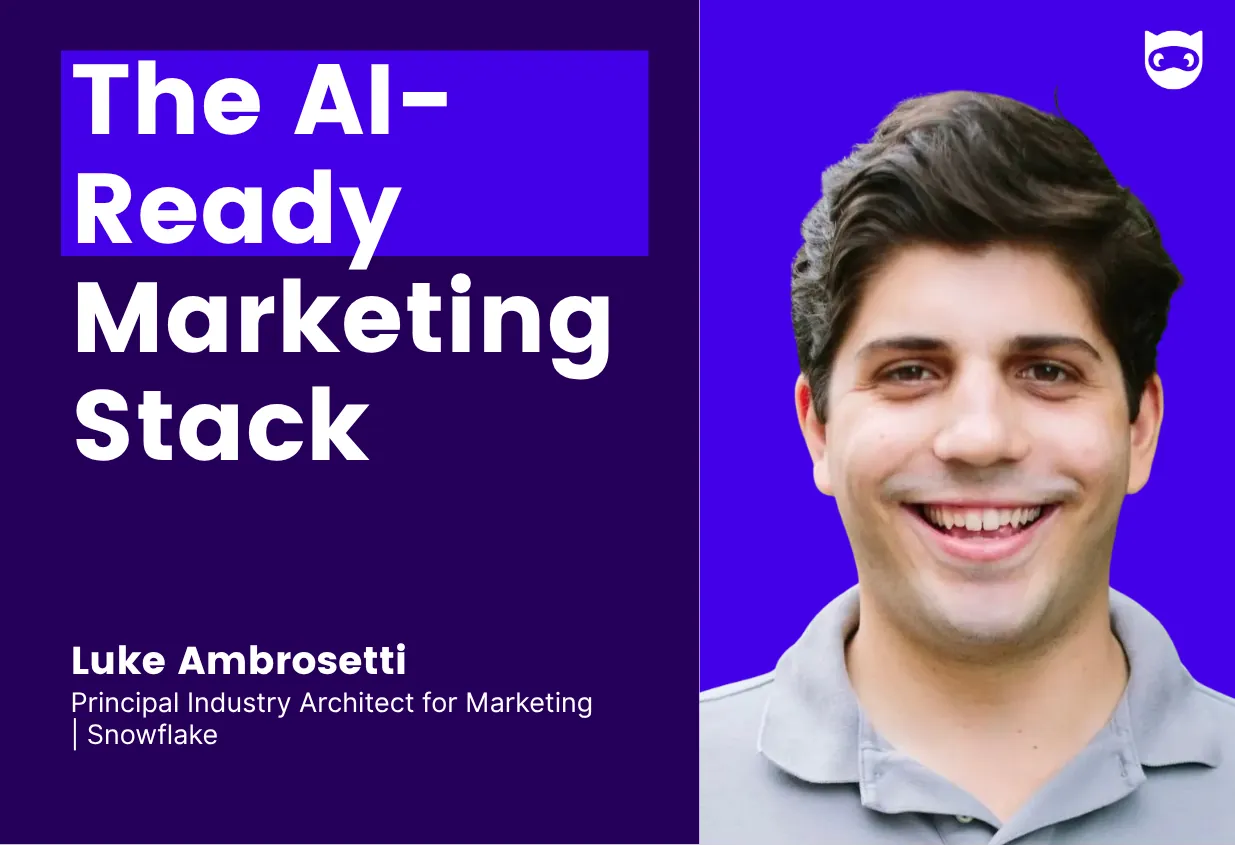
Something has shifted in how brands relate to their own data, and Luke Ambrosetti, Principal Industry Architect for Marketing at Snowflake, has watched it happen in real time.
"Brands have traditionally relied on agencies or martech platforms to help wrangle or own... to help understand their own data," he says, "but what I'm seeing the most is that brands are starting to really want to take control of their own data — of their own processes with data."
This new chapter of the data story, a story Luke’s been following for decades, isn’t primarily technological but organizational. For years, the complexity of managing marketing data at scale made outsourcing the practical choice. Agencies and platforms became the de facto stewards of data that brands technically owned but rarely controlled.
That arrangement made sense when the tooling required to do otherwise was expensive, slow, and demanded deep technical expertise just to operate. What's changed is that AI has lowered the bar — not to zero, but enough to shift the calculation.
"With AI, the bar has been lowered significantly," Luke says. "It wasn't and hasn't always been easy, but with AI it is becoming a lot more approachable for brands to do this themselves."
The word he uses is approachable, and it's worth dwelling on. He isn't saying AI makes the mastery of marketing data analysis automatic or that the hard work disappears. He's saying the path into it is less intimidating than it used to be.
For agencies, that's a signal worth paying attention to. The role of external data steward isn't disappearing, but it is changing shape, and the organizations that don't notice that shift early enough will feel it later.
There's a conversation about Big Data the industry quietly retired, and Luke names it directly at the top of the interview.
"The Big Data era, we’re talking actual storage and the compute — I feel like that's a solved problem," he says. "Just storing it and collecting it is probably more of the easier part now."
The cloud handled it, and the companies that built infrastructure to manage volume at scale did their job. What replaced that problem is harder to name cleanly, which is probably why the industry hasn't been as direct about it.
The clichés that circulated for years — data swamp, garbage in garbage out — haven't gone away. Luke is clear about that.
"They are true problems," he says. "But they've tended to get framed as infrastructure problems, as if better pipelines would resolve them.”
The actual issue Luke sees is interpretation: whether the people and systems working with data can extract something real and useful from it, and whether they're asking the right questions in the first place. Organizations, unaware of the hidden costs of building an AI marketing stack, that treat this as a plumbing issue, will keep attaching more pipes. The ones making genuine progress are treating it as a question of what they actually need to know and whether they're structured to find it.
"Sometimes us nerds, we think about more of the technical perfection and the technical architecture over finding what is that business outcome that the business needs."
Luke jokingly says this about himself as much as anyone else. He isn't diagnosing a problem he sits outside of, but describing a tendency he’s recognized from the inside, which makes the observation more credible and the challenge more honest.
The gap between technical teams and marketing leadership isn't fundamentally a knowledge gap. Both sides understand their own domain reasonably well. It's an orientation problem.
"Technical teams need to focus on providing value to the business," Luke says, "being a part of not just a cost center, but especially within marketing, a part of being a revenue driver."
He's quick to acknowledge this isn't a solved problem.
"I naively thought at one point that might be solved, sooner rather than later," he admits.
It hasn't been. Budgets, competing priorities, and differing definitions of success continue to create friction, and probably always will to some degree.
The practical path out of it for the technical-types, in Luke's view, starts with reframing what data teams actually produce. Not queries. Not pipelines. Products.
"Think about what are your data products — what is your asset catalog that you're actually able to give to your business stakeholders," he says. "If you have a catalog of data products that you can showcase to both your business stakeholders and to leadership as well, that's what you need to start thinking about."
Customer churn probability, propensity to buy, campaign attribution by channel — these aren't outputs of a one-time analysis. They're assets that can be catalogued, discovered, demonstrated, and defended in a budget conversation. The data teams that have built this kind of visibility are the ones that have moved from cost center to partner.
"If you're still very reactive in how you do your work," Luke says, "then that's not gonna win the day for you." That shift is positional, and it tends to happen when someone on the technical side decides to stop waiting to be asked.
Marketing leaders have been told, in various ways, to get comfortable with AI. Most have interpreted that as: use the tools, run the experiments, get familiar with the outputs. Luke is pointing at something more specific, and more demanding.
"I don't always know if marketing practitioners understand, from a data point of view, how does AI work," says Luke. "The better questions is, how have you become AI fluent?"
The definition of AI fluency he's working with has nothing to do with prompting techniques or familiarity with particular products. It's about understanding that the best AI agents in marketing are only as good as the context and semantic layer you provide them.
"If you're not providing context to your AI, you're not gonna get great results from it," he says, and the downstream consequence of that is significant: "Your data team will be speaking a totally different language if you don't make sure that the context and semantics are connected."
In practice, this means that before AI can do anything genuinely useful in a marketing context, someone has to do the work of defining what the data actually means — what a "customer" is in your system, what counts as a conversion, how your attribution model works, what distinguishes a qualified lead from an unqualified one.
The organizations that have gotten AI to actually work — and Luke is careful to say no one has reached the full vision — tend to be the ones where the semantic work came first. The meaning was established before the model was pointed at the data.
"If you're a little bit smarter about becoming AI fluent," he says, "then you can actually go and partner and build that relationship better with your data teams." That partnership, between marketing leaders who understand what they need and data teams who understand what's possible, is where the real progress happens.
It's also worth being honest about the other side of this. Luke is direct that AI is being over-relied on — that organizational policies are being built around it, and processes are being handed to it that probably shouldn't be. He sees this pattern across customers and industries, and describes it as a near-universal concern among the practitioners he talks to. The answer isn't to pull back entirely, but to be precise about what AI is actually suited for, and that kind of precision requires the fluency he's describing.
Calibrating a tool you don't fundamentally understand is difficult, and the organizations that skip the foundational work tend to find that out the hard way.
This is where data infrastructure becomes a strategic question rather than a purely technical one. NinjaCat's integration within the Snowflake ecosystem sits at exactly this intersection — enabling agencies and brands to collaborate on data, share context across partners, and keep the semantic layer intact as information moves between systems. The value isn't in the movement of data alone. It's in whether the meaning travels with it.
The last question Luke gets is the simplest one: if you're a marketer staring at a broken stack, overwhelmed and not sure where to start, what do you do?
"Pick one thing that makes you the most sad looking at that and just go attack that," he says. And then, the part that matters: "Selfishly, pick something foundational. Pick something that you can build upon — that can make the next thing you pick even better, and even faster to implement."
This is a sequencing argument more than a motivational one. The reason most marketing stack overhauls stall isn't that the problems are too large — it's that teams attempt to address everything in parallel, make partial progress across all of it, and end up without anything solid to stand on.
"Once you have that one thing," Luke says, "you feel better about it. It’s a small thing, but you will feel less sad about how things are going."
A foundational fix, whether that's the data layer, the semantic definitions, or the single source of truth for customer identity, gives every subsequent decision a more stable surface to build from.
Each thing that comes after is faster and more likely to hold. The stack doesn't have to be perfect at the beginning. It just has to have a floor.
Listen now: Spotify | YouTube | Apple
Connect with Luke: LinkedIn | Website
Subscribe to What Gets Measured for more conversations like this.