Jake Sanders
Content Strategist
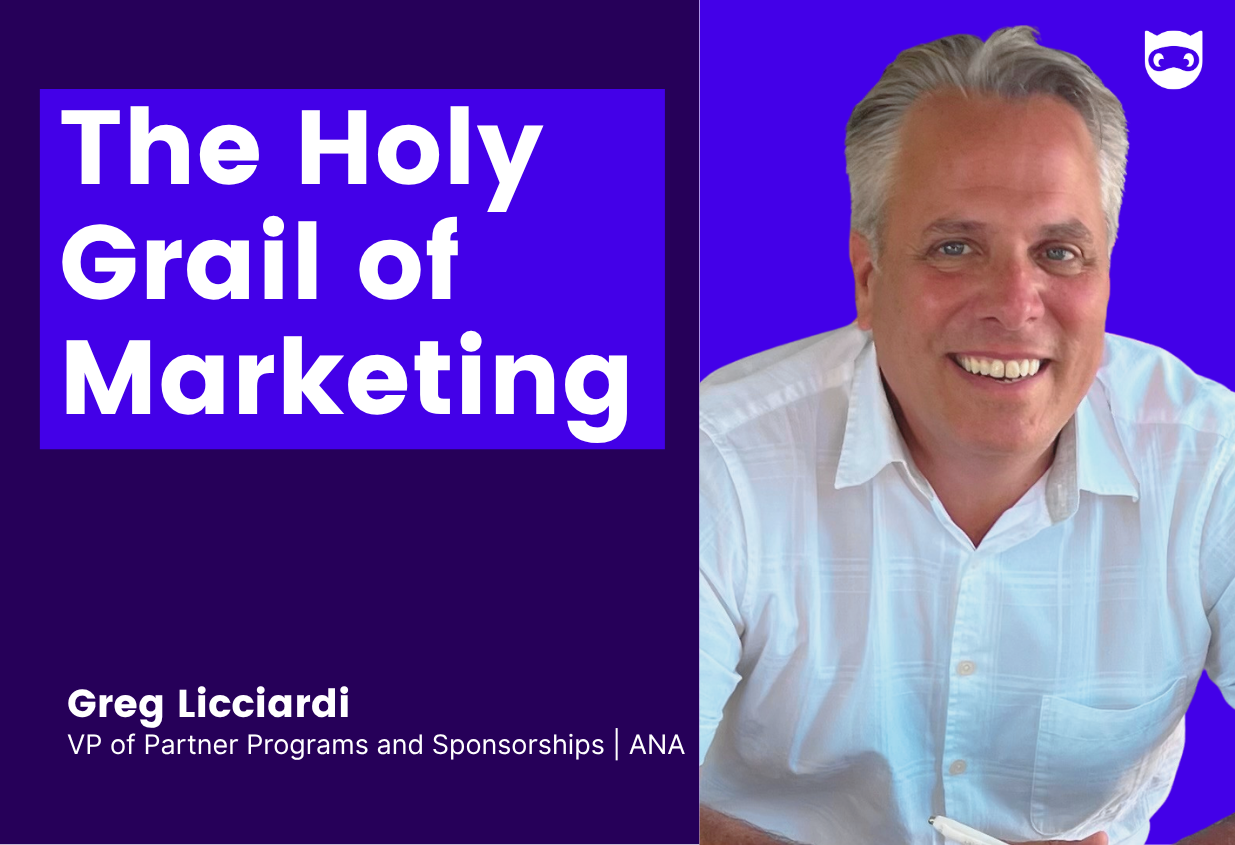
Greg Licciardi has spent his entire career in marketing and advertising — from ad agencies in SoHo to media companies like American Express Travel and Leisure and Univision, to his current role as Vice President of Partner Programs and Sponsorships at the ANA, the Association of National Advertisers. He teaches Integrated Marketing Communications at Fordham and Seton Hall. And about three years ago, sitting on a Zoom call, waiting for a Wendy's order to arrive, he had what he describes as a marketing epiphany.
On this episode of What Gets Measured, Greg talks through the framework that epiphany produced — the five Rs of the Holy Grail of Marketing — and what it takes to actually execute it in an industry that keeps throwing more tools, more pressure, and more complexity at the people trying to do the work.
The Holy Grail of Marketing did not begin with a whiteboard session or a consulting engagement. It began with Wendy's.
"I started receiving Wendy's ads in my social feed on Fridays at eleven AM," Greg explains. "And I said to myself, 'This is the Holy Grail of marketing. It's the five Rs. It's a framework.'"
Wendy's was reaching the Right Person — Greg, a known customer. They were sending the Right Message — offers, not brand awareness. Getting the ads well-before lunch meant the Right Time was locked. The Right Environment was Greg's social feed, where he was already engaged. And the Right Outcome followed: he went back to Wendy's instead of another burger joint.
The framework is straightforward, but the execution is anything but. Greg is direct about what happens when marketers treat the five Rs as a checklist rather than an interdependent system.
"If you miss one of the Rs, everything you've invested in — you can hire a hotshot agency, you can hire a high-tech AI agency — but if you don't look at your outputs and where they're showing up and how they're showing up, all that investment will go out the window."
The five Rs are not five separate problems to solve in sequence. Each one conditions the others. A perfectly targeted message in the wrong environment fails. The right timing with the wrong message fails. The framework holds together or it doesn't hold at all.
Greg wrote “Holy Grail of Marketing” with a subtitle — How to Achieve Optimal Marketing Success Using AI and Beyond — and the word "beyond" carries most of the weight.
"AI does a lot with the where, who, and what," he says. "But the why is missing. That's what us human beings, us expert marketers, that's what we have to really solve for and really help our brands dig into."
The distinction matters practically. AI generates data at a volume and speed that wasn't available to marketers a decade ago. The data is rich, Greg acknowledges — richer than it's ever been. But the data-driven marketing question it cannot answer is why a consumer would want to purchase a brand, use a brand, or trust a brand. That question requires human judgment.
"It takes the human being to take that forward and curate the output," he says. "Don't settle for generic output because it was simple and easy and saved you time."
The risk Greg names is not that AI produces bad work. The risk is that AI produces convincing work — output that looks complete but is missing the motivational layer that makes marketing actually land. Any AI agents for marketing are only as good as the data layer they sit upon. The data is only as good as the insight applied to it. And the insight requires someone willing to ask why in the first place.
To illustrate what it looks like to build from the why outward, Greg turns to Harry's Razors — and to a firsthand account he gathered from John Gillis, one of the company's early hires.
Harry's launched as a direct-to-consumer challenger to Gillette, a multi-billion dollar brand owned by Procter & Gamble. Two founders, a shoestring budget, and a very specific answer to the why question.
"They saw the white space in the marketplace, that unfulfilled consumer need — the why," Greg explains. "They crystallized it down to an affordable razor that could be sent to a young dad's home. That was it."
The clarity of that insight shaped everything. The product design, the price point, the delivery model, the brand voice — all of it followed from one well-defined consumer truth. And then came the execution, which Greg describes as relentlessly iterative.
"It was an iterative process. They constantly tested. They were doing it as they were in the air flying — they had to, because they had a shoestring budget. So every dollar they spent, they tracked ROI, they tracked performance, they measured success."
The right message found its audience. And then that audience carried the message further. "The early customers became disciples," Greg says, "to preach the good word of Harry's." The targeting strategy, in other words, eventually became self-sustaining — because the why was strong enough to travel person to person.
The lesson Greg draws is not that small budgets force creativity, though they often do. The lesson is that a clearly defined why generates a force multiplier that no ad spend can manufacture.
The right environment is the R that Greg says gets the least attention and causes the most damage when it's ignored.
"One size doesn't fit all," he says. "You really have to look at your brand message, your brand ethos — what is it that's so special about your brand that you live and breathe for every employee."
The failure mode he describes is familiar to anyone who has run a programmatic buy: a brand with a clear ethos, a strong message, and a defined audience launches into a broad programmatic buy that isn't monitored. The ads surface on unsafe sites, fake news sites, detrimental sites.
"That's where you lose the right environment," Greg says. "Sometimes the medium becomes the message that you show up in."
Brand safety is the floor, but the ceiling is something higher — what Greg, drawing on contributor Paulina Brown, former president of LVMH North America, calls aesthetic intelligence. The principle is that brand essence is not a positioning document. It is a lived practice across every touchpoint a consumer encounters.
The failure version: a luxury watch brand that executes a beautiful advertising campaign and then staffs its retail floor with salespeople who "can't tell me what a tourbillon is." The consumer who walked in converted by a great ad walks out confused about why they bothered.
The success version: J.Crew.
"You go into a J.Crew store, it's like you're in a bar," Greg says. "They're happy. They're smiling at you, they're throwing pants at you, colors I've never seen before. It's a great experience. I always walk out of there spending more money than I should have."
The difference between the two is not budget or brand size. It is whether the brand's aesthetic intelligence — its attunement, its articulation, its ability to curate an experience — is embedded into the operation or left as an aspiration in a brand guidelines PDF.
"It's gotta be consistently embedded into every part of the brand," Greg says. "Owned and operated sites, retail stores, newsletters — whatever it is."
Greg closes the conversation with something closer to a challenge than a summary.
"It takes courage," he says. "Have the courage to go out and learn about the consumer you're targeting and to deliver a campaign that's truly unique to your brand purpose."
The pressure running against that courage is real. Marketing has gotten faster, more complex, and more bottom-funnel in its orientation. The next board meeting, the next quarterly number, the next reporting cycle — all of it creates an incentive to reach the most consumers at once with the simplest possible message, track the conversion, and call it done.
Greg's argument is that the framework exists precisely to resist that pull. The five Rs are not a productivity tool. They are a North Star — a set of principles that remain valid no matter how fast the tools change, how much automation enters the workflow, or how much AI reshapes what's possible.
"Really slow down a little," he says, "because marketing is an incredible field. Some of the smartest, most creative people are in this field because of their ability to be creative, lay off the gas, and really take data and make it into marketing that stands out — that delivers on that why and fulfills that white space in the marketplace."
The data is only as good as the insight. The insight is only as good as the question. And the question that drives the whole system is the one that still requires a human being willing to ask it: why would someone choose this brand?
Cracking that code is the key to unlocking the map to the holy grail of marketing. For marketers ready to grab the grail, connect with Greg online and pick up his new book at the link below.
Listen now: Spotify | YouTube | Apple
Connect with Greg: LinkedIn | Website
Subscribe to What Gets Measured for more conversations like this.