Jay Snyder
VP, Client Services

When it comes to managing OEM reporting for digital marketing agencies, the process can be incredibly complex. Providing detailed performance reports across multiple brands means navigating complex, ever-changing requirements—and when things go wrong, fines, audits, or lost client trust can quickly follow. But what if your agency could turn this headache into an automated, seamless process that keeps you ahead of the game?
NinjaCat’s Data Services Team has cracked the code on OEM reporting automation, offering a solution designed to save agencies hundreds of hours while ensuring compliance. Here’s how NinjaCat streamlines the OEM reporting process and why it’s a game changer for agencies managing performance data across numerous OEM brands.
OEM reporting involves collecting, analyzing, and sharing performance data between OEMs (like major car manufacturers) and their network of dealers, distributors, or marketing partners. For agencies involved in these co-op advertising campaigns, particularly those that work with Shift Digital, staying on top of ever-changing report requirements is crucial. Not only does accurate reporting demonstrate the effectiveness of your marketing efforts, but it also ensures compliance with OEM objectives—protecting your agency from audits, fines, and reputational damage.
But managing OEM reporting tools manually? That's where the real struggle begins.
Let’s face it—manual data aggregation and formatting for OEM reports can be a nightmare. Between constantly shifting requirements, new KPIs to track, and varying deadlines, keeping everything straight can feel like a full-time job. Here are just a few of the challenges agencies face:
For many agencies, OEM reporting has become a time sink that prevents teams from focusing on more strategic, high-value tasks. That’s where NinjaCat comes in.
NinjaCat’s OEM reporting automation doesn’t just simplify the process—it transforms it. Our platform integrates with all your data sources, streamlines the reporting process, and automatically formats reports to meet Shift Digital’s exact specifications. Here’s how NinjaCat adds value for your agency:
NinjaCat isn’t just another data-driven marketing tool—it’s a partner in ensuring that your agency is always compliant, efficient, and ready to scale. Our ongoing services proactively maintain your reporting workflows so you can focus on what matters most—driving performance for your clients.
OEM reporting on NinjaCat goes well beyond a monthly file export. One marketing agency working with auto dealers runs more than 250 OEM and co-op templates across a dozen manufacturers, including Kia, GM, Stellantis, Subaru, BMW, Genesis, Mazda, Ford and Honda, and generates roughly 15,000 OEM reports a year.
That work happens in three layers:
The question shifts from "did the export go out?" to "is every co-op dollar accounted for and compliant?"
Answering that question at scale is where AI agents now do the heavier lifting.
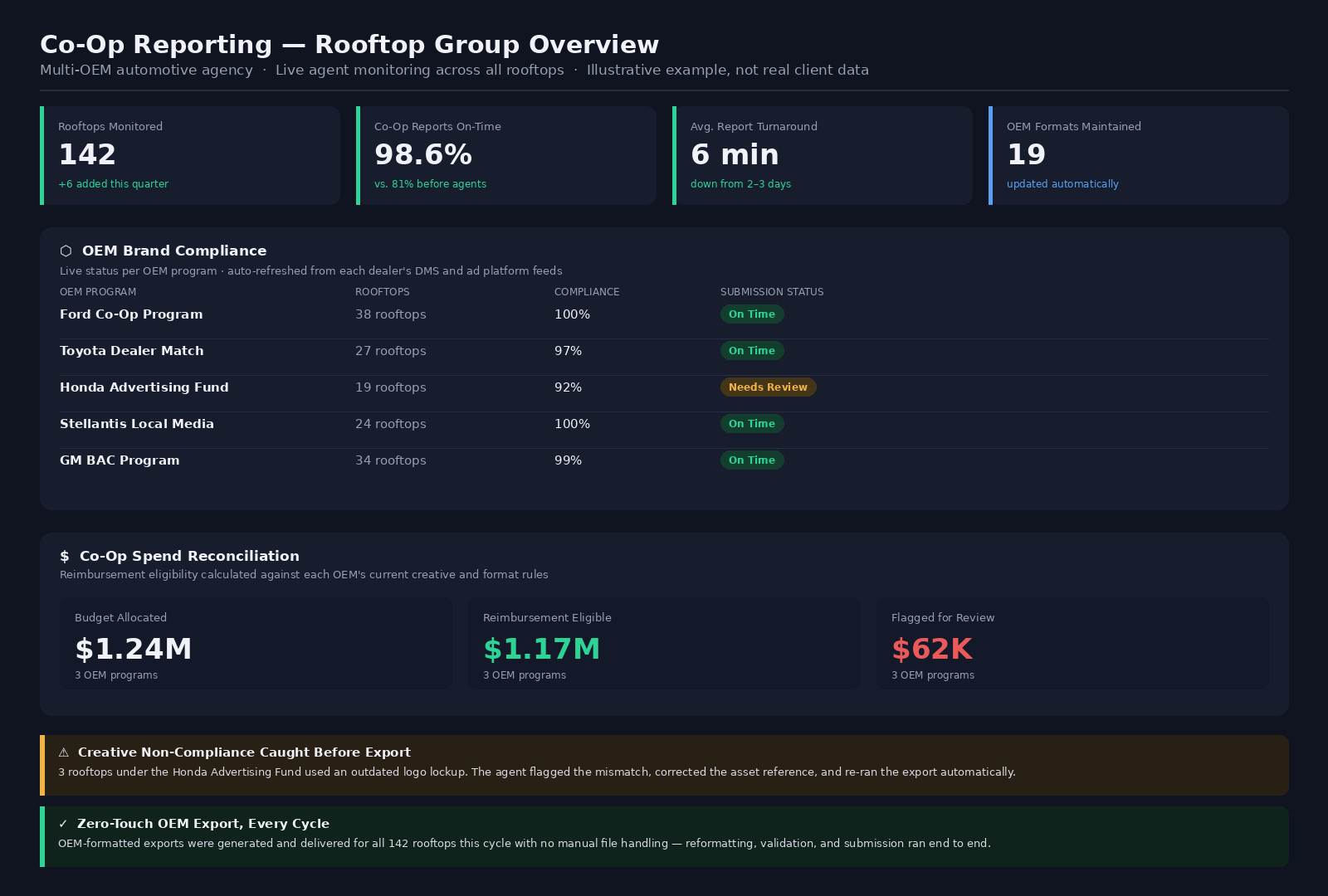
NinjaCat's AgentOS (agent operating system) is designed to run agents assigned to the account level — which, in an OEM reporting context, means the individual dealer rooftop — so every rooftop keeps its own co-op rules, its own OEM compliance requirements, its own inventory feeds, and its own local budget, while an agent team works against all of it continuously instead of on a monthly scramble. Co-op report turnaround that used to take days now takes minutes, because the agent pulls, validates, and formats the data the moment it's available.
Compliance works the same way. Instead of a team member catching an out-of-spec creative or an outdated logo lockup during review — or, worse, an OEM catching it during an audit — agents check brand and co-op rules as the export is being built. If a rooftop's creative doesn't match current OEM guidelines, the agent flags it, corrects what it can, and re-runs the export before anything goes out the door. The compliance check stopped being something a team performs and became something the system enforces automatically, every cycle, for every rooftop.
For agencies managing dealer groups at scale, this means the reporting operation doesn't need to grow headcount in step with the number of rooftops or OEM programs it serves. One governed view at the agency level, with every rooftop still getting its own pacing, its own co-op reconciliation, and its own report, formatted exactly the way each OEM requires it.
The same approach works beyond cars. Another marketing agency working with powersports and marine dealers has built more than 80 co-op report templates for manufacturers such as Polaris, BRP, Harley-Davidson, Kawasaki and Yamaha. Each dealer gets reporting that matches its manufacturer's co-op program, without the agency rebuilding it for every rooftop.
Below is a sample of what that looks like inside NinjaCat — an illustrative dashboard showing co-op compliance status across OEM programs, spend reconciliation against reimbursement eligibility, and an agent catching a creative compliance issue before export:
Yes. Daily OEM files can be scheduled to land at a fixed time, such as early morning before the OEM's cutoff, in the column layout the program specifies, broken out by dealer code, channel, campaign type, campaign and ad group. Once it's set up, the file goes out every day without anyone touching it.
Every export is logged: what was sent, where it went, when, and how many rows. When an OEM partner questions a missing drop, the agency can show exactly what was delivered.
Yes. Teams can get notified when an export fails, so they can fix and re-drop it instead of hearing about it from the OEM. Built-in QA reports also flag accounts with missing tracking or missing analytics data before anything is submitted.
OEM reporting depends on mapping campaigns to the right tactic, program and dealer, and real-world naming is messy. NinjaCat sorts campaigns by naming rules, and QA checks catch the ones that don't map, so naming errors get fixed before an OEM audit, not after.
Yes. Agents can compare monthly and daily OEM views row by row and flag the differences, a check that agencies used to do by hand in huge spreadsheets.
Yes. Accounts can be grouped by dealer group, OEM brand or program, so one report or dashboard rolls up every rooftop. Dealers can still get a view of their own store.
Yes. Co-op dashboards break eligible spend out by tactic, from geo-addressable display and CTV to retargeting, online video, audio and foot-traffic campaigns. Dealers and OEM program managers get one consistent view instead of a stack of platform screenshots.
OEM programs change often: new campaign types, new columns, new channels. Because OEM templates are built once and shared across every dealer in the program, an update is made in one place and applies to every rooftop.
That's the question that matters most, and the best way to answer it is with your own data. In one agency's side-by-side test of NinjaCat against its existing OEM process, the team concluded: "This is more accurate than what we're currently providing… I'd be comfortable switching it on." They went live with their first OEM programs right after.
No. The same approach supports any manufacturer co-op program: powersports, marine, outdoor power equipment and more. Each dealer gets reporting that matches its manufacturer's co-op requirements.
The same data that powers your OEM files also powers client reporting, dashboards and AI agents across every dealer you manage.