
Jake Sanders
Content Strategist

In 1961, BBDO became one of the first enterprise advertising agencies in the world to install an IBM 1401. The machine weighed roughly a ton, leased for around $2,500 a month, and required its own climate-controlled room. The agency used it for media billing and reconciliation — work that had previously been handled by teams of clerks running mechanical calculators.
Leadership could point to it as proof of technological advancement. Clients could be walked past the massive machines to ‘ooh’ and ‘ahh.’
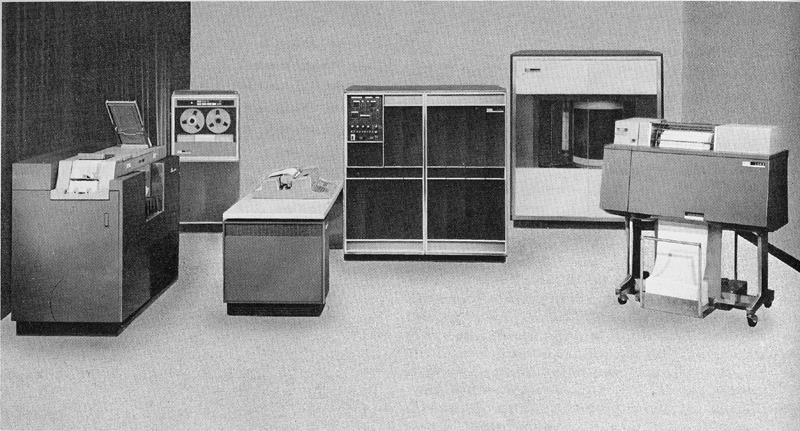
While some staff in the agency took time to truly adopt the technology and learn the new machines, most people in the building never touched them.
With the machine in the process, behaviors started to change. Planners now completed standardized forms. Keypunch operators converted the data into cards. Programmers assembled batch jobs. The computer eventually produced a report, a media schedule, a billing reconciliation. The work that arrived at a client's desk looked the same it always did. Faster, perhaps. More precise in places. But the client deliverables gave no indication that a mainframe, or a behavior change, was involved.
Maybe something similar is occurring with AI, the latest machines to receive enterprise marketing's 'oohs' and 'ahhs?'
The organizational change that happens in martech adoption in an organization, isn’t that every employee becomes experts in technology, but that employees learn adaptations. Employees learn the new deadlines, classifications, procedures, and authority structures that form around the machine. Technology has historically reorganized workers, long before it transforms the work.
AI is entering enterprise marketing at a different point in the interface curve — the tools are accessible to nearly everyone from the start, but the AI maturity gap is still very real. The deeper adoption problem with AI today, is remarkably similar to the ways IBM mainframes of the past changed behaviors in an organization. Access to powerful technology does not tell an agency, brand, marketing team how to reorganize work.
BBDO could afford to own the IBM 1401. Most agencies at that time could not. The industry's answer was the service bureau, a type of computer rental arrangement.
One such service bureau, Donovan Data Systems, founded in 1964, let agencies rent mainframe capabilities — media billing, traffic management, accounting — without owning or operating the infrastructure themselves. The complex machinery became a service. The service became a standard. And Donovan Data Systems, over the following four decades, evolved into what is now MediaOcean — one of the major platforms that underpins media buying workflows for a significant portion of the agency world today.
Nobody running campaigns on MediaOcean today thinks of themselves as "using a mainframe." The legacy service bureau infrastructure became invisible. The work it enabled became ordinary. What remained visible — and differentiated — was the judgment agencies brought to the work the infrastructure made possible.
That sequence has repeated across every major technology marketing has absorbed. The enterprise installs the machine. The intermediary packages the complexity. Costs fall, standards emerge, and capability becomes infrastructure. And the question of what an agency actually offers its clients sharpens back to the only thing that infrastructure cannot supply: the alpha, the expertise, the relationships, and the accumulated judgment that no competitor can replicate.
The current AI adoption numbers look strong on the surface. McKinsey's State of AI report found that 72 percent of organizations have adopted AI in at least one business function — up from 55 percent the year prior. Trade coverage reads the increase as momentum, and it i. But the number measures access, not impact.
NinjaCat's own 2026 research into AI Maturity Across the Analyze, Optimize, Act Cycle — surveying 532 marketing leaders across agencies and enterprise brands — found something more specific underneath the headline confidence. Ninety-one percent of respondents said AI had streamlined their workflows. Eighty-five percent reported strong data visibility. But the same respondents told a different story in the next set of questions: 72 percent said their reporting was still highly manual, and 77 percent reported that data preparation alone consumed between three and ten hours per report.
Same survey. Same respondents. Two different realities.
The most plausible explanation is not that respondents are wrong about their tools. It is that they are answering based on what they believe about their setup rather than the lived experience of working inside it. Adoption became the answer before value became legible — exactly the dynamic that played out with marketing automation, social media, and the IBM 1401 before either of those.
For enterprise marketing teams at agencies or brands, the question is not whether to adopt AI. Adoption is already underway. The more consequential question is what organizational conditions determine whether AI spending produces durable value or just faster output.
NinjaCat's research identified the top eight percent of AI-mature organizations — the ones that have moved from AI as an add-on to AI as an operational layer running across analysis, optimization, and execution. Three characteristics separate them from the other 92 percent.
Leadership defines the standard. In AI-mature organizations, adoption is not a grassroots experiment — it is something leadership expects, invests in, and holds teams to. Without that, AI initiatives stay siloed.
One data layer. AI-mature teams operate from a shared surface — a single place to align, decide, and act from. Not a dashboard per team. Not spreadsheets reconciled after the fact. One centralized layer that makes coordination possible rather than aspirational.
Coordination treated as infrastructure. The top performers built the organizational conditions — shared definitions, clear ownership, documented workflows — before layering AI on top. Most teams are still waiting for the right tool to make coordination easier. The sequence runs the other way. The conditions enable the tools; the tools do not create the conditions.
The throughline across all three: AI is an amplifier. When the organization is fragmented, AI accelerates fragmentation. When the organization is aligned, AI compounds the advantage.
Every capability enterprises build first eventually becomes standardized and available to the broader market. The IBM 1401 that leased for $2,500 a month in 1961 was, within a few decades, displaced by personal computers costing a fraction of that outright. The bespoke marketing automation systems enterprises built in-house in the early 2000s became SaaS platforms available to any agency with a credit card.
Data ingestion, normalization, governance, system integrations, permissions, and security maintenance are essential to AI-enabled agency operations. They will follow the same curve — standardized, packaged, and available to anyone willing to pay for access. Even if there are significant hidden costs to building your own AI marketing stack, building proprietary infrastructure is possible with the tech. But differentiating on infrastructure becomes harder as productization does its work.
The proprietary layer worth building and protecting consists of domain knowledge, vertical expertise, client understanding, and the decision frameworks that reflect years of accumulated practice. The judgment that recognizes when a recommendation is right and when the underlying data is misleading. The methodology that took fifteen years to develop. The client relationship that no automated workflow replicates.
Paul Deraval, CEO of NinjaCat, frames the distinction directly: "What you build has to be based on something your clients actually experience — the agents your team runs, the data apps you put in front of clients, the outputs those agents produce. That is your alpha. That's where your differentiation lives. What isn't your alpha is the infrastructure underneath it. Data ingestion at scale, memory architecture, governance, role-level permissions — NinjaCat has spent 13 years on the data reliability piece alone. That's not a knock on anyone's engineering ability. It's an honest accounting of what it takes to do it right."
The agencies that benefited most from computing were not the ones with the largest machines. Long-term value emerged as computing moved out of the dedicated room and into the ordinary structure of how work got done — in the schedules planners followed, the reports clients received, and the decisions campaigns reflected.
AI might follow its own path, but the pattern is consistent: purchasing the future and reorganizing to benefit from it are two separate events, and the work that separates them has never been about the machinery, but about the team.
When AI capabilities become ordinary infrastructure — and based on sixty years of evidence, they will — how will you build your alpha with AI agents? What will still belong uniquely to your agency?
NinjaCat provides the data foundation, governance, orchestration, and agent-building environment that lets enterprise marketing teams deploy AI against what makes them different — without rebuilding the infrastructure underneath it. See how it works.