Jake Sanders
Content Strategist

Given all the latest news about frontier AI, model changes, ambitious claims, and the fact that the pace of change doesn’t seem to ever let up, a lot of marketers are playing the wall, dipping their toes into the technology, but ultimately waiting for the AI dust to settle.
NinjaCat’s AI Maturity research of 532 marketing leaders found that 91% of respondants believe AI has streamlined their workflows and 85% report strong data visibility. Yet 72% still describe reporting as highly manual, and 77% spend three to ten hours preparing data for every report. 63% say their performance data is fragmented across multiple platforms and spreadsheets.
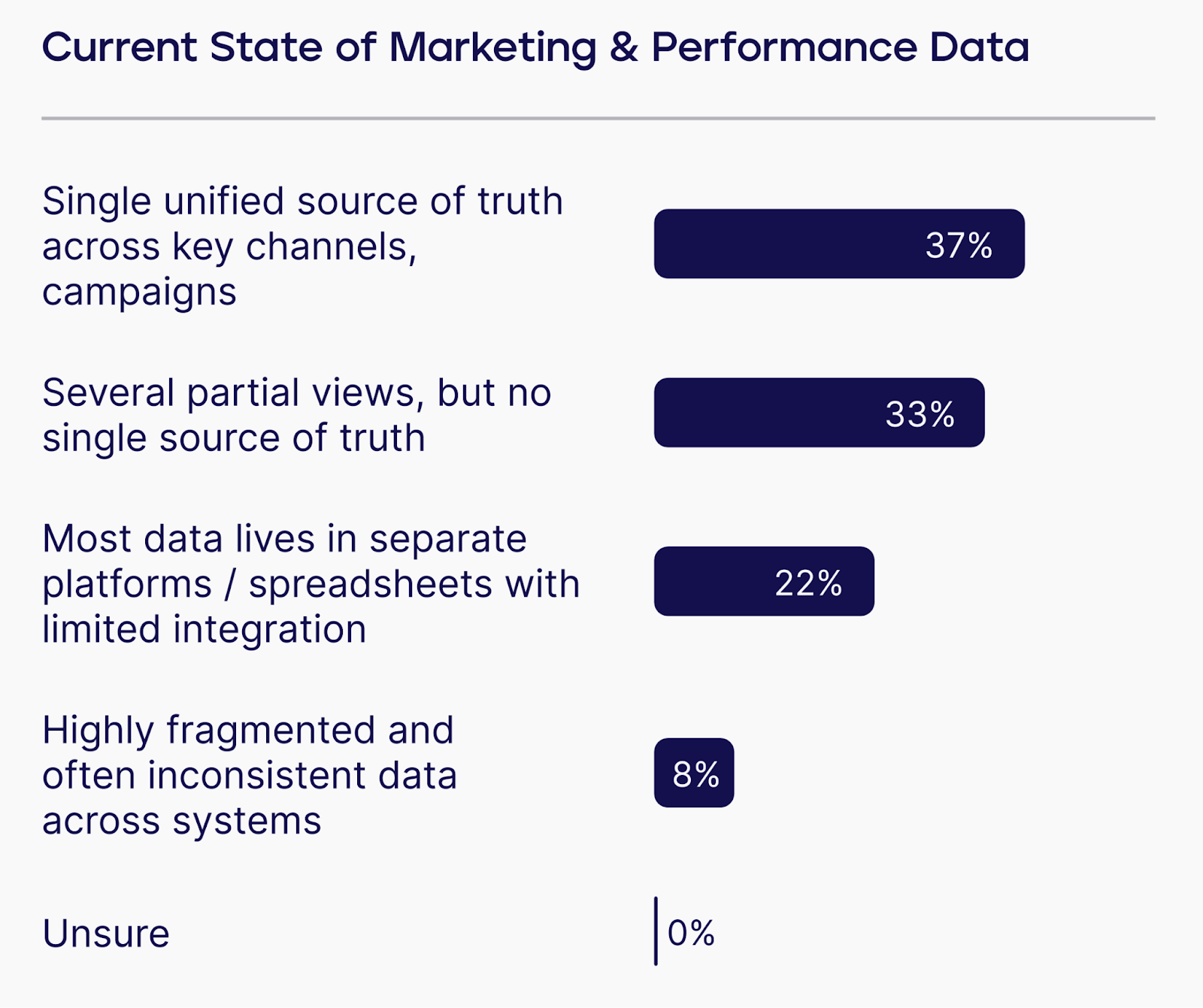
Our research found that 89% of teams rely on at least three different tools to identify performance issues and implement campaign changes. Nearly half use five or more.
Only 8% use AI to orchestrate workflows across tools and teams.
Every marketing organization is already invested in an operating model, which is engineered to collect data, reconcile metrics, monitor performance, prepare reports and decide what deserves attention. If that work is spread across disconnected platforms, spreadsheets and individual employees, postponing change means choosing to keep funding that system.
That is the real divide taking shape in marketing.
Not between organizations that use AI and those that do not, but between organizations adding AI to the existing way of working and organizations building a new operating model around it.
Most fragmented martech frankenstacks were assembled rationally.
The organization bought a data ingestion platform to move information. It added a cloud warehouse to store it. It licensed a business intelligence platform to visualize it. Now, another platform promising AI agents for marketing is being considered.
Each tool solves a legitimate problem. The warehouse stores data. The ingestion platform moves it. The BI platform displays it. The agent platform reasons over it.
The “inefficiencies” appear between the tools, and looks like the daily work of marketers.
Someone must determine which sources belong to which clients. Someone must normalize names, currencies, time zones and conversion definitions. Someone must notice when a an anomaly happens, a connector fails, or a dashboard contains stale information. Someone must reconcile discrepancies and turn the results into something a client can understand.
The stack works because people make it work.
That labor is rarely recorded as a technology cost. It hides inside spreadsheet checks, dashboard revisions, Slack messages, recurring meetings and explanations of why two reports disagree.
The Frankenstack is a permanent internal data product that the organization must build, govern, operate and debug, not simply a collection of software.
The visible costs of a marketing stack are easy to identify:
The complete cost is much larger:
Instead of the simplistic math of Software = Cost, the real equation ends up looking like:
Software + implementation + platform labor + manual work + rework + risk + lost capacity
If an account team spends only 90 minutes per client each month collecting, checking or reconciling data, an agency with 100 clients consumes 1,800 hours a year. At a loaded labor cost of $75 per hour, that means racking up $135,000 in annual work, and that's before dedicated data engineering or reporting costs are included.
The agency may call this account management. Economically, it is the integration expense of the Frankenstack.
Since NinjaCat’s data cloud, our suite of integrations and data connectors, proprietary data sets from decades of marketing/advertising, and agent OS allows marketing teams to eschew the traditional concerns around frankenstacks, the difference between owning tools and operating a system becomes clearer when the organization changes the questions it asks.
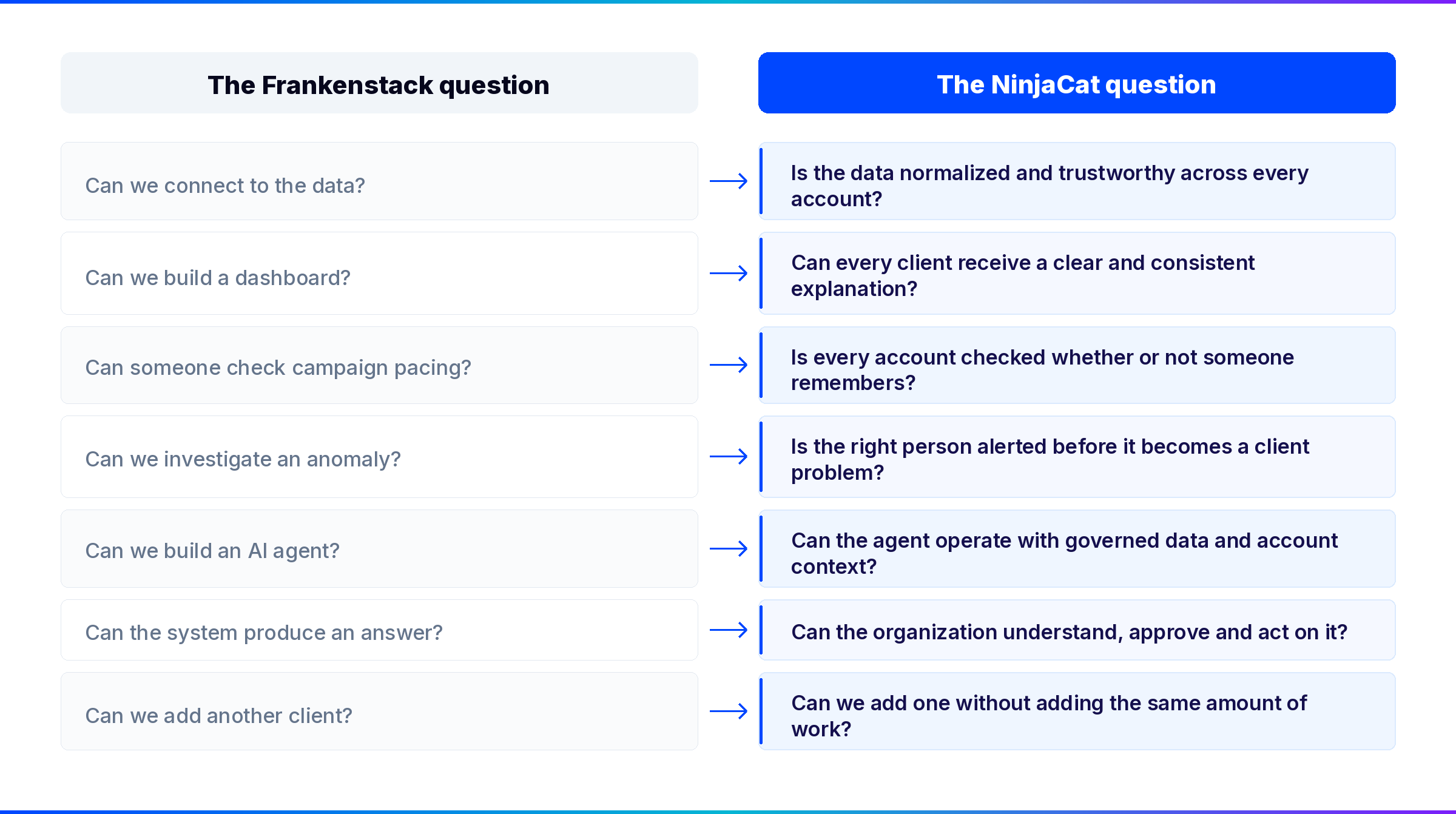
The Frankenstack question is usually about technical possibility.
The NinjaCat question is about reliable operation at scale.
Almost anything can be built with enough platforms, engineers and time. The more important issue is whether the workflow can run consistently across hundreds of accounts without depending on manual assembly and individual heroics.
An organization that postpones change is not merely keeping its current software contracts.
It’s holding onto the spreadsheets employees created because the dashboard couldn't answer a client’s question. It’s preserving the undocumented query only one analyst understands. It’s clutching to conflicting metric definitions and the weekly ritual in which account managers manually inspect performance because no system consistently tells them where attention is needed.
Postponing digital transformation also entombs an org into a costly way of scaling.
As the number of clients grows, so do the connectors, exceptions, dashboards, checks and reporting requirements. The organization responds by adding analysts, account managers and operations staff. Revenue grows, but the work required to support that revenue grows with it.
Margin is consumed by coordination. Client onboarding remains slow. Important knowledge becomes concentrated in a few employees. Problems remain hidden until someone happens to look. Reporting crowds out analysis, and analysis crowds out strategy.
Doing nothing means continuing to normalize thousands of small tasks that prevent the organization from becoming more scalable.
Adding AI to the top of a Frankenstack does not resolve its fragmentation.
An agent can summarize a report, but it still needs trustworthy data. It can identify an anomaly, but it needs to understand the client, campaign, objective and threshold. It can recommend an action, but the organization needs a way to evaluate and approve that action.
Without this foundation, AI can accelerate the production of answers without increasing confidence in them.
The result is another platform to operate and another output to check.
The real competitive threat is not that another agency has access to a better model. It’s safe to assume that capable models will be broadly available.
The threat comes from competing organizations that operationalize the capabilities of AI first.
They will monitor more accounts more frequently. They will identify problems earlier. They will produce reports with less assembly work. Their people will spend more time interpreting results and less time locating them. They will add clients without reproducing the same operational burden.
The strategic divide will not be between agencies that use AI and agencies that do not.
It will be between agencies that build their alpha with AI as part of a governed operating system and agencies that add AI to a collection of disconnected workflows and tools.
NinjaCat brings governed marketing data, account context, reporting and AI agents together in a platform built for multi-account marketing.
Instead of requiring employees to carry data and context between platforms, NinjaCat makes those relationships part of the system. Instead of relying on someone to remember every check, agents can monitor reporting, QA, pacing and anomalies across accounts.
This is how NinjaCat makes the invisible missing work visible.
Once the work becomes visible, the organization can decide what should be automated, what requires approval and where human judgment creates the most value.
The relevant comparison is not NinjaCat against the price of one reporting platform or one agent builder.
It is NinjaCat against the complete cost of the alternative: the platforms, the integration work, the manual checks, the problems discovered late, the employees consumed by assembly and the clients the agency cannot add without increasing headcount.
Waiting for AI to settle may feel cautious.
But doing nothing is still a choice.
For many marketing organizations, it may be the most expensive one.