Jake Sanders
Content Strategist
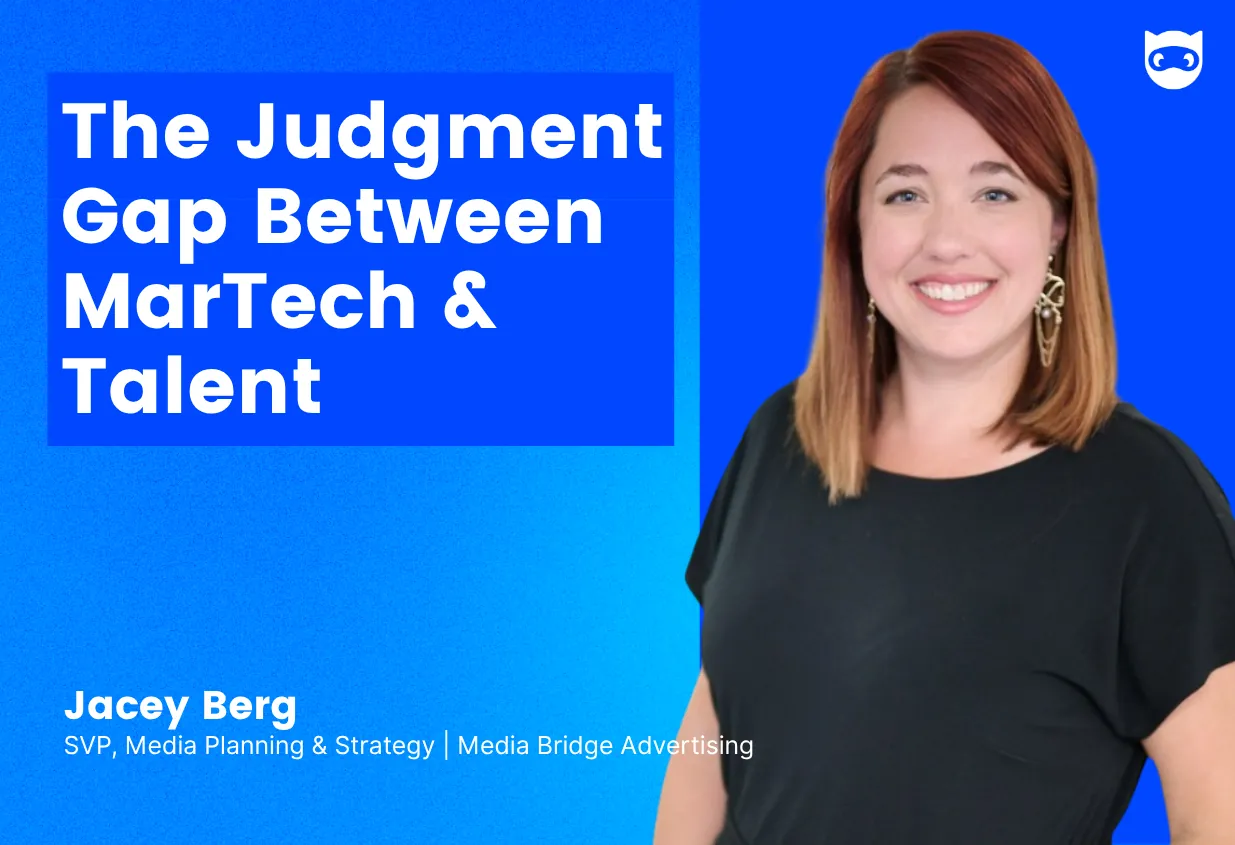
Marketing technology has always been good at speeding up work, but has our education on what constitutes “good” increased and evolved in tandem? AI can tell you what worked, but who makes the call on whether the work is actually good?
Jacey Berg, SVP of Strategy and Planning at Media Bridge Advertising, a women-owned full-service advertising agency, has spent nearly two decades in the strategy and planning discipline. In our interview, Jacey articulates a concern that simmers below the martech conversation and AI: this technology is arriving at precisely the moment when companies are reducing junior roles, limiting training budgets, and expecting immediately usable work. AI is accelerating production which is having an effect on the environments in which professional judgment develops.
The challenge for marketing organizations is no longer simply teaching people to use AI in martech, but ensuring that teams still acquire the experience needed to question what AI produces.
Jacey traces her own development of professional instinct not to a training program or a methodology, but to an environment. Her first agency gave her bounded decisions she could own, defend, and revisit. In that role, Jacey’s boss offered feedback that distinguished between personal preference and actual error.
"If we were working on something, she would say, ‘this isn't how I would've done it, but you did a really good job’ versus ‘you did this wrong.’ I had room to chase theories and be wrong," says Jacey.
That environment produced a feedback loop that’s very familiar to science fans: form a hypothesis, see what happens, explain the reasoning, receive criticism from someone with more experience, revise the understanding, try again. Looping through the scientific method is how exposure becomes expertise. It requires time, low-stakes opportunities to fail, and someone senior enough to give a correction worth receiving.
Jacey specifically mentions what breaks the learning loop. It isn't ego, though ego plays a role, but pressure.
"The modern expectation is that everything is done perfectly,” explains Jacey. “We've decided there's no room to be wrong, chase ideas, try something different. That pressure leads to defensiveness."
Jacey goes on to explain why it’s hard to develop judgement in an environment of defensiveness. A marketer whose primary response to criticism is self-protection learns to produce safer work, not better work. The loop then switches to “how quick can I get this off my plate?” instead of asking "what can I learn from this?"
There’s an organizational implication Jacey points out directly, because judgement tends to get framed as a talent problem when it is often an environment problem. Companies describe good instincts as an individual quality — someone either has them or doesn't.
Jacey's experience suggests judgment develops where people can be wrong without being punished for it, and stalls where every assignment must be immediately client-ready, polished, and unambiguous.
When AI enters this context, it makes the organizational/environmental problem harder to see.
Generative AI can imitate the surface characteristics of expertise, but how do we evaluate expertise? The output might be structured, plausible, and complete enough to pass initial review — especially from someone who hasn't built the judgment to evaluate it critically.
A recent MIT study found that over-reliance on generative AI leads to reduced memory retention and reduced critical thinking. Jacey's explanation of the mechanism is precise: "It's because you're having someone else do all the work to think. And generative AI doesn't think. It pulls information from a variety of sources, it finds patterns, combines ideas. That's not thinking and ideation — that's pattern recognition."
The output looks finished before anyone has decided whether it is good. A recommendation can be factually coherent and still be strategically useless — missing the client's actual objective, the constraints that matter, the competitive context, the trade-offs the organization is willing to accept. None of those things are in the prompt.
Jacey doesn't argue against using AI. She uses it constantly, but for specific, bounded tasks: finding a peer-reviewed study, sizing an audience, navigating regulatory updates in healthcare. "I'm not having it build from A to Z," she says. "AI helps me review the process but it’s not the final producer."
"We have to really remember to use our expertise and our critical thinking, not to just take generative AI at face value," Jacey says. "Go back to basics, go back to the brief, brainstorm. Marketing is best when it's collaborative, a combination of arts and science."
Her practical instruction: "Don't assume it's right. Don't assume it's smarter than you because it's a computer, and push back on generative AI the way you would with a peer or a junior employee."
And the standard she holds herself to: "We first have to value our own expertise before someone else can value it. If you want your expertise to be valued, you need to feel it is valuable as well — and not just replicable in ChatGPT. I think some people are starting to forget that once upon a time they knew what good looked like."
Jacey's challenge isn't to the efficiency argument for AI, but what happens with the efficiency once it's captured, and if efficiency is confused for effectiveness.
"I can't tell you how many times I ask clients, 'What does success look like to you?' And they'll say, 'Oh, click-through rate.' And I have to tell them, that's one way to measure success, but there are others," says Jacey. "Are you looking for an increase in unaided awareness? Incremental leads? More efficient CAC?"
A media KPI is not a business objective. AI-driven optimization makes the gap between the two easier to ignore. Jacey cites a specific example, a Meta Advantage+ campaign can improve cost-per-click indefinitely while the underlying objective goes unexamined.
"Anyone can use AI to run a Meta Advantage Plus campaign, letting it optimize every facet. You might get a more efficient CPC," she says. "But is that impacting the bottom line? Is it actually signaling success with your business objectives?"
The same logic applies to how organizations are treating their people. Jacey describes a shift she's watched accelerate: companies requiring employees to incorporate AI tools while cutting the training budgets and headcount those tools were supposed to free up.
"They'll just proactively reduce head count on what AI should save them. So now you need to keep everything on the rails with fewer people while learning and implementing a new skill set." Her counter is blunt: "You have to invest in training your people. Batteries run out of power, and you have to continue investing in growth. It's not about eliminating junior employees in favor of AI work, but evolving how you're leveraging the next generation."
The marketers Jacey sees using AI well aren't using it to move faster through the same work, but expanding their visibility.
"If you're just using AI as a way to do a task for you and just do it faster — it kinda takes a little bit of your soul away," she says. "The marketers who are using it to be better are using it as the lever to make them think bigger." Theses teams are applying AI enabled analytics to their reporting, spending less time managing the numbers, and more time thinking about what the numbers mean.
The category of work Jacey most wants marketers to protect is the kind that produces no deliverable and appears in no dashboard: building relationships across clients, vendors, and the industry at large.
"Go to happy hours after work, go get coffee, do outreach on LinkedIn, join a networking group, practice awkward small talk, deal with rejection, practice emotional reactions," she says. "You want to be able to navigate the human messiness — because I think that's just going to be even more valuable with computers doing the automation."
The durable advantage for an agency or brand will not come from access to the fastest content generator or the most automated media platform. Tools are available to any competitor willing to pay for them. But how do you differentiate? You might opt to build technology in-house, but what are the hidden costs of building your own AI marketing stack?
The true advantage will come from teams that develop judgement. Marketers capable of interrogating outputs, challenging objectives, explaining trade-offs, and navigating the human complexity surrounding business decisions.
The capacity to judge properly takes time to build, requiring environments where people can be wrong, seniors who give criticism worth receiving, and organizations willing to treat development as an ongoing investment rather than a solved problem.
If AI takes over the work through which marketers once developed judgment, where will the next generation of judgment come from?
That's the organizational question the industry is in the midst of struggling with. But Jacey's read on the practitioners who are already getting it right, is that they aren’t treating AI as a finish line or a threat. There are marketers, she says, who are using this moment to become dramatically better at what they do — spending less time managing numbers and more time understanding what the numbers mean, less time on research and more time on building relationships.
"The marketers who are using technology like AI to be better," says Jacey, "are using it as the lever to make them think bigger, and expand their range of judgment."
Listen now: Spotify | YouTube | Apple
Connect with Scott: LinkedIn | Website
Subscribe to What Gets Measured for more conversations like this.
# Jacob Sanders
[00:00:00]
**Jacey:** Okay. J.C. Berg, welcome to What Gets Measured. How are you? I'm great. How are you?
**Jacey:** I'm great. How are you?
**Jake:** Oh, so good. Um, J.C. and I are LinkedIn friends.
**Jake:** That's how I find a lot of these guests. Um, but I, I came across one post of yours that just blew me away. It was just, it was based on judgment, research, where we get information. It was specifically about Nielsen and sort of the consolidation that's happening and the craziness. But it inspired me, and I'm glad I got you on the show, um, to talk about the judgment gap.
**Jake:** But I, I wanted to just get a sense for the audience. Uh, give us a little bio. You know, how'd you get into marketing, and what led you to the strategic focus on planning and advertising today?
**Jacey:** Yeah. Well, I've been in marketing for almost 20 years now, and my college journey was varied. Um, thought I wanted to be an architect and then a [00:01:00] psychologist, and then I was in mathematics and statistics. And in the end, I realized I probably wanna be in something where I can touch on a lot of things, and that led me to marketing.
**Jacey:** Um, the great thing about marketing is you can be in healthcare, you can be in CPG, you can be in retail, you can be in the circus. And,
**Jake:** Literally. Yeah, literally
**Jacey:** you know, it keeps, it keeps things, um, interesting, and that's, that's sort of what led me to, um, being interested in marketing. And then if I'm being honest, I was graduating in 2008, famously an amazing time
**Jacey:** to be entering the workforce.
**Jacey:** And I, I knew I wanted to get into marketing, but I hadn't thought much beyond that,[00:02:00]
**Jacey:** and was applying for any job I could get, and ended up as a, a media planner intern at a small digital agency called Space 150 in Minneapolis. And they took a chance on me, and it just ended up being a really good fit, so that led me to staying in the strategy and planning realm
**Jake:** Mm-hmm. Yeah. I mean, it's, it's, it's an interesting, um, aspect that m- uh, most, m- I mean, business folks don't get, but marketers understand. Like, it isn't just about coming up with ideas and making things look pretty. Somebody has to plan this stuff out and strategize. And everyone's like, "What is strategy?
**Jake:** Tell me more about this," because we just have a, a, a, a duffle bag full of tactics back here.
**Jacey:** Right.
**Jake:** so I, I love that you're focused in on that. And media planning is so amazing because it ends up being one of the more important parts about advertising effectiveness and success. It's not like a great ad. It's like, [00:03:00] did enough people see it, you know?
**Jake:** Um,
**Jake:** which I lo- hats off to you planners out there
**Jacey:** I mean, I, I would almost challenge that a little bit. I think
**Jake:** Let's
**Jacey:** put on media to talk about the success. Um, but actually many studies show that creative, as long as it's reaching the right people with the right frequency, does have a bigger impact on the success metric. It's, if, it's easier I think...
**Jacey:** I,
**Jacey:** I, I, I think media maybe gets a, gets handed almost too much responsibility sometimes because we're the ones handling the reporting and the measurement solutions. But, uh, oftentimes I think it's, it's really about all of it, and I think a bad to mediocre media plan can be overcome by really great creative.
**Jacey:** But really bad creative,
**Jake:** Can't be saved
**Jacey:** plan [00:04:00] actually makes it wor- makes it worse.
**Jake:** or I don't know. I mean, I, I'm still thinking about Snuggies, you know, after they came out. I, I was like, "Well, is this necessary?" But they sold some Snuggies
**Jacey:** you know, uh, good creative doesn't necessarily mean, uh, like Oscar-worthy creative.
**Jake:** Uh, yeah, that's what I'm saying. It's effective, okay?
**Jake:** Uh, shout out to the s- people with the Snuggies out there, like
**Jake:** clutching them, like, "Who are they talking about?" Um, but this is interesting though 'cause it gets to the judgment of just sort of that right there, the dichotomy in between creativity, like all we need is a good idea i- and it'll catch fire.
**Jake:** And you're like, "No. All we need is a media budget and it doesn't matter what it is." Also no. So there's judgment, there's discernment. H- I just wanna get a sense of, you're new in the ch- role as a media planner. How did you start to get a sense of judgment? Like, "Hey, that makes sense," or, "Hey, that doesn't."
**Jake:** Like, what, what... [00:05:00] I mean, it's kind of a general question, but can you kinda trace it back?
**Jacey:** Well, I can tell you that when you're suddenly in the room with a client or a senior person and you're having to defend or stand up, whether it's reporting or a recommendation, um, there will come a point where someone is just laying into you for being an idiot. Um, and, you know, you're young, you don't understand, you don't know what good looks like.
**Jake:** I'm not triggered. I'm not triggered.
**Jacey:** yeah, um, but everyone will have that moment, not just in marketing, but I think in a variety of your career. And what mattered to me was I wanted to do good work.
**Jacey:** Um, and so it, it led me to have to swallow my pride, uh, a little bit 'cause, you know, the first thing everyone wants to [00:06:00] do is justify what they put together and instead be like, "Okay, what can I learn from this?
**Jacey:** How can I apply this better in the future?" And I was also lucky enough to have leadership and, um, bosses who tried to look for opportunities where I could stick my neck out a little bit, I could grow, I could, could show off,
**Jake:** Right
**Jacey:** was not, like, make or breaking the company either.
**Jake:** Right. Safe risks. I, you're
**Jake:** bringing up a really good point though, because that tracks with wow, how I develop judgment. It wasn't just in a vacuum or with a Google Search window open. You talk to people and you're like, "Hey, does this make sense?" And, and, and all of the best bosses that I've ever had have allowed that space.
**Jake:** Like, "I'm gonna give you a little runway. I'm gonna tell you how to do it, and then, uh, you're gonna watch me do it, and then I'm gonna let you do it." [00:07:00] And, and then I... Like, that, that was one of my first bosses. I, I worked at a Montessori school in Manhattan. Um, but she was amazing, like in the way that she, she was like, "You don't know what you're doing in these spreadsheets."
**Jake:** I was like, And she's like, "Here, here, watch me," you know? "And, and then you do it and I'll look, and now you can do it." You know? But it was, it was a very warm transfer of knowledge, and it wasn't cold. And I think that's key. But also, most people's reaction is to double down, you know? And why don't, why didn't you have that response?
**Jake:** I mean, i-
**Jake:** just 'cause you're cool? Hmm?
**Jacey:** no, I, I mean, I definitely did. Um, you know, I'm not, I'm not a saint by any means. Like, I just, I realized that, you know, trying to double down was, was not always getting the reaction I wanted.
**Jacey:** Um, and so you have to learn how to [00:08:00] swallow that a little bit and find the balance between... It, it doesn't mean just rolling over every time someone asks a question.
**Jacey:** Um, sometimes it is about standing behind the work that you've done and what you've shown and, and the balance of that. Uh, but it's also understanding where it is you need to learn, have different considerations. If someone, someone might have a very different priority, um, and just recognizing that. And I've, I'm by no means always pick the right route today or anything, but I, I think it's being open to having that conversation with yourself that helps you grow
**Jake:** Well, yeah is the answer, and yes. But why don't people do it? Like, I, like I, I think you're kinda hitting on something with, um, I don't wanna look dumb. Um, I need some respect a little bit, you know, here and there. Um, and also I don't [00:09:00] want to admit I might not know something. I'm assuming a bunch about this audience, but I
**Jake:** just wonder why, like you had a lot of...
**Jake:** It's intellectual humility is what it seems like you bringing to the table. Um, and I- Do you think that's because you were so new in your role that you were willing to question this?
**Jacey:** I think it was, it goes back to, I think the environment I was in
**Jacey:** as well.
**Jacey:** Um, I wasn't expected to turn around a perfect finalized document in two hours. I had room to chase theories and be wrong.
**Jacey:** I had room and understanding from my boss on occasion to, um... She was very good, my first boss, at being like, "Hey, this isn't how I would've done it, but you did a really good job," versus, [00:10:00] "No, you did this wrong."
**Jacey:** So it also meant I really respected a lot of the feedback that was coming to me.
**Jacey:** I found later I worked with someone who was much more, "I have a vision for exactly how this is supposed to get done,
**Jake:** Угу
**Jacey:** and I'm not very good at sharing what that's supposed to be."
**Jake:** Hmm.
**Jacey:** Um, they didn't recognize that. But when you completed something and it was done well, they got very, very nitpicky because it wasn't ma- matching their vision.
**Jacey:** And so I, I think that was more part of it. It wasn't because I am any better or worse than anyone else.
**Jake:** yeah, yeah, yeah.
**Jacey:** it was I had the environment and the support,
**Jake:** Hmm.
**Jacey:** I think goes back to this, this is about relationships and things. And I think it's getting harder because the expectation [00:11:00] is that everything is done perfectly because we've decided there's no room to be wrong, chase ideas, try something different.
**Jake:** Right. Yeah.
**Jake:** I,
**Jacey:** that, pressure leads to defensiveness
**Jake:** I thi- I think you're right. It, it's, it, but, uh, a lot of people say it's ego, but I think it's pressure. Um, do you, do you think ego has a role to play in developing judgment? Like, "Nah, this is how I think," or, or
**Jake:** is, do
**Jacey:** Absolutely. I mean, for sure there's absolutely... I, but I almost, um, I think it's for sure a thing with, with junior employees on occasion. I
**Jacey:** mean, you know, if they're told all the time, "You're right, you're perfect, you can't make mistakes," it's a, it's a blow [00:12:00] to the ego when someone starts telling you, "You're wrong.
**Jacey:** You're not perfect, and you're making a lot of mistakes." And, uh, you know, that's an issue, but I also think there's ego at the top. Again,
**Jacey:** like, "I'm so smart, I know everything that's right," and the way that you show it is by taking down other people,
**Jake:** हम्म। हम्म।
**Jacey:** them rather than supporting them and bringing them up.
**Jacey:** So egos definitely has a role to play for sure, and, and I think we all have to think about it, but we also need to create room for, like, deflating that ego a little bit
**Jake:** Exactly. Uh, well, and that's just a little bit of air gap, a little, little space that you keep in between your ego and the world. It- you should get that gap as big as you can. Um, 'cause, like what you said is give them low stakes places. Don't feel too pressured, but those are the times where you can start playing around with this.
**Jake:** Um, [00:13:00] not like, "The deck needs to be done tomorrow," like your clients, and, and you're like, "Yum." And then you're gonna just throw whatever. But that gets to this next question of, like, AI is helping people produce competent-looking work, for sure.
**Jake:** Um, so how do marketers learn to recognize what's actually good, important, and true?
**Jake:** Um, I mean, that's a big question, but
**Jacey:** Yeah. It is. Uh, well, I think we can't forget that we all have... We- we're building expertise, we all have, and
**Jacey:** I, I think some people are starting to forget that once upon a time they knew what, what good looked like. Um, there've been recent studies, I know one, um, recently by MIT, showing things like the over-reliance on generative AI specifically leads to reduced, um, memory [00:14:00] retention and reduced critical thinking,
**Jake:** Угу
**Jacey:** it, it's because you're having someone else do all the work to think, and generative AI doesn't think.
**Jacey:** It pulls information from a variety of sources, it finds patterns, combines ideas. That's not thinking and ideation, that's pattern recognition. There can be value to it, but I don't think it's so much worrying about, oh, we need to define a definition of what good looks like.
**Jake:** Mm.
**Jacey:** It's more we have to really remember to use our expertise and our critical thinking, not to just take generative AI at, at face value.
**Jacey:** Don't assume it's right. Don't assume it's smarter than you because it's a computer, and push back on generative AI the way you would with a, a peer or a junior employee. Um, [00:15:00] you know, go back to basics, go back to the brief, brainstorm. Marketing is, is best when it's collaborative, a combination of arts and science, and if you're sticking to those fundamentals
**Jake:** Mm.
**Jacey:** not just putting something into generative AI and being like, "I'll just take the output,"
**Jacey:** then I, I think you'll start to remember what's actually good, important, and true.
**Jacey:** Um, it can be used as a tool for sure. I, I definitely use generative AI as a tool all the time, but my prompts are not, "Hey, how should I take campaign XYZ and grow by 10%?" What I get out of that is not helpful at all.
**Jake:** Não
**Jacey:** But I may be like, "Hey, can you find..." Generative AI, like, "Help me find a case study in this category," or, "Help me find a, a peer-reviewed study from recently about [00:16:00] something."
**Jacey:** Um, "Help me size an audience," or, "Hey, what are recent updates," um, working a lot in healthcare on regulatory changes in da, da, da.
**Jake:** Perfect for that
**Jacey:** Those, those are great and they help me navigate those things so much faster, but I'm not having it build from A to Z. I'm helping it get me the fundamentals quicker
**Jake:** Right, right. And w-, d-, but you're ... I- it's cool because this 20-year career, you know.
**Jake:** Like, it's, that's what's going on in the prompts, you know? It isn't like, does she have a special way she's... No, it's, it's really about all of the experience of expertise, and you made me think of something. Expertise, experience. I think we've, we've, maybe missed a chance to, [00:17:00] to, experience expertise because we've, we've, we're experiencing other things that, that might be pretending to be expertise, and that's why I think it's smart. You know, like, don't worry about what's good or important or true. You have to use the signals that you've always already had to sort of get to this.
**Jake:** But experience and expertise, I think there's something there. Like, you have to sort of experience. Like what you said, you're, somebody's gonna say that you're an idiot, which is not 100% true. They say it nice.
**Jake:** But, you know, but you feel it. And, and, and that's one of those moments where you're like, "I'm gonna start developing some judgment.
**Jake:** I'm gonna start figuring out what's good, important, and true for this gig, for this role, for this client, for this moment." And then that experience becomes expertise, but without that experience, there is no expertise. Do you think? I mean, I don't know. Did I say something?
**Jake:** Was that a [00:18:00] question?
**Jacey:** I don't know if it was a question, but yes, I, I think that that's definitely something we have to consider is where is that expertise coming from? Because the output of generative AI can look really smart.
**Jake:** looking real good
**Jacey:** And for people who don't know what they're looking at, it, it, it ... Will it work? Will it not? I don't know.
**Jacey:** And will the person evaluating it even understand what good, what, what working looks like? Um, but I, I think we first have to value our own expertise before someone else can value it. If you want to be a marketer and you want your s- expertise to be valued, then you need to, you need to feel it, it is valuable as well, and not just replicable in, in ChatGPT
**Jake:** There you go. That's, and that's why I'm saying there's something unique about what you're [00:19:00] doing. It isn't just something anyone can do. And there's a lot of, like, cog mentality in, "I can find somebody to do this cheaper. I can find somebody on Fiverr. I can find somebody to do this." Like, you're replaceable.
**Jake:** And you're like, "Yeah, yeah, yeah. No, I am. I, oh, I am replaceable." That's, that's great to hear. And then you wonder why no one shows up to their jobs. Because they failed to see an opportunity where they might just develop a little bit of what's good, important, and true. And that might be some experience, and that might be leading to expertise.
**Jake:** But a lot of people don't ever get that because maybe we're not focusing on what makes us better marketers. We just wanna be better employees. So if AI's making you faster, you're cranking out work, what do you think we should be measuring to know whether all that work is making us better marketers?
**Jacey:** I mean, marketing [00:20:00] success is, is always or should be based on, on the results on your business. Um-
**Jake:** Sorry, guys. Sorry. If you wanted it to be applause or something, or virality, ooh,
**Jacey:** No, I mean, uh, defining success is always a crucial part of, uh, of marketing, and I don't think everyone... M- a lot of big brands don't actually do a very good job of that. I can't tell you how many times I'm like, "Well, what does success look like to you?" And they'll say, "Oh, click-through rate." N- and that's not success.
**Jacey:** Are you looking for an increase in unaided awareness? Do you feel like no one knows who you are? Are you looking for incremental leads? Are you looking for more efficient CAC? What are, what are you looking for? So you always wanna make sure you're working within your organization to understand expectel- expectations and also the [00:21:00] due diligence of determining if the expectations are realistic.
**Jake:** Mm-hmm.
**Jacey:** are so many-
**Jake:** yeah, stretch goals. I mean, talk about it. They're like, "Yeah, we're gonna-
**Jacey:** Well, there's stretch goals and then there's completely unachievable goals. I, I had a client once, and I would call this more of a stretch goal, who wanted to increase unaided awareness pretty significantly, and we did an evaluation of their audience, industry, competitors,
**Jake:** Mm.
**Jacey:** and found that really in order to reach their goal, they would have to increase their annual budget by five times.
**Jacey:** It wasn't based on their revenue outside of the realm of possibility, but it wasn't going to happen. So they went back and reevaluated
**Jacey:** their, their goal, um, and their expectations because we were like, "Just realistically, this isn't going to happen."
**Jacey:** And another case in my career where it was not just a stretch goal, but [00:22:00] completely unrealistic, they experienced growth during COVID, unprecedented growth, and wanted to continue that afterwards.
**Jake:** Hmm.
**Jacey:** the issue was everyone who was going to convert did during COVID, and were going to actually experience a lull based on the potential audience size. But they didn't wanna hear that, so they, they moved on to a different team and actually, uh, eventually went bankrupt, uh,
**Jake:** Oh. We
**Jake:** don't like to... Well, you wanna hear those stories because we hear a lot about the winners, but we don't hear a lot about the failures. That's a very interesting,
**Jake:** too strong of a goal
**Jacey:** it, it was, this is completely unrealistic, um, unfortunately, and, and they didn't want to hear it and continued to push and continued to build their [00:23:00] infrastructure around an assumed growth that wasn't possible. So I think first, you know, like is this actually making us better marketers? Well, what's the success of your marketing?
**Jacey:** You have to account for internal and external factors, um, when setting your objectives and goals. And, and then what, you know, should we be measuring whether AI is, is making us better marketers? Um, it's, it is that ROI. What's the cost of the AI tools? What savings has it generated? And then are you meeting your marketing objectives?
**Jacey:** Things like sales, awareness, incremental growth.
**Jake:** All that
**Jacey:** Anyone can use AI to run a Meta Advantage Plus campaign, letting it optimize every facet. You might get a more efficient CPC.
**Jake:** Mm-hmm.
**Jacey:** that impacting the bottom line? Is that identifying [00:24:00] audience growth segments? Is that, you know, actually like improving sentiment?
**Jacey:** That's a media KPI. Is, is it actually signaling success with your business objectives?
**Jacey:** Um, and I think that that analysis in general is crucial to understanding the impact of AI
**Jake:** I love it. And, and you were, uh, uh, just recently Facebook said they're gonna remove the ability to, for people to choose where certain ads go to. Like, if you throw some ad money into Meta, it's gonna go to Facebook, uh, Reels or, you know, Meta or Instagram, and you don't get to choose. You used to be able to choose.
**Jake:** And now, I mean, you know, it's, it's really interesting. Uh, we'll, we'll help you run it. Uh, PMax is another one. Like, just, "Oh, we're changing the way we're bidding on things and, uh, reporting on things," and, uh. It's, it's, it's so easy and apparently, you know, cheap [00:25:00] to, um, execute ideas. But you mentioned something about ROI.
**Jake:** Yeah, yeah, yeah. But I'm wondering about, like, some internal ROI of the stakeholders.
**Jake:** Nevermind. ROI all day, people. Don't listen to what I'm about to say. But there's ROI for the campaign, but I'm just thinking what is valuable for a marketer to learn inside of them that they might be able to take to another gig or might be able to strengthen some of their ability to stand and sort of deliver, um, for the analytics or somebody pushing back on things? It ca- uh, like, of course it's ROI, but I think if you're just gearing for that... And you, you said something interesting. Are you looking for this type of outcome from advertising? Are you looking for this type of outcome? There are 70,000 different outcomes that aren't ROI.
**Jake:** But just, just just to, just to talk about the Joe and Jane [00:26:00] marketer out there, they know ROI.
**Jake:** They know. How can you help them think of ways to increase their value and knowledge? Like, it's like, "Oh, I'm glad I made the numbers go up and people are happy," but did I become a better marketer? And, and again, this is aside from the ROI stuff. But what do you think?
**Jacey:** Yeah, I mean, aside from actually l- you know, are we
**Jake:** Selling stuff. I'm, I'm, I'm...
**Jacey:** like, doing our job?
**Jake:** That, that, that's what I'm kinda talking about
**Jacey:** I, I think there's also, um, do you feel like you're just personally, intrinsically, do you feel like you're adding value?
**Jake:** Hmm.
**Jacey:** Um, or are you just the meat puppet taking outputs from ChatGPT and putting them on a slide and passing that [00:27:00] along
**Jacey:** to someone else?
**Jake:** Dude, if we get to choose our flavor of meat puppet, I, I think I wanna be pork or I don't know. Never mind.
**Jake:** But
**Jacey:** other white meat
**Jake:** uh, oh, God. We're gonna get canceled, Jacie. Um, no, I think what you said was key. Do you feel valuable? Plus, of course, uh, the value's coming into the, the, the company. You're not making a fool of yourself.
**Jake:** You know, you're, you're doing your due diligence. Do you feel valuable or do you just feel like you're plugging around? And I think I've gone in between those things twice a day. You know, you're like, "Man, does this make sense?" And then you get one cool moment. Maybe you send an email with somebody, or a client reaches out, or you read something, and I'm back in the game. You know? I, I think it's, it's hard for people who want to have strong signals, and that's why I'm gonna be confident. The value of having knowledge is sometimes it's useless. Ugh. [00:28:00] Like, I'm sorry, but, you know, all the media planning stuff that she just said, maybe one of those, two of those things count. But she knows 27 other ways to measure this. You know, like, I think maybe there's something about creating that sense of worth inside of you. Like, do you have another idea? You know, rather than, "That's all I got." Like, you
**Jake:** know, like
**Jacey:** you know, a-again, it's are you actually taking what's happening with AI and,
**Jacey:** um, doing anything with it, applying it, thinking it through? Are you adding that, that value? Um, you know, going back, it's a very simplified, um, example. There are tons of reasons this could be applied, but, like, an advantage comp- plus campaign in Meta,
**Jake:** Угу
**Jacey:** you pulled all the levers.
**Jacey:** There wasn't even the option to do mass automation
**Jacey:** on, on [00:29:00] Facebook back in the day. Um, so you had to design the audiences, understand overlap. You had to determine the scale that you were going to do for each placement. You had to determine your objective, which types of creative you were going to run, which platforms you were running on, and less of that is, is, like, a lot of that's going away.
**Jacey:** Meta's not only said, "Oh, we're gonna add more automation options," but they're actually like, "And we're gonna eliminate your ability to make decisions about where your brand shows up." We're not gonna, you know, as an individual planner, you're not gonna change that. Now, brands overall, the clients, your clients, your bosses, your brand should understand the impact and trade-offs of that, for sure, and you should share that.
**Jacey:** But you should also understand, [00:30:00] like, maybe becoming the best at running a multifaceted Meta campaign, how can you take those skills
**Jacey:** and, and bring it elsewhere? The benefit of those previous levers you could pull on Meta, you could identify growth audiences and compare different audiences, and you could do early market message testing.
**Jacey:** You, and you could understand why something worked or something didn't. Now, Meta's just going to tell you, and you're gonna not have visibility into what the algorithm was doing. That's a great option for direct response, low-funnel, direct-to-consumer sales. Um, but what happens when you're trying to build or grow a brand from scratch, or when you're trying to understand efficiently what message you should work?
**Jake:** Mm-hmm[00:31:00]
**Jacey:** There will be platforms where you can do that. It doesn't have to be Meta, so start thinking outside the box rather than just putting Meta on the plan because it's always on the plan.
**Jake:** Always on the plan. Yeah, and, and, and we've always done it this way. And, and I think there is... One of the things that I experienced is I, I came in, um, to my first job as a marketer, and I was ready to burn it all down. I was like, "You know what? We- you're doing it the old way. You've been doing it for too long this way.
**Jake:** You need to burn it
**Jake:** down." You know? And I had, you know, I'm new to marketing. This is, you know, 11, 12 years ago. But I was on social media. Content, that's all you do. YouTube, this is where the future is. Dinosaurs, TV. Dinosaur, radio. Dinosaurs. You know? And, and I was, I was like, "I [00:32:00] have the passion and the heart to tell y'all you don't know what you're doing." And they looked at me, and this is, this is a good leader here. They were like, "All right. Tell us what you think you know." And I was like, "Yeah." And then, um, as I started to piece through it, I was like, "Huh." And then I read a couple more books. Uh, up until this point, I, I was just, like, thrown into my job, so I was learning as much as I could and just sucking up all of this information.
**Jake:** And one of those books was Bob Hoffman, Marketers Are from Mars and Consumers Are from New Jersey. Um, I thought it was funny. And I read it, and he was like, "This digital stuff is backwards. Like, some of the traditional stuff works still."
**Jake:** And I was like, "What?" I was like, "Who, who is this? This old dinosaur."
**Jake:** You know? And then I did a little research and I was like, "Uh-oh." And then I got the P&Ls. I was curious about my client. I said, "Show me the P&Ls." Which they didn't [00:33:00] offer them to me. I had to go look for them. But when I saw that those traditional mediums were outnumbering by factors of 10 all of my digital stuff because they had been doing it that way for that long. And you're like, "Ah, oh, mm, oh. Hmm." So early on I learned th- this endless change thing, that's good, but it might not be right. This dinosaur stuff might be bad, but it might work still. So I ha- I, I like kinda got slapped around, but they never told me I was dumb. I, I had to just feel stupid. Once I figured this out, I was like, "Oh, I got it so wrong." You know? But I... You have to do this, and you have to have a moment where you're like, "Is this true?" And, "Did I check it out?" And, "Oh, man." But I think there's a lotta energy for like, "I'm about to change things.
**Jacey:** Well, it's not just, [00:34:00] it's not just, "Oh my gosh, I'm gonna change something for the sake of changing it," but I think
**Jacey:** it's, it's... When I'm saying, like, does Meta need to be on it 'cause it's always been on it,
**Jake:** Oh, I'm not, I'm not even, I'm past
**Jacey:** Oh yeah, I'm more just, hey, it, it needs to, it, it just, you have to constantly evaluate. Oh, we've always done TV.
**Jacey:** Okay. Like, let's just reevaluate it. I'm not saying remove it or don't, but
**Jake:** I didn't do...
**Jacey:** to be that way.
**Jake:** But you're a G- you're a JC and you're smart, but I was Jake and I was dumb. You know, 'cause I was like, "No," you know, "No, you have to reevaluate." But I just came out and said something.
**Jake:** So the judgment was lacking. But now, the older I get, the less lippy I am, which is, I don't know what that is. Is that maturity? But, you know, you realize you might not have to say anything yet. You might not have to say anything now. You might [00:35:00] just need to be quiet. You know, and I think a lot of marketers are feeling that pressure, pressure to speak, pressure to talk, pressure to explain things. Um, you know, um, how do you get people to confidently describe, like, a dashboard or a presentation, or here's the metrics, here's the charts? I- do you have any advice on how to get confident when you're presenting things to clients?
**Jacey:** It's, it's practice. I
**Jacey:** mean, that, that, like anything, I, I'll be honest, I ... When I was in high school and college, I was definitely one of those, um, you ... I, I will probably throw up if I go and need to speak publicly. I hated it. Um, I still would, you know, do it, but even in class, I would stumble over my words, I would forget things.
**Jacey:** It [00:36:00] was not great. And I of knew that I just, I like being good at things, so I don't know that I knew that public speaking was going to be something that would be valuable in my career or anything,
**Jake:** right. Toastmaster. Look at
**Jacey:** I need to be better at this. And so I made a concerted effort to do that, and honestly, one of the things that helped was singing karaoke.
**Jake:** Ah, love it
**Jacey:** Um, every Thursday night in college, me and my friends would go out to a bar in Dinkytown here in Minneapolis, and we'd sing karaoke. And I am a terrible singer. I will never be a good singer. It's okay. But getting up there with friends,
**Jake:** it go
**Jacey:** being, you know, sounding terrible, forgetting words, doing that, but still having fun, that helped, [00:37:00] helped me get over some of it.
**Jacey:** I don't know that that's for everybody, and I don't think I did that on purpose, but I recognize that being on display like that helped me get over some things. And then after that, it was just looking for opportunities to be uncomfortable. Um, volunteering to be the one who presented our class, uh, deliverable.
**Jacey:** Uh, volunteering at my job at the library to, um, do the how to use a library presentations that every English class needed to go to. Um, and so it's, to me, it's just, it's practice, and it's not just, oh, I need to set up a meeting with my boss to go through this report. It's finding other ways to get comfortable with speaking, 'cause once you get over that hump, then it just becomes, okay, I need to know what I'm talking about, and hopefully if you've developed [00:38:00] the report, you know what you're talking
**Jake:** y'all read the report? You know- Hopefully you did.
**Jake:** Hopefully. you have some context to add, some insights. Well, um, okay, let's keep going. Keep it on judgment, keep it on, um, how you develop a, a sense, um, of what to pursue, what to let go, what to kind of, you know, stick up for. So junior marketers historically learned through that experience, um, pulling reports, doing research. If people are saying apprenticeship is, is, is disappearing because AI is sort of taking over, uh, the execution side of it, we have just told you all about experience and expertise and all of this stuff, but I'm just wondering, going forward, knowing that AI is on board, how are, how are, how do you think agencies should be developing junior talent?
**Jacey:** I think the first and foremost is actually prioritizing, um,
**Jake:** Development.
**Jacey:** junior [00:39:00] talent.
**Jake:** Oh, upskilling. I've heard upskilling. Is that one of those words?
**Jacey:** uh, I think, uh, I guess I've seen, um, a lot of things where people will say, "Oh, we need to have, you know, senior talent on this project. We need employees who are batteries included." Um, well, you know, batteries run out of power, and you have to continue investing in growth, and it's not just junior roles.
**Jacey:** Um, companies used to regularly invest in their employees. You'd get sent on training seminars.
**Jake:** I remember that
**Jacey:** get paid certification. You'd get schooling. Um, it would be accounted for in your schedule. When, when I was a junior employee, I had to become Google certified, and, like, three days were blocked off so I could attend the courses and take the test and do all of that.
**Jacey:** I know it's not all gone. That's still happening in [00:40:00] places, but more and more I'm hearing from people and companies that you need to figure out and up- upscale yourself on your own time and dime.
**Jacey:** You know, they want you to incorporate AI tools and solutions into your department, but they're not gonna bring in a Claude expert to help you.
**Jacey:** They're not gonna pay for you to go to an intensive training, training program. They'll just proactively reduce head count on what AI should save them. So now you need to keep everything on the rails with fewer people while learning and implementing a new skill set. So it's not just junior employees that it's impacting.
**Jacey:** It's, it's everybody, and so I think it's just reminding, like, you need to, you need to be invested in upskilling your employees, um- Right ... investing in them
**Jake:** To, but you just said something, apprenticeship, um, [00:41:00] junior, um, not fully formed is es-
**Jake:** essentially what we're trying to say. But what, what I was just like, "Oh, no." You know, I'm a, I'm a professional musician. You know, I'm out on stage, I'm doing my thing. I'm past the apprenticeship, probably in a craftsman, you know, area. Not a master, but the point is I'm always learning. I am always in apprenticeship mode almost. I mean, I'm like, "Well, how, how does that work? Well, why does that work? How, what makes this tick?" So it's very interesting to say apprenticeship is going away, juniors are ch- It affects everybody.
**Jacey:** Yeah, I mean
**Jake:** I mean, it's just like, are we what?
**Jake:** That's so obvious. You should always be i- in somewhat appreciative of apprenticeship and maybe pushing yourself into apprenticeship roles even into your old age
**Jacey:** Yeah, I mean, we just, we have [00:42:00] to, as an industry and all, not just marketing, but all companies, how do you continue to prioritize the hire, train, and deploy model? It, it's not about eliminating junior employees in favor of AI work. It's evolving how you're leveraging, uh, the next generation
**Jake:** And it just has to be. And, and I love your first step is have a budget item for it. Marketers, we love to laugh about budget items. They are, are out there. There is money out there, I've heard. Um, so, so right now, um, we're, we're getting closer. I wanna wrap it up and give people... Um, you said some of that uncomfortable work that marketers should seek out rather than automate, presenting things, um, kind of giving your, a chance for a hypothesis t- to form. Uh, what do you think is some more uncomfortable work that you would tell some, [00:43:00] any marketer that they should probably handle rather than automate?
**Jacey:** Well, I don't, you
**Jake:** Uh, it's a binary. I'm sorry, that's false.
**Jake:** You know, you might use a little bit here and
**Jacey:** Oh, for sure. But
**Jacey:** it's, it's different. I mean, you know, the uncomfortable work back in my day was trafficking ads and managing on-site pixels and taking raw data and turning it into a report. I don't think it's realistic to say that
**Jake:** You gotta do that.
**Jake:** You gotta copy and paste
**Jacey:** that.
**Jacey:** It's just, it's not... I, I think it's valuable. I mean, it's how I learned how to become a better reporter by understanding the data. It's how I learned about customer journey by, by trafficking, like all of those things. But I, I think it will be automated. It will become something that frankly, like you won't even be able to do,
**Jacey:** and employers won't value it.
**Jacey:** So you have to lean into the uncomfortable work that will be [00:44:00] valued and, and I think one of those is relationships. Marketing at its core is developing a relationship with your brand and your consumer. Um, that's, that's the, the crux of it, but also it's developing relationships in the industry, um, working with vendors and, um, networking and getting ideas and collaborating.
**Jacey:** That's a huge part of marketing that will be more of the focus. So what you wanna do is, that might be uncomfortable, go to happy hours after work, go get coffee, do outreach on LinkedIn, join a club, a networking group, practice awkward small talk, deal with rejection, practice emotional reactions. Um, you wanna be able to navigate the human messiness 'cause I think that's just gonna be even more [00:45:00] valuable with, with computers doing the automation of, of the trafficking
**Jake:** Yeah. That's great. I mean, and that's specific advice for, you know, planners and, um, strategists, but again, all of this stuff just feels like it could be applicable to everyone. Um, so that's great. It- a bit of universal appeal here for folks. Um, so I wanna end with one question. Um, right now there are marketers who feel like AI is happening to them, uh, and marketers who are using this moment to become dramatically better at what they're doing. Um, maybe using AI, maybe not, but it's definitely on board. What do you think the second group is doing differently? 'Cause other people are saying, "It's just coming at me." Other people are sort of grabbing it. What are they doing differently?
**Jacey:** think one, the, the first group [00:46:00] I, I think is seeing AI in a very limited way. They're looking at it, Claude, ChatGPT, they've played around with it. There are applications of AI beyond generative AI. Analytical AI, um, agentic AI that I think you should sort of look into applications beyond just I ask it a question and it pops something out.
**Jake:** Right
**Jacey:** I think also if you're just using it as a way to do a task for you and just do it faster, whether that's writing or, "Hey, make me an ad, make me a song, make me a whatever," it I think kinda takes a little bit of your soul away. Like, you sort of, again, feel like w- well what am I doing here? Um, and I think the, the second group, the ones who are using it to be [00:47:00] better, are using it as the lever to make them think bigger.
**Jacey:** They're applying analytical AI to their reporting so that they're spending less time managing the numbers and more time thinking about what the numbers mean, what the strategy is. They're spending less time doing, like, research and having AI elevate the research so they can spend more time on the customer psychology.
**Jacey:** And so I think that that's, that's the balance, is they're not using it to do their job for them, they're using it to supplement their job
**Jake:** Period. I mean, it's just crazy. But, but you see people raw dogging these LLMs and just saying, "Please do this thing and make it look great."
**Jake:** Um, so a little nuance, a little experience, a little expertise, some craftsmanship, some context, some confidence, a little healthy ego, but a [00:48:00] little humility. Uh, we've talked about a lot here.
**Jake:** Um, y- but you are such an amazing follow. Please follow J.C. online. If people wanna connect with you and learn more about, uh, about you, J.C., how can they do that?
**Jacey:** Yeah, I mean, you can find me, Jaci Berg, on, uh, LinkedIn would be the, the best way to do so.
**Jake:** She's fantastic. Okay, I'm
**Jake:** not letting you.
**Jake:** go until we play a game called Cheese or Chocolate, where I ask you two, or give you two options, and you have to choose one. Are you ready?
**Jacey:** Yes
**Jake:** Yes. Cheese or chocolate?
**Jacey:** Cheese. Cheese. Well, 'cause that's an incredibly difficult question, and I
**Jake:** both dairy options
**Jacey:** Yeah. Yes. I luckily am not lactose intolerant, but if, um, you'd asked me an hour ago, I might have said something different. Like, those are, those are almost impossible to choose from, but right now I'm, I'm feeling cheese.
**Jake:** Okay, [00:49:00] I'm with you. Later on might not be the same. It's fine.
**Jake:** Um-
**Jacey:** go great with wine. Uh,
**Jake:** a long face. I, I do, I've been told. Um, okay, next. Walk in the forest or walk on the beach?
**Jacey:** I would say the beach.
**Jake:** You like the ocean?
**Jacey:** I, I love the water, although I'm more of a freshwater Minnesota Lake.
**Jake:** Lake. You're a lake lady
**Jacey:** Yes, I don't know. I- freshwater... When you get in saltwater, it's in your eyes, it stings.
**Jake:** it burns. Yeah, yeah. It's in, and then, yeah, it's, does stuff to your hair. Okay, moving on. Um, shapes and colors or words and numbers
**Jacey:** Oh my gosh. I mean, I had minors in both art and mathematics. Um,
**Jacey:** I guess, I guess words, words and numbers. Words and numbers. '
**Jake:** Cause shapes and colors, you're like purple triangle. You're like, "Do you want a hot dog or not? Go away." [00:50:00] Um, okay. Uh, I, I thought that was deep, and turns out it's kind of a dumb question. Okay, moving on. It's fine. I'm, I ask them all the time. Hair metal or glam rock?
**Jacey:** Ooh, Glamrock
**Jake:** And now I'm thinking about that, that was a no-brainer too. Okay,
**Jacey:** come on. They're, the outfits, I mean, the music's good, but
**Jake:** But
**Jacey:** the fashion.
**Jake:** there's something else. I mean, and it was like they're owning it. The hair metal, they like walked their way into it. Um, anyway. So we'll talk about hair metal ne- next podcast.
**Jake:** Uh, camping under the stars or ordering room service under four stars
**Jacey:** Room service. I love being outdoors, but I do not like sleeping outside. The bugs, man, can't do it.
**Jake:** The ca- the tent? I gotta, I gotta build my room? Aw, I'm good. Okay. All right. You've answered correctly on all of these,
**Jake:** but the last one, [00:51:00] let's see what you do. Secret password or secret handshake
**Jacey:** Password
**Jake:** Oh, really?
**Jacey:** Yes.
**Jake:** You... No, you don't wanna, you don't wanna, you don't wanna go through all this?
**Jacey:** I, I don't know if I have the, like, physical coordination to remember a secret handshake. I'd probably end up, like, I don't know.
**Jake:** Poking somebody's eye
**Jacey:** yeah, I'd, I'd end up, like, tossed in jail for impersonating a spy or something. Like, I can remember a word. I can't remember if we're supposed to use our right hand or left hand.
**Jacey:** Like
**Jake:** I know. And then you'll probably go too hard and break
**Jake:** somebody's arm 'cause don't make JC mad. Oh. Oh, beautiful. All right, we're gonna end it on a laugh. Um, I'm gonna
**Jake:** stop. Stay here