Jake Sanders
Content Strategist
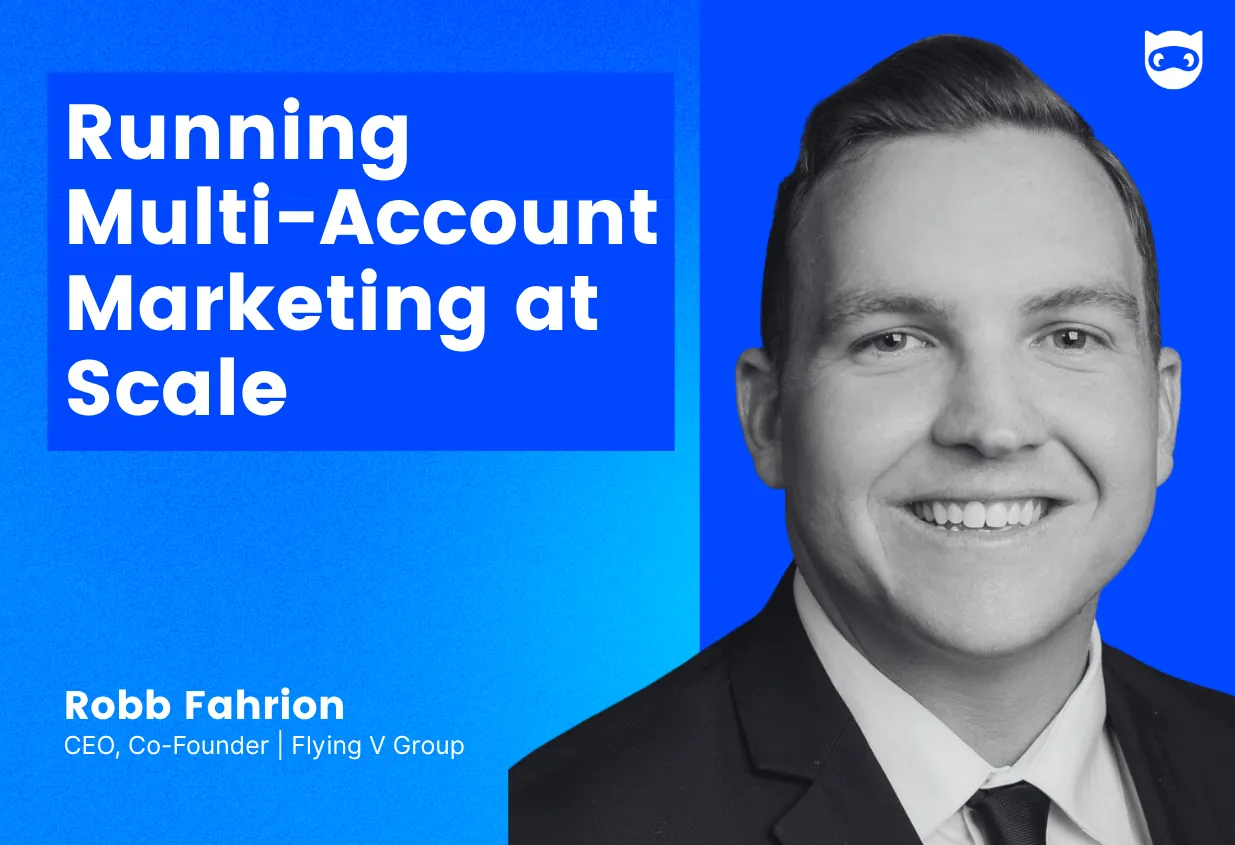
Robb Fahrion co-founded Flying V Group in 2016 with $15,000, his brother, and his best friend. Ten years later, the agency is 34 people, fully independent, and managing $5M+ in annual ad spend across 450+ clients spanning healthcare, finance, real estate, renewable energy, and beyond.
On this episode of What Gets Measured, Robb talks through what running marketing at that volume actually demands and details the operational realities, client dynamics, and experiential knowledge that keeps the multi-account engine running.
When an agency is managing many accounts at once, Robb is direct about where the real complexity lives. Early on, he says, the team was running channels in silos — paid search here, SEO somewhere else, social doing its own thing.
"What we saw over time was a lot of these channels work in unison together — they're leveraging one another, or they should be," says Robb. Getting omni-channel marketing to actually work together wasn't a creative challenge, but an organizational one.
"The marketing's kinda the easy part," says Robb. "It's getting it all organized — the process, the automation, the guardrails and checks and balances, which actually allows you to move in alignment fast enough to generate the desired results."
How the team facilitates work across channels — what content each platform needs, how to surface it, how to keep a team of account managers moving in the same direction — that's what consumes the most energy at scale. And Robb and his team have learned that clients feel this too. In discovery, one of the first things he's listening for is how a prospective client thinks about marketing.
"Do they see it as an expense or an investment?" he says. "That's generally your easy tell." Clients who see it as an investment tend to understand that good marketing requires operational buy-in on their side as much as his.
After hundreds of client engagements across a wide range of industries, Robb has developed a clear view of what's repeatable and what needs to be bespoke, which he roughly states as a 70/30 framework.
"60 to 70% of campaign work, you're gonna set up conversions the same way and tie them out," explains Robb.
"When you're creating the ads, no matter what ads you're creating, you're going to test a certain number of them as a part of that campaign to understand if it's working or not." The structural logic of a campaign, how you define a conversion, how you test creative, and manage ad spend at scale, holds across all accounts and verticals.
The other 30% is where vertical, industry-specific knowledge actually matters.
"What changes (in these instances) is who is the consumer or who is the target customer persona," says Robb. "What expertise does the brand or the company bring to the table that can help them carve through all the noise."
Robb and his team handle this by deliberately matching people to accounts where they have real industry familiarity. "My SME knows the jargon," he says. Working with a medical client, for example, requires a fundamentally different posture than working with an entrepreneur or an insurance firm.
And when regulations shift, or new information comes from a source outside the agency, it’s important to have specialists who know and can pivot fast.
"New legislature comes down, Medicare, Medi-Cal all of a sudden changes how you can even make money,” explains Robb. “Next thing you need to do is go find a brand-new ad strategy because the old one is completely irrelevant now."
One of the more vivid examples Robb shares involves a university client — a case where the multi-account marketing mindset applied inside a single organization.
On the surface, explains Robb, a university looks unified. Everyone shares the location, the mascot, the football team. But the audience inside that institution is anything but uniform.
"You've got your band people, you've got your business guys and gals, you've got finance and accounting, liberal arts, creative writing, drama," says Robb. "Just because they're a part of the same audience doesn't mean that the same message is going to work."
Robb and his team built individual funnels for each discipline, driven by page-level behavioral data. If a visitor was browsing business school pages, they got tagged and received business content. Drama students got something else. The university had been advertising to everyone with essentially the same message — come here, we're a great school, we have a big football stadium. Segmenting by discipline and building content to match changed what the campaigns could do.
The omni-channel revelation Robb had earlier on about multi-account marketing matters here too.
Robb describes a separate client situation — a cautionary one — where the team went heavy on a single ad channel because one thing was working. "We just burnt cash because they hit that diminishing point of return too quickly," he says. The better move would have been holding back 20% of that budget and building out optionality. "We didn't have Meta set up, we didn't have TikTok, LinkedIn — we could have diversified that spend across those channels."
When asked how he and his team maintain a consistent client experience across dozens of active accounts, Robb's answer is two words: communication and accountability.
"Communication is critical. Our clients know where things are at, at all times," he says.
"Whether it's a weekly, bi-weekly, or monthly meeting, we hold our team to a standard that we show up to that meeting. We not only show up, but we have the report. The report's accurate. It's been QA'd. It has the new recommendations we need for the client."
Robb is clear that a dashboard alone doesn't create trust, but the experience around that data does.
"If you don't actually have somebody that you trust monitoring the dashboards, they're probably not giving you the right data," he says. "When something's on fire — who are you calling? Who is accountable? Who will help you through whatever that giant situation is that you didn't expect?"
Clients who trust that someone will pick up the phone stay. Clients who are handed a login and a report don't have the same foundation of trust to stand on when things get hard.
Which ties into the final and most important piece of advice Robb has about multi-account marketing, which is the power of relationships.
Robb and his team run sophisticated automation across client funnels. His view on where automation stops is straightforward.
"We could have the best marketing system, the best drip sequence, the best retargeting, the best funnel, CTAs, whatever," he says. "But guess what? What happens when a client calls? Does someone pick up the phone? If they do have to leave a voicemail, do you call them back in an hour or three days? When they get on that first discovery call with your team — do you show up? Is your camera on? Do you even know what the call is about?"
Automation moves people and processes to a threshold. The human side, the relationship side, determines what happens as your accounts pass through it.
Robb connects this back to a broader point about AI and marketing. “The faster AI moves,” says Robb, “the more trust becomes a competitive advantage, the more important and critical it is to build trusted relationships, and make yourself available."
His practical advice for anyone managing marketing across multiple accounts: go have the conversations before you build anything.
"Lead with curiosity about the client," says Robb. "What are your pain points, how are you measuring, how are you not, what do you wish you have that you don't already have — all the basics.”
Robb expands on the importance of conversations, especially with different stakeholders. “Talk to the CEO and the director of marketing separately,” he adds, “because they're thinking about completely different things even when they're working toward the same goal.”
And on the question of when to expand versus when to hold — Robb's framework is crawl, walk, run, sprint. "To run accounts at scale, you gotta start small, and then grow and expand," he says.
Listen now: Spotify | YouTube | Apple
Connect with Robb: LinkedIn | Website
Subscribe to What Gets Measured for more conversations like this.
Jake: [00:00:00] Rob Farian, welcome to the show. How are you, sir?
Robb Fahrion: I am doing great, Jake. Yeah, appreciate you doing this. Excited to be here
Jake: Yeah, man, the Flying V. We're in a formation. We're not guitars. We, we had that conversation. We're, we've moved on. [00:02:00] Um,
Robb Fahrion: moved on
Jake: so this is exciting, doing research for this, um, looking up, uh, Flying V and, and your, uh, success as an agency. 450 clients managing millions in annual ad spend. I mean, this is... You're working at a pretty big clip.
Jake: Um, this is about multi-account marketing, like how you treat a bunch of accounts like they're your only one. I, I just wanted to get your sense, um, from your history of going from the beginning to scaling up, at what point does marketing stop being about campaigns and it becomes some operational challenge?
Robb Fahrion: Hmm. Great question. Yeah. We've been doing this and building Flying V Group since twenty sixteen, so coming up on our tenth year, and I, I think early on we didn't have that figured out, right? You were running a lot of different channels or maybe even an individual channel just in a silo.
Robb Fahrion: Right
Robb Fahrion: so what we saw over the years [00:03:00] was, hey, a lot of these, uh, channels work in unison together, or a lot of times they're leveraging one another, or they should be.
Robb Fahrion: How about that? Leveraging one another. And so you need to be using multiple platforms, models, et cetera, to perform. But then, yes, you're exactly right. Okay, great. How do we now facilitate the team across all these different channels, the content type that all these different channels needs, how we get the content in the first place and surface it?
Robb Fahrion: So, uh, yes, I'd say more now than ever, it's operational, and especially where we're at, the marketing's kinda the easy part. It,
Robb Fahrion: Mm-hmm.
Robb Fahrion: it's getting it all organized or finding an organization that values that organizational component, uh, the process, the automation, uh, the guardrails and, and those checks and balances to actually allow you to move in alignment fast enough to actually generate any sort of results[00:04:00]
Jake: Totally. And so I'm, I'm wondering, you, you, you, you take on a bunch of different clients and, and it is sort of hand-to-hand. I mean, marketing, it depends. That's on our tombstone, that's on our birth announcement. It all depends from cradle to grave. But what I think is interesting, and I wonder if you have some insight here, do you...
Jake: Are your... Do you have a sense when you talk to a client initially in that briefing stage that they are going to be an operational nightmare, or, or these people have their sh- their S-H-I-T together? Or, or, or does it matter sometimes? Is, is that like... Do you know what I mean?
Robb Fahrion: It, it starts in, and I've been using this word a lot lately, the alignment as an agency, right? So yes, finding out those key, um, indicators, whether it's revenue, head count, or just understanding how these people [00:05:00] think about marketing and advertising. Do they see it as an expense or an investment? That's generally your, your easy tell, um, to where you wanna obviously be with those individuals that, and groups that understand it's more of the investment.
Robb Fahrion: So yeah, I think there's a lot of that going on in our discovery process, our, um, proposal process. Our pricing obviously plays into that, uh, quite a bit as well because yeah, as, we always say this, as critical as it is, of course, for, uh, us to align with what they need, there's also an element of agency world that they need to align with how we operate
Jake: You know,
Robb Fahrion: And some people don't like to hear that
Jake: already I'm scared because you... Oh, don't tell them that, Rob, because you're gonna scare people out of the room. It- most people are like, "Whatever you want." And, and you talk to a lot of salespeople, I don't know what the process is, but you're like, "What did the salespeople promise them?"
Robb Fahrion: Right
Jake: "Uh, well, [00:06:00] we just wanted to get them in,"
Robb Fahrion: Great
Jake: I think a lot of people want to sign the business, want to get the interest, need to establish that in the front. How do you say no to that? Uh, ha- have you ever had an instance where you're like, "Nah"?
Robb Fahrion: 100%. Yeah, I mean, I think
Jake: more about that, because a lot of people would be like, "Oh, Rob's saying no to money."
Robb Fahrion: Right. Right. Yeah, I mean, I think it really is having a process in terms of how you do things and how you are going to determine whether they're qualified or not, right? I mean, I think some of the easiest things early days is can they get on the call, and do they show up, and are they present? And when I ask them the questions, you know, do I feel like they're giving me straightforward answers, or is it the constant runaround?
Robb Fahrion: And, you know, you push it further and further through these different gates and marks. But, you know, even all the way through the proposal, how are they handling those negotiations back and forth? And, you know, even one where it was, it was almost to the very finish [00:07:00] line, and I had to have a conversation with them like, "Look, you've basically got me to the point where you want me to rewrite my entire MSA.
Robb Fahrion: Why? Why should I do this? Or what, what's going on on your side? What do I need to know about your past experiences that are having, you know, making me do this, right? Knowing that we've done it very successfully for a lot of other people, and no one has ever asked me the question, these questions, and their retainers are 10X yours, right?"
Robb Fahrion: So that will be a instance where you might walk away from the table a little bit quicker.
Jake: It reminds me, I was just thinking of somebody who, who, uh, they're dating, and the first thing they do is go to couples therapy. you're like, "What happened in the past that requires us now?" You know what I mean?
Robb Fahrion: Yep
Jake: how damaged are these goods? Um, but I, I think that's, that's key to notice the tensions.
Jake: [00:08:00] It's key to figure that out. marketing to me is relationships. How much do you find that just having a great rapport seeking to establish a relationship with people, do you find that that's the way to do it? I mean, uh, you know what I mean? Like, like, h- why do people talk themselves into these rationalizations when they need to be working on relations?
Robb Fahrion: Spot on, right? And we're working in this very interesting spot, right? Marketing, and you think about AI. Everyone wants to talk AI all the time. You look at marketing, that's the one area that can be disrupted the fastest and the easiest. It always has been. Low, low barrier of entry. And what we're seeing is just the faster AI is moving, the more important and critical it is to build trusted relationships, [00:09:00] and being available to have a conversation or meet in person,
Robb Fahrion: Hmm.
Robb Fahrion: To sit across from the table from them and s- understand or get a better understanding of whether or not this is someone you can trust, this is someone you can get into a six-month, 12-month, maybe even longer, um, type of relationship.
Robb Fahrion: And so I think that's really been lost over the last couple of years for obvious reasons. And if you go even pre- pre-AI, it was COVID, which brings a lot of the same challenges.
Robb Fahrion: Right
Robb Fahrion: doing stuff now from everywhere with very little to any regulation or guidance. And so, um, yeah, we're just seeing marketing become more relational than ever, uh, across, across the board.
Robb Fahrion: Uh, everything. A- any industry
Jake: w- and e- every industry, and then when we get back to this idea of scale, this was all to say relationships are at the core.
Robb Fahrion: [00:10:00] Right
Jake: when you're thinking of doing things at scale, um, maintaining relationships at scale across the teams, across, you know, like what you said,
Jake: across teams, across channels, across account managers, across, you know, um, the, the biz dev experience versus the client experience, onboarding, uh, you know. I mean, it's so insane. do you keep giving accounts, you know, no matter how many people are there, how do you feel like giving them like they're giving that not a c- cookie cutter experience, maybe that branded experience of relationships?
Jake: How do you do that at scale?
Robb Fahrion: I think it's two words, communication being the first one, and the second one being accountability. And so for us, one of the best things that we see that we offer is we're on top of communication. Our clients, we push to have them know where things are at, at all times. [00:11:00] Uh, whether it's a weekly, bi-weekly, or monthly meeting, we hold our team to a standard that we show up to that meeting.
Robb Fahrion: We not only show up to that meeting, but now you're transitioning into the accountability. We have the report. The report's accurate. It's been QA'd. It has the new recommendations we need for the client. And so that's what, going back to rela- that's what builds a strong relationship is trust. And so our clients then trust that no matter what channel, whether it's SEO, paid media, social media marketing, Rob, Brennan, Tyler, a- and their team is going to show up, right?
Robb Fahrion: Number one, and then number two, they're gonna show up with something of value. They're going to listen, ask questions, give me my report.
Jake: Uh, and, and, and I think what I was just thinking of is, oh man, trust is an experience.
Robb Fahrion: Mm.
Jake: It isn't something that you're taking [00:12:00] away. A- and I think trust is like, well, you can trust because I gave you the reports. And you're like, no, isn't enough. I think, uh, there's something about trust being a behavior, you know?
Jake: Because I was just thinking, man, if I got the reports and they all look good, and they had the KPIs, and I put a little thing like st- executives, take a look at this, campaign folks, you know, I added the insights. Trust is there. Trust is there. But you said something interesting where these people's names are going to talk to me about this, take my questions. is a behavior, but somehow we stop at the dashboard. How do you think dashboards and metrics are replacing trust?
Robb Fahrion: Uh, they're not, right? They're, they're
Jake: are they?
Robb Fahrion: they're a tool, they really are. But the more you're finding out, if you don't actually have somebody that you trust monitoring them, they're probably not giving you the [00:13:00] right data. So that's the, that's the first issue. But yeah, I mean, I think you nailed it with the word experience, right?
Robb Fahrion: So yeah, you have these AI tools, you have all this automation nowadays, but what's the experience that you are getting? When something does... Uh, when something's on fire and who are you calling? Who are you emailing? Who will help you through whatever that giant situation is that you didn't expect? Um, and so yeah, I mean, I think that's that experience, again, that communication, accountability.
Robb Fahrion: I mean, you take those three things right there, and you really have how you're winning out in a variety of different indus- I was thinking about, uh, CPG when we were having this conversation, right? It started to scale up in COVID, uh, into AI, and you had these brands, and they were scaling no matter what they were selling.
Robb Fahrion: Rapid, if it looked cool, people bought it. Now, the number one peop- number one thing people are asking is, "Wait a minute. Who's actually [00:14:00] behind this business?" Right? Is this business just the same consumer-driven product that comes out of the same factory? Or is there a reason that actually I should buy this versus that, right?
Robb Fahrion: So, um, no matter what it is you're selling, right? Service, obviously high trust, uh, high visibility necessary, but even all the way down to a $3 soda or, or pop, whatever it is you buy, uh, popcorn at the store, whatever it might be, right? There's an element of trust
Jake: Well, and so this gets to the next question about the different types, because yeah, fast-moving consumer goods, uh, everyone takes marketing principles from them.
Robb Fahrion: Mm.
Jake: um, not enough. I wish I could have as much fun as these soda and chip marketers, bro.
Robb Fahrion: Same.
Jake: having such a great time.
Robb Fahrion: No doubt
Jake: you're selling, like, real estate stuff, and you're like, dry." But, you know, not to say... Everybody has unique problems. Please, [00:15:00] uh, call Flying V. Um, but different verticals like healthcare, finance, real estate, renewable energy, I mean, this is kind- you've worked in all these different sectors, um, other dozens of different industries. After hundreds of engagements with these, w- w- like, when we're talking about the data specifications, like how we're working multi- multiple accounts, what, what...
Jake: Is there something true that's across all of these verticals, and is there something that's super distinct?
Robb Fahrion: Yes, I believe there is. So we really do believe over the years as we've built up an understanding of how these platforms work, understanding of how structured campaigns work versus unstructured campaigns, that there is a right and wrong way to basically build the campaign, deploy the campaign, manage the campaign, optimize the campaign.
Robb Fahrion: Uh, so you look at, again, [00:16:00] whatever it might be you're selling, 60 to 70% of that, you're gonna set up conversions the same way and tie them out, right? Yeah, it might be B2B and you're tracking a lead form versus a purchase, but you're still gonna tie it out to some action.
Robb Fahrion: Hmm.
Robb Fahrion: when you're creating the ads, no matter what ads you're creating, you're going to test a certain number of them as a part of that campaign to understand if it's working or not.
Robb Fahrion: Um, so what changes, though, is that other 30%. It's yes, who is the consumer or who is the target customer persona? Uh, what expertise does the brand or the company that we're working with bring to the table that can help them carve through all the noise and say, "Hey, we're actually different in a world full of flavored water," for whatever reason, um, that might be.
Robb Fahrion: So and then we're getting feedback, and that's where communication comes in. So it's all right, [00:17:00] we've now set up these systems and these processes on top of your business or within your business or as a, a silo in certain-- with bigger companies, right? We'll do maybe just one piece, but, uh, you're at least going to get consistent return on data and understanding, and then we're gonna take back feedback, communicate with you, and make the necessary adjustments and changes together and then report whether or not they worked or did not.
Jake: So, and, and you get me k- uh, thinking about like, um, diversification of specif- sp- like specialty
Robb Fahrion: Mm-hmm. Mm-hmm. Yes
Jake: you know what I mean? Like, I, I think everyone says, "Bring us your business. We'll sell your widgets. We'll sell your water. We'll sell your, uh, you know, whatever. We'll sell it all."
Jake: But do you have inside your team, these are the healthcare folks, like they crush in this zone because they have [00:18:00] experience, they work with the accounts, just, they just know what to say. Do you help develop that inside, or do you want people to be sort of Swiss Army marketers? Like, I want you to be able to talk to these 70%
Robb Fahrion: Hmm.
Jake: generic part
Robb Fahrion: Yeah, it's a great question, question, Jake, and I think it is a little bit of both, right? But 100%, we are strategically aligning certain people in instances, right, that have worked with a similar type of client and have performed and shown results, right? Yes.
Jake: they have a relationship with
Robb Fahrion: the, they know the jargon, right?
Robb Fahrion: They know do- medical, for example, you cannot work with a doctor in the same way that you might work with an entrepreneur or a, a lawyer or an insurance or accounting guy. They're-- they operate differently.
Jake: looking at those things, you know what I
Robb Fahrion: Right, 100%. So it's that relatability, familiarity, and experience, right, [00:19:00] which is obviously your expertise.
Robb Fahrion: But in our space, marketing and just technology in general, you have to be comf- we say comfortable being uncomfortable. Things are going to shift at any moment. Uh, medical, one of the things that I notice of people that work best in medical is when things do have to just flip on their heads. Why? New legislature comes down, new laws,
Jake: big
Robb Fahrion: Medicare, Medi-Cal all of a sudden changes how you can even make money.
Robb Fahrion: Next thing you need to do is go find a brand-new ad strategy because the old one is completely irrelevant now, um, based on who we might or might not be able to target, coming from a decision that we have absolutely zero control, um, of. So, so yeah, that it's a, it's that combo, and that's not a cop-out, right?
Robb Fahrion: But it is finding that element, and my job is putting them in that position to succeed more than anything
Jake: And can I ask another question? Um, [00:20:00] how do you... 'Cause I was just thinking, um, a lot of people don't have opinions about marketing. Um, I mean, not the people who are working inside an agency. I mean, we love this stuff.
Robb Fahrion: Of course
Jake: a lot of people have an opinion outside of just make the number go up.
Robb Fahrion: Right.
Jake: the number go up. Why, you just mentioned if you're working in healthcare, you gotta look at m- uh, l- legal stuff. You know, if you're working over here, you have to think about this, you know? Um, how, do you, how do you develop an opinion about marketing if, if i- i- that just isn't financial? Like, why do people give a fuck other
Robb Fahrion: Yeah.
Jake: money?
Jake: Why, how-
Robb Fahrion: Yeah. Yeah, great point. I think it's, one, structured data, so you actually do have the ability to show what you're saying. Everyth- people want everything to go up, right?
Jake: Well, of course
Robb Fahrion: yeah, and then the difference, and this is where going [00:21:00] back to that fit, who do you actually want to be working and aligned with?
Robb Fahrion: So why are they in the business that they're in? What is their ethos? Does it align with our ethos as a business? Because marketers, right, we're going to help businesses grow. Well, trust me, I've had these situations. There were instances we're making money for so and so, and I'm... I don't feel good about it, right?
Robb Fahrion: I, I know how they operate. I, I know how they treat their people. Um, I know how they've treated my team or employees just based on when things aren't good, show, you know, really showing their true face and, and those sorts of things. So, um, yeah, I mean, I think that's where we take a stand too. We try and obviously come with as data-driven, um, ideas and new ways of thinking about marketing and advertising, tying it out.
Robb Fahrion: You know, we talk about that a lot, monthly recurring net income. No one's talked about that prior to us because it didn't exist, but it's something we were like, "Okay, well, it's not even just about [00:22:00] driving revenue. It's about creating predictable income and profitability more than anything," and no one was talking about it that way, right?
Robb Fahrion: Um, but then yeah, again, going back, it's alignment, relationship. I wanna win with people that I like doing business with, that I believe in what they're doing. Like, that's what gets me excited about waking up every day is working with a lot of others that, you know, have their own dreams, passions, and wanna do it the right way, the way we think is the right way, and we get to choose what that is
Jake: Right. And, and I, I love how you get to have an opinion, but you back it up with data. Now, one of the things I'm thinking about, m- m- we got franchise businesses and stuff. Is there something that you've worked with when somebody comes on board that you were shocked to think, well, you didn't, they didn't know that multi-account marketing, like roll-up reporting, like all of the benefits of seeing data work across different [00:23:00] locations, collecting sentiments.
Robb Fahrion: Yeah
Jake: was, was there, was there a shocking moment? Maybe give us a Cinderella, uh,
Robb Fahrion: Yeah. I ha- I have a good...
Jake: a, a
Robb Fahrion: Yeah.
Jake: story if you have
Robb Fahrion: Yeah, sure. I've got a good... Yeah, I won't name names, but first one I think of is a university, right? So you had a university, and you think about that, it's a collective group of people that are all kind of aligned behind, you know, a location or a, a mascot or maybe a football team.
Jake: tons of interesting marketing aspects
Robb Fahrion: Yeah, but then in between, you obviously have all these different disciplines. You've got your band people, you've got your business guys and gals, you've got finance and accounting, you've liberal arts, you know, creative writing, drama,
Robb Fahrion: mmm。
Robb Fahrion: you name it. And so, you know, what we found was, hey, you really did, even though everybody, yes, is in the same boat and we're all collectively together, you have to have these individual disciplines and be able to speak to them in their own language too.
Robb Fahrion: So [00:24:00] just because they're a part of the same audience doesn't mean that the same message is going to work. So we created these individual funnels based on the pages of the websites that they were on. So yeah, if you were a, uh, business major, you'd get business content because we tagged you and know what pages.
Robb Fahrion: And so, um, they were just really advertising to everybody, "Hey, come to, come here because we're cool and have a big s- football stadium and, and a brand," right?
Robb Fahrion: Right
Robb Fahrion: so that really changed the game there. Um, and then Horror Stories was I think, and this is where, as an agency, part of our job is to really take the reins and bridle that horse when you need to, was a group that they were just so hungry and aggressive and wanting to just scale, but they saw one thing work, and they said, "Put it all there," right?
Robb Fahrion: And so we ha- got heavy aggressive with one channel of ad spend, and what happened was we just burnt [00:25:00] cash because they hit that diminishing point of return too quickly. And what would we have been better off doing? Probably saving 20% of the budget that we spent, and then at that time, making sure we had optionality with distribution of ad channels.
Robb Fahrion: So ha- we didn't have Meta set up, we didn't have TikTok, LinkedIn, to where you could have diversified that spend across those channels
Jake: Yeah, uh, b- sh- m- so are you saying at different locations there was different channels driving different interest for the same place?
Robb Fahrion: That's exactly right. That's exactly right.
Jake: that sounds like marketing, you know. Um, man. Oh, wow. That is fascinating. And if you didn't have the pr- like the, the kind of understanding to see multi accounts maybe where they don't even exist.
Robb Fahrion: That's right
Jake: that was interesting that you broke out a multi account approach to thinking about the different disciplines at a university. M-
Robb Fahrion: Right
Jake: could [00:26:00] do something similar to, um, Arby's with their potato cakes.
Robb Fahrion: Mm.
Jake: following this with such interest because one, I went there two years ago, they didn't have the potato cakes and they were like, "We took them off."
Jake: And I was like, I was about to drive through that Arby's. I was like, "What?" 'Cause I, I talked to my daughter in the back and I was about to share a, a legacy.
Robb Fahrion: Yeah, man. I hear... I'm an Arby's fan too, so I haven't had the potato cakes though
Jake: oh, g- g- ah, sh-
Robb Fahrion: Kick this guy out of here
Jake: Okay. But anyway, but the point is they took them off and I don't know why, but then they brought them back to much aplomb.
Jake: Everybody loves it. And you know how pe- McRibs, you know, you
Robb Fahrion: Yeah
Jake: give us a little, take it away. But have now f- filed a lawsuit against themselves that if they ever take the hash brown off, they can get sued.
Robb Fahrion: That is so
Jake: was
Robb Fahrion: great
Jake: like, what an amazing thing because yes, we have the meats, Arby's, we [00:27:00] have this, but they have created this pocket for the hash brown to live in this way.
Jake: So you start thinking of all of these different ideas and it's so tantalizing as a marketer because people would say, "Oh, I gotta sell blank." Well, have you thought of all the different multi accounts that are inside blank?
Robb Fahrion: Right
Jake: like this isn't just a healthcare brand, it's a wellness type thing. How do you... to me about the creative process
Robb Fahrion: Mm-hmm.
Jake: accounts.
Robb Fahrion: Yeah
Jake: how, how do you guys, uh, and gals get in there and think
Robb Fahrion: Yeah
Jake: about like accounts that have so many different touch
Robb Fahrion: Right. Yeah, there, there's that balance as well, and I think that's where our experience and just kinda knowing what that blend is from a budgeting perspective. So that's where we like to speak the language of the dollars and cents. And it's not that we're opposed to high-end creative or spending hundreds of thousands of dollars on creative, it's just you have to make sure that [00:28:00] it's balanced properly.
Robb Fahrion: So if you're gonna spend $100,000, well, you probably better have, you know, 5X maybe the amount of ad spend behind it to then get it out and distribute it. So, o- or, yeah, just break it up, right? All right. Don't spend it all in one place. Let's maybe test it over five more bite size that we could push out a little bit depending on str- and then come back and double down.
Robb Fahrion: So we're definitely still data-driven there, but we understand the messaging, the creative, right? That does, that's the human element, the psych- psychological element. Um, but we gotta make sure that we can actually give it that chance to breathe and, and be seen because you can have the best creative in the world, but if nobody sees it, right?
Robb Fahrion: It's the, the tale as old as time
Jake: Just getting so mad. I was like, I hope my head doesn't explode, because people don't give things a chance to cook. It is insane. And, and we're, we- [00:29:00] change, change it up, change it up, change it up, change the slogan, change the tagline, change this, change that. Afterwards, nobody knows what the hell you've done because you are a patchwork, just like a clown wearing every funny thing you collected for the past six months.
Jake: Oh my God, stop. How do you get people to stop? Like, how, do, is this a data-driven thing again, Rob? Are you gonna tell me that you're data-driven
Robb Fahrion: It's not at all. It's again, we want-- If we're not actually failing as a part of what we're doing too, then we're not doing our job. So you do find this additive nature that we wanna add things on top of what we're already doing. We wanna do it strategically. We wanna think about it, but then just make sure we're testing it too.
Robb Fahrion: I, I spoke with a gal last Friday. Their approach was, "Hey, if you have a new channel that we're actually not touching right now with either our own team or our own [00:30:00] vendors, please, I want and need to know about it because we're constantly needing to find new channels to add new users, new viewers," whatever, again, traffic your goal might be.
Robb Fahrion: So, um, yeah, I mean, I think just thinking in those ways of everything we're doing, we wanna amplify. Or if you are adding something, how can we repurpose? How can we use it as leverage on other channels? All right. You're dr-
Jake: leverage, redistribute, repackage. People
Robb Fahrion: Boom, right? Okay.
Jake: them you test,
Robb Fahrion: Yeah. Yeah.
Jake: no.
Robb Fahrion: Yeah. Yeah. Yeah.
Jake: say, "No, get out of here. Quit being stupid." No.
Robb Fahrion: Sometimes.
Jake: Well, so here's, here's a question.
Robb Fahrion: Yeah
Jake: You can test, you can test, you can test, you can test. When do you say we're good? Like, like, everyone says, "Well, try it out, try it out." When do you ever say nah?
Robb Fahrion: That's it.
Jake: no?
Robb Fahrion: That's the agreed up- that's where you agree on those [00:31:00] measurements, okay? How
Jake: get to a metric that both of you ha- uh, you all know it's a no.
Robb Fahrion: Yeah. Well, yeah, I'm like, well, what is success? What's not success? How... And that's as a part of the biz dev when I'm selling too, right? Okay, how are you gonna hold my team accountable? What are the metrics? Are they reasonable based on what you're trying to accomplish or not? So yeah, lining up that measurement, um, just understanding how you're gonna track it and tie it out.
Robb Fahrion: Uh, those are all things throughout that onboarding process. Process again, no matter what we're selling, how much is it worth? What's the lifetime value? Do we have it tr- tied out and tracked? Yes, we do. Okay, great. We're confident that we can have some success here. Let's put this out in the market and, and see what everybody says
Jake: And can we then say that maybe what process is at a multi-account level is relationship management?
Robb Fahrion: All of, because that's the other piece is as [00:32:00] an agency, you also need that buy-in from whoever that person is on that side to help you do your job. And then the better that relationship is, guess what? "Hey, guys, I'm seeing this. Do this this time," or, "Here's what the numbers look like. Amazing. Keep the pedal down," and we can actually get a true barometer of whether or not we're being successful
Jake: Oh my God, because then, 'cause if you take, if you take it wrong, you're gonna take it personal. But
Robb Fahrion: Right
Jake: the process tight, it's going to be s- staying on the work. Uh, 'cause I, you know, if y- if your
Robb Fahrion: 100%.
Jake: is loose, you're going to take things personally, and that is gonna kill you
Robb Fahrion: That exa- that's exactly right.
Jake: This is great. Okay, here.
Jake: Um, so we, we, you mentioned AI at the beginning. Of course,
Robb Fahrion: Mm-hmm.
Jake: about it.
Robb Fahrion: Yeah, yeah, man
Jake: Well, you talk about processes, you're talking about relationship, all these beautiful things. We have more automation, more data, more tools than we've ever had before. What [00:33:00] still can't be automated when you're managing marketing across many different businesses?
Jake: What can't be automated?
Robb Fahrion: Yeah, so we've obviously talked a lot about the relationships and people element, and it, it... I even double down, and you said the word, that experience element. So we could have the best marketing system, the best drip sequence, the best retargeting, the best funnel, CTAs, whatever. But guess what? What happens when they call?
Robb Fahrion: Does someone pick up the phone? Do, do you even answer? If they do have to leave a voicemail, do you call them back in an hour or three days? Um, when they get on that first discovery call with your team, now, now it's on you, right? Do you show up? Are you in an office? Is your camera on? Uh, do you, do you know even what the call is about and any research that you might have done?
Robb Fahrion: So I think that's where you still have to close that gap between, okay, yeah, AI can do all this automation and deep [00:34:00] tech and get them to a certain point, but there's always going to be that human element that really does drive it over the finish line more often than not, especially B2B, right? Relational.
Robb Fahrion: Yes, more elements on the B2C side too, like we talked about earlier with who's behind these brands.
Jake: Sure
Robb Fahrion: but yeah, it's just that experience. And same thing, even customer service on, on product base. You know, you buy something, you get it, you don't like it. Y- the determination you probably have of whether or not you will buy again is d- was it easy to return it?
Robb Fahrion: Were they accommodating? Did they even listen to the reason why I didn't have a good experience in the first place? A restaurant, same example. Okay, what happened? Maybe they were down a couple peo-- All right, you might give it... You know, you look at the positives of the experience. You liked the drinks. You liked the ambiance.
Robb Fahrion: Okay, we'll come back and give the food maybe one more try because they were honest with us. They gave us a free des-- You know, whatever it might be. Uh, you name it. I don't know. I've never worked in restaurants, but I'm assuming [00:35:00] that-that's how I might attack it.
Jake: but you're approaching it as most marketers don't, which is from a consumer lens. I think we spend a lot of time in marketing to avoid thinking like the lowly consumers,
Robb Fahrion: Right.
Jake: you fail to realize when you go to Target, you are not reading people's brand stories. You are not comparing, like, the brand narratives between two things.
Jake: You're saying, "What's the cheapest refried beans?
Robb Fahrion: Yeah
Jake: I guess I like green." I mean, we, we would be horrified to know what's actually going on in consumers' minds, other than when you trap them in a $40 room and you have them compare the societal benefits of two different macaroni and cheeses. You're like, "Which one makes you feel elevated politically?"
Robb Fahrion: Amazing.
Jake: this one.
Robb Fahrion: This one time.
Jake: Clearly this is Satan's mac and cheese."
Robb Fahrion: That's too good. That's too good
Jake: um, but I love market reflection, consumer [00:36:00] awareness,
Robb Fahrion: Right
Jake: about relationships across different, uh, areas, but the process is so key. The people are so key,
Robb Fahrion: Yeah
Jake: I think we landed on experience. But all of this is great
Robb Fahrion: One more on that too, just, uh, Jake, a little further. I think from our angle too is that marketing for us is really the tool and the vehicle in the sense that we're, we're very entrepreneurial. So, you know, we're coming to the table of, tell me about this business. How do you make money? Um, not just drive revenue.
Robb Fahrion: Uh, where, where-- When w- when we're determining what to market across your product stack, well, which one's the most profitable?
Jake: Hmm.
Robb Fahrion: which one has the mar- biggest market that maybe we haven't tapped into that, you know, someone's been saying for the last year, "Hey, if we would just focus a little bit more time and attention there, we'd make 10X or 10% more on top of what we're already making."
Robb Fahrion: So that's where you're strategic and it's like l- you [00:37:00] know, you get in, it's crawl... It-- A lot of times too, it's gotta be crawl, walk, run, sprint. So people just trying... Now with AI, everyone's like, "Oh, I gotta be doing everything everywhere all the time." And it's like, well, you gotta start, you gotta start small, and then grow, expand, expand, right?
Robb Fahrion: Tie certain ar- you know, make sure they don't work before you move on to something else because it's that, uh, meme you've seen where the guy's digging for the diamonds, you know, the one guy turns around and if he had just gone another month, you know, you would've seen it through. So... And that's where we're very process-driven as well of like, "Hey, here's what we're gonna do in the first 90 days."
Jake: Yeah, we're gonna see it through. I think that's a, that's a benefit. I
Robb Fahrion: Yep
Jake: so giving people a sense of timeline, autonomy, being so serious with the briefing and the onboarding, because downstream you're about to get a whole bunch of messes. It
Robb Fahrion: Mm.
Jake: like you really make sure the alignment is upfront, but I love your thinking of multi-accounts being [00:38:00] everywhere, just inside disciplines, inside of an idea, inside of a company, inside of everything.
Jake: If you had to give one person one piece of advice sort of thinking about multiple accounts in marketing at one time, what would your one piece of advice be?
Robb Fahrion: You have to go out and have conversations with the people that you're going to be working with in those accounts and in those verticals, right? So if it's, hey, healthcare, go talk to healthcare CEOs, see what they care about, and then go talk to the director of marketing and see what he or she might think about, because it's gonna be two very different things.
Robb Fahrion: But a lot of times they're working-- they really are going to the same direction. But the director of marketing, their challenge is gonna be, "Okay, how do I get the CEO to actually give me 30 minutes of his day [00:39:00] to write a letter to the organization or to our audience or, uh, prepare a new deck based on new research and information," right?
Robb Fahrion: So yeah, I think you just have to have those conversations, lead with curiosity, um, right? And that's where you're gonna find the answers is just by what are your pain points, how are you measuring, how are you not, what do you wish you have that you don't already have
Jake: Oh,
Robb Fahrion: I mean all, all the basics.
Robb Fahrion: All the basics
Jake: but what, what I, I have, you know, earlier on, and we'll get off the call, okay? We'll end. If people are bored, you could turn off the podcast, okay?
Jake: one of the things that I discovered early on in my marketing career was phone conversations with people.
Robb Fahrion: Mm.
Jake: And, and I... Everyone's like, "What is it? What is it?" Well, I'll tell you, because you don't need to plug anything in. You don't need to pay any tokens. You don't even need any weird platform. You just need a phone. And you pick up the phone [00:40:00] and you talk to your customers. And, uh, I know, I know, it sounds insane. No one does it. I don't know. I, I asked, I've given a couple talks at marketing conferences. I ask this question to everyone. Only a handful of people
Robb Fahrion: Yeah.
Jake: their hand.
Robb Fahrion: Yeah
Jake: a phone conversation with their customers or clients
Robb Fahrion: Right
Jake: 30 days?
Jake: None of them.
Robb Fahrion: Right. Yeah, that's crazy
Jake: What? What? I love that your one piece of advice is the one damn thing I've been saying for the last 10 years
Robb Fahrion: Yeah
Jake: You will get everything you need when you talk with your face to a client or a customer. Why don't people believe this?
Robb Fahrion: Yeah, s-
Jake: doing this?
Robb Fahrion: spot on. And there, and there shouldn't be excuses either because, like, I'm not necessarily the type, have I done it? Sure. Pick up the phone, call, or, you know, you gotta address it head on. Yeah, that a lot of times came just over the years and getting tougher, uh, more than anything. But it's find an alternative.
Robb Fahrion: You know what I like to do? I like [00:41:00] to go to coffee. So on LinkedIn, when I try and connect with someone in par- that's my first step, right? Will you go grab a coffee with me on, you know... I'll, I'll, I pay for it more often than... And I just start to learn about their business. I don't come wanting to sell, thinking about selling, because oftentimes it's not the right time.
Robb Fahrion: Marketing works in cycles. You know, you're coming up to the year-end, you're thinking about it. Or, you know, depending on how, if it's a priority or not, some start planning for it in quarter two for the next year, right? Who, who knows when it might be. So I think if you just lead with value, uh, my big thing's community, so, you know, we have actual offices with people that come to the office because
Jake: that
Robb Fahrion: we've found collaboration, creativity flows faster, communication.
Robb Fahrion: So even just, you know, our ability to get stuff done faster for our clients is a competitive advantage, which kind of sounds crazy nowadays, right? But it's not
Jake: for a Slack and you don't know where that person is. Are they [00:42:00] asynchronous? Are they out of office or are they out of office?
Robb Fahrion: 100%, so
Jake: down the hall and you're like, "Ken!" Um,
Robb Fahrion: Yeah, and we, we do have remote too, so it's that blend, but it's at least okay with remote. We're very on top of, "What are your hours?" It's okay if you're off, we just need to know what that response loop is gonna look like, feedback loop
Jake: because it, it's nice to talk to somebody and have a conversation and share with people just the importance of having a chat. And I am so grateful that you gave your time to us and the audience. Um, if people wanna connect with you and learn more about you, Rob, how can they do that?
Robb Fahrion: Yeah, Jake, I, I love that. I think I look back at my career, and honestly, a lot of all the good things that have happened have just started with ex-- That could be a podcast, right? On-- In itself, just a chat. Um, so anyone that would love to chat more, LinkedIn, my name is, uh, where you can connect with me directly.
Robb Fahrion: I'll get you my email address for sure. I'm also on [00:43:00] Instagram and X. And then for our company, Flying V Group, flyingvgroup.com. We have a ton of great content, information, some lead magnets if you're interested. Get subscribed to our newsletter and then all of our, uh, handles @flyingvgroup as well. And yeah, I just really appreciate the opportunity and, and the thoughtful questions and dynamic conversation for sure
Jake: My man. Woo! Okay, I'm not gonna let you go until we play a game called Cheese or Chocolate, where I ask you two things, and I give you w- two options, but you gotta choose one.
Robb Fahrion: Okay.
Jake: say both. Okay? Are you ready?
Robb Fahrion: I'm ready
Jake: Okay. Cheese or chocolate?
Robb Fahrion: Definitely chocolate. Yes. Yeah, I know. You caught me actually there. But, but definitely chocolate. Sweet tooth at heart. I do absolutely love cheese because I drink wine. But yeah, if I had to, chocolate.
Jake: She's only gets a mention 'cause of the, the wine.
Robb Fahrion: Yeah, there you go.
Jake: oh, here we go. I'm asking serious ones.
Robb Fahrion: Okay.
Jake: or [00:44:00] King Kong?
Robb Fahrion: Ooh. All right, I'm gonna take a minute here. Uh, I'm gonna go,
Jake: would be easy
Robb Fahrion: ah, I'm gonna go Godzilla. Uh, I think I always had a propens- I like the Ninja Turtles, right? So kinda keep it in the reptile category.
Jake: And it turns out, like, Godzilla's good. Like,
Robb Fahrion: Yeah.
Jake: in this whole thing, like all of the bad people are secretly just aggrieved. You know? Godzilla's just got an ax to grind, okay? So anyway, no, um, I think he protects us from the other monsters. Anyway, shut up. Okay, we're moving on. Uh, chill by the lake or chat by the fire?
Robb Fahrion: That is a tough... Uh, I gotta go chill by the lake. Yeah, so Lake Tahoe's near and dear to my heart, so yeah
Jake: have a lake in mind, of course, 'cause a fire can be anything that you've taken [00:45:00] from your ex in the closet, and you f- burn it, and then you keep your hands warm around your revenge fantasies.
Robb Fahrion: Yeah.
Jake: kidding.
Robb Fahrion: the oil drum.
Jake: I'm just kidding. that's it's like the end he told me everything wrong with him. Okay, anyway.
Jake: Um,
Robb Fahrion: Too good.
Jake: more.
Robb Fahrion: Okay
Jake: or a fort?
Robb Fahrion: Fort. Yeah, fort. Yeah.
Jake: tree house, you can, I'll see you in three months
Robb Fahrion: yeah, my, I, I never got a tree house as a kid maybe, so the forts were the options, so we made where, made... Yeah, it's nostalgic.
Jake: Yeah, well I, my, yeah, my tree house was somewhere in the alley. Like,
Robb Fahrion: Yeah.
Jake: don't know.
Robb Fahrion: Like
Jake: all
Robb Fahrion: in a ditch. I found
Jake: a
Robb Fahrion: a bu- I found a bush, a bush that had a little potential door
Jake: to, real Bear Grylls shit.
Robb Fahrion: Yeah, exactly.
Jake: two more. Smooth jazz or dental work?
Robb Fahrion: So my mom was a d-
Jake: smooth jazz,
Robb Fahrion: my mom was a dental hygienist, so I understand maybe where someone's coming from. But yeah, smooth [00:46:00] jazz all day, all day long.
Jake: A- a- and just because you love it or you hate dental work?
Robb Fahrion: Uh, I don't mind dental work actually, 'cause I know, yeah, your teeth are, your teeth are very important. People don't realize it. Yeah
Jake: then, yeah, so kick on that smooth jazz. That's, that's the attitude. Love it. Okay, and finally, oh man, I just... Well, this is probably gonna be easy. Coke or Pepsi?
Robb Fahrion: Coke. Coke
Jake: So if somebody says, "Pepsi okay?" Are you like, "No
Robb Fahrion: No, not at all. And there are different degrees of Pepsi that I don't mind, but I'm more on the diet side. And Diet Pepsi's their one that's just, it's got issues. But I d- you know, I like, like a Cherry Pepsi. I actually sometimes will take a Pepsi over a regular Coke every now and again, so.
Jake: Woo!
Robb Fahrion: I know, crazy.
Jake: get some mail, bro. He's gonna get some mail. like, "What? Why'd you say that?"
Robb Fahrion: I'm easygoing, man.
Jake: I know, too [00:47:00] easygoing. All right, all right. We're, we're stopping it. I'm stopping it on a laugh