Jake Sanders
Content Strategist
Most data-driven marketing teams would never say they are short on data, but a brave few would admit they long for better decision making capability. But instead of having that discussion, teams stay "on target," adding more KPIs to the stack, firing off reports, and refreshing dashboards in real time.
All the while, the same decision-driven questions keep circling the room without confident, data-based answers.
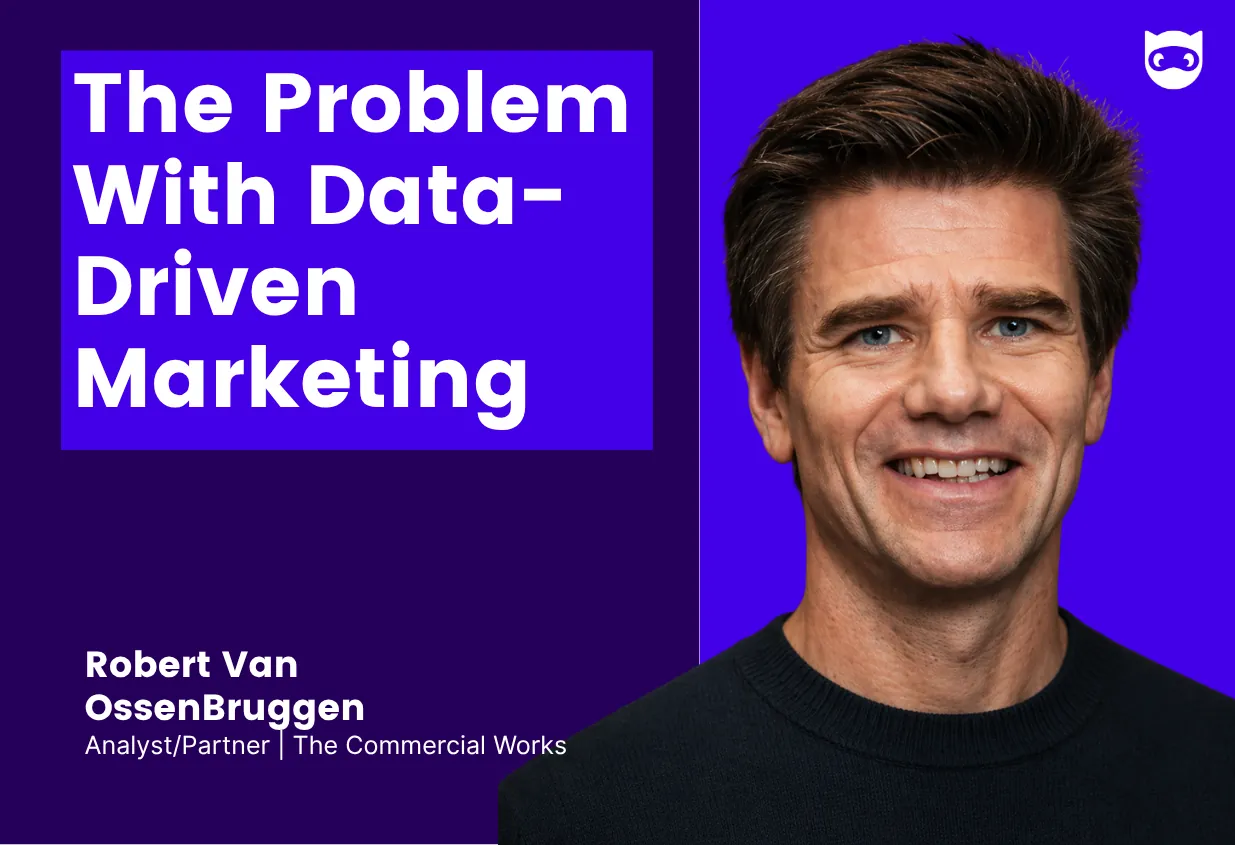
Robert Van Ossenbruggen, a marketing strategist, analyst, and partner at The Commercial Works, has spent his career working inside the gap between data and decision, and his diagnosis is consistent across every organization he encounters; being data-driven in marketing, rather than decision-driven and evidence-based, is the cause of our woes.
"We have this idea,” says Robert, “that if we have hard data, hard numbers, we can draw hard conclusions. It's not like that at all."
What sits between data and a good decision, according to Robert, is a layer of work that most organizations have learned to skip.
"There is this journey between data and decisions that takes a lot of effort and a lot of blood, sweat, and tears — debating and synthesizing and contextualizing and hypothesizing and all that. And we are a bit uncomfortable with those 'softer' parts of analysis, because we are so much focused on the measurability and the objectivity and the efficiency and the accountability."
The discomfort the business world has around soft skills is not incidental, but structural.
"Strong data cultures signal that everything needs to be objective,” says Robert. “And I think that is really in the way — it's killing everything that is not measurable and everything that is not accountable. That is actually where the value is usually created: in the debating, in the hypothesizing, in the struggle. Where is the friction? What are the trade-offs? That part we are not really comfortable with."
The clearest symptom of the problem with data-driven marketing, in Robert's view, is where analysis actually starts inside most organizations.
"Most organizations are not really explicit in the difference between analysis and a KPI report,” explains Robert. “They think they're sort of the same thing. Maybe not consciously or explicitly, but when you really zoom out and talk about this, most people recognize the struggles and recognize where it's coming from."
Robert has seen through his consultancy work, that these KPIs-as-analysis systems have been built over time, and are consistent: "You can find it everywhere. It's in the tools, it's in the assumptions, it's in the workflows, it's in the roles, it's in the incentives."
Real analysis, Robert argues, begins with a question the data alone cannot answer: why.
"The analytical process should start with continuously asking, 'Why do we see this thing go up, and why do we see this thing go down, and why is this grouped differently from the rest?' That takes time. It takes domain knowledge. It takes hypothesizing. We need to maybe have additional data sources, talk to an expert, talk to a client. All that kind of stuff takes time. It takes effort."
Robert also mentions that the speed at which most data-driven marketing teams operate can hamper effectiveness..
"Usually when there is an obsession with data-driven, there's also an obsession with efficiency — and it always goes at the expense of effectiveness. It's about doing things thoroughly and better, versus doing them fast and cheap. And consistently, organizations choose faster and cheaper over better. That's just how it works." The short-term pressure that follows reinforces itself: "The whole culture of trying to prove things, make everything measurable and accountable, drives you toward this short-term performance thing. It always goes at the expense of something else — at the expense of long-term, at the expense of effectiveness, at the expense of really understanding, rather than just filling up the KPI templates."
Robert anchors the abstract in a specific example from his own career. Several years ago, he stepped into an interim commercial analyst role at Schiphol Airport in Amsterdam, covering for a departing analyst the organization was struggling to replace.
What made the outgoing analyst exceptional was not purely technical, explains Robert.
"He was a great analyst in a technical sense — he knew his way through Power BI and spreadsheets, knew all the technical details of what's going on under the hood. But in addition, and this is what I think made him an excellent analyst, is that he invested in relationships with all the stakeholders — marketing, sales, the shop holders. And that takes a lot of time. From an outside perspective, it might look like he was just chit-chatting at the coffee machine. But that is so much important work. He's building relationships, he's hearing all these things about what's going on, and he builds domain knowledge while he is investing in those relationships."
The return on that investment was concrete. "When some number was off and everyone was confused and asking questions, this guy knew the answers. And that's not because he had these hard analytical skills — of course, also — but in addition, it is these softer layers, these soft skills he had invested in, that made him a really great analyst."
What the story points to, Robert says, is a broader refusal in the industry to acknowledge the conditions under which decisions actually get made.
"We are very good at pretending — or creating the illusion — that we have these fantastic, systematic workflows and this objective data," says Robert. "So we create this illusion of objectivity, that everything is systematic and logical. But meanwhile, there is politics, there are hidden agendas, there are cognitive biases. These are the more messy layers that are also part of reality. And then there are also a lot of things that we do not measure and do not know, and we need to fill in those gaps."
The gap-filling is where the real analytical work live, where the marketing data strategy should come from — and it requires exactly the kind of contextual knowledge that gets built at the coffee machine, not the dashboard.
Once something meaningful surfaces in the data, a separate problem begins: getting other people to see it. Robert draws a clear line between an analysis and a data story — a distinction most organizations don't make.
"Analysis is a finding. A data story is a lot more than that. A data story has structure, it has narrative, it has context, it has the answers to the why question — and eventually it ends up with, 'Okay, and now that means we're going to need to do this, this, and this.'" The moral of the story has to be earned through the work that precedes it.
Data people and stakeholders are typically organized into a client-supplier relationship — the stakeholder requests, the analyst delivers. Robert argues the model needs to be inverted.
"We should have more partnerships where we both acknowledge each other's expertise and do the messy thing together — the synthesizing, the hypothesizing, the contextualization — because the data people really know what to find in the data and what the limitations are, and the stakeholders usually know much more about the context. If you respect each other in that expertise, then you can actually together craft those insights. An insight is not something we just deliver at the door of the stakeholder."
The phrase "data-driven" is, for Robert, part of the problem — not because data does not matter, but because the phrase orients the entire process in the wrong direction.
"Data-driven is a word that sort of stimulates you to start with the data,” says Robert. “And if we start with the data, we also usually start with the technology. But it should always start with the best business questions that we want to answer."
He points to the framing in Decision-Driven Analytics by Stefano Puntoni and Bart de Langhe — a value chain that runs in reverse, from decisions down to data rather than from data up to decisions. Robert also cites Sebastian Wernicke's Data Inspired, which makes a related argument: that data is one input among many. "Data, information, understanding, decisions. We start with the decisions, and we work our way down from there — which makes a lot more sense than starting with the data and the technology."
In the end, Robert is precise about where he stands in the decision-driven marketing discussion.
"I see myself as an evidence-based marketing consultant who happens to know a lot about data. My starting point is always decision-making — and then the data, not the other way around. Evidence is not the same as data. If we have a keener eye for evidence — for what it takes to be convinced that a hypothesis is true or not — we wouldn't be so obsessed with all this data. We need some data, but we need a lot more than that."
Listen now: Spotify | YouTube | Apple
Connect with Robert: LinkedIn | Website
Subscribe to What Gets Measured for more conversations like this.
[00:00:00]
Jake: go. Robert van Ossenbruggen, and welcome to the show. It's been a long time coming. How are you, sir?
Rob: Well, very good, uh, Jake. Thank you for having me. It's great to be here
Jake: But I'm, I, uh, you- people don't know this, but I've been following Robert for years on LinkedIn, always saying something sharp, smart, i- intuitive, insightful. I'm sharing it internally. It's just a kinda joy to have someone that I sorta look up to here online in front of me and for the listening audience.
Jake: So thank you for your continued work, um, just helping people think differently about data, which is what we're gonna talk about today. Um, data, you know, there's so much of it, Robert. We have more data than we ever have. So this episode is about making decisions with data. We have all the data.
Jake: We have it. Why are we still struggling to make good decisions?
Rob: [00:01:00] Um, ooh, that is a big question, Jake. Um, first of all, thank you for the very warm welcome. Those were very nice words.
Jake: Thank you
Rob: I'm really happy that people enjoy my posts, um, because there's a lot of time going into it. But it's, um, you know, it's just not only advertising, uh, myself, it's also, you know, it helps me.
Rob: You know, writing posts helps me write, you know, sort of order my own thoughts.
Jake: Agreed, yeah
Rob: so why, um, why are we still struggling? I think it has a lot to do with the assumptions we have about data. Um, so what I see, uh, in lots of organizations whether I do, you know, advisory work or training work, it often comes down to that we have this idea that if we have the data, if we have hard data, hard numbers, we can draw hard conclusions.[00:02:00]
Rob: Uh, it, it's not like that at all. So there is this journey between data and decisions that takes a lot of effort and a lot of, you know, blood, sweat, and tears and debating and synthesizing and contextualizing and hypothesizing and all that. And we are a bit uncomfortable with those, what I call the softer parts of analysis, um, because we are so much focused on the measurability and the objectivity and the efficiency and the accountability and all that.
Rob: That is what, what for me, um, strong data cultures, uh, sort of signal. Everything needs to be objective and, um, and all that. And I think that is really in the way and sort of killing everything that is not measurable and everything that is not accountable. And thus, that is actually where the-- usually where the value is [00:03:00] created, you know, in the debating, in the hypothesizing, in the, in the struggle.
Rob: Where is this friction? What are the trade-offs? Uh, and that part we are sort of, um, not really comfortable with. So we think, you know, we have the data, uh, then we know what to do, so more data is better, so we don't filter, so we drown in the data, and we keep on, you know, uh, pushing for more dashboards, more KPIs, more frequently shared KPI reports, et cetera.
Rob: But it's, it's, it's mostly a distraction
Jake: And it, it's based on assumptions, which I think is really interesting. As you were talking, I was thinking data leads to decisions, destiny. But data is actually de- you have to have a democratic... I, I would say, like, the reason why it's probably not going well is because we don't wanna have a democratic sort of panoply of d- discussions and stuff.
Jake: do you think there's some sort of hiding, [00:04:00] hidden inability? Like I, I... It's clear we can't have a conversation and get anywhere, so why would I try and have a conversation about data?
Rob: Mm, I'm not sure that is really the problem. Um, I, I think the, the... It is, there is... Maybe it has a lot to do with the history of data-driven marketing or data-driven decision-making
Jake: the next question is data-driven. What, you know, everybody's data-driven.
Rob: Hmm
Jake: you know, mere reporting from real analysis? I mean, let, let's get
Rob: Most organizations are not really explicit in the difference between analysis and a KPI report. They think they're sort of the same thing. Um, maybe not, you know, consciously or explicitly, but what I notice a lot when I, when I talk [00:05:00] to clients or, um, talk to people in my training sessions is that if you really zoom out and talk about this, what we are talking about today, then most of the people recognize the struggles and recognize where it's coming from.
Rob: But we have, you know, over the past two decades or so, we have sort of created this system, a data-driven system that is, um, you know, you can find it everywhere. It's in the tools, it's in the assumptions, it's in the workflows, it's in the roles, it's in the incentives. It's everywhere
Jake: it's even in your personal life, you know, on your watch or, you know, I mean, we're
Rob: Yeah.
Jake: ana- analytics runs
Rob: But, you know, what I think we should do or acknowledge more is that, first of all, data is just one ingredient in the decision-making puzzle. Um, it's not the ingredient, and once we have the [00:06:00] data, you have the right data, you do the right analysis, then you know what to do. It doesn't work that way because we have this, you know, what I just said, you know, those softer parts of the decision-making process.
Rob: Um, and they take a lot of time, um, and they take a lot of effort, and they take a lot of domain knowledge. So we need to be experts. it's sort of crazy when you think about it, where if you see, you know, how many, um, juniors, especially at agency side, are sort of responsible to, you know, get to these insights of really strategic questions, and they have no clue.
Rob: You know, they have not the experience. Um, they might have some analytical capabilities, but they don't have that contextual knowledge that you need to, you know, solve these kind of difficult problems. Um, and it's also the problem that we sort of assume that, you know, you distill an insight from a data set, and then you deliver it at someone's door.
Rob: [00:07:00] There's the insight, you know, and now good luck with it, and I go on to the next project. But it doesn't work that way, you know?
Jake: I mean, it,
Rob: In-
Jake: Yeah, that's just how it goes. Everyone goes to conferences, gets all the information. None of you are gonna do anything with it. Everyone has all the information on how to run a business, blah, blah, blah. You're not gonna do this stuff. Like, it's hard work seeing things through. It, it- you, you mentioned earlier, uh, analysis begins when you ask why. Like, how
Rob: Yeah
Jake: why question, and why aren't we asking why more?
Rob: Well, it's, it's-- I think it's the most essential question of an analysis. But as soon as you sort of, you know, define analysis as producing the numbers, and again, this, this is not what we do explicitly, but it's often, you know, how the system works. You know, share those KPI reports, um, share the dashboards, and everyone can do their own [00:08:00] analysis because the dashboard has all the data.
Rob: Um, yes, it has all the data, um, which is great as a starting point. Uh, but then the an-analytical process starts. And it should start with, you know, continuously asking, "Why do we see this thing go up, and why do we see this thing go down, and why is this grouped differently from the rest?
Rob: Why is that?" Um, so yeah, I think-- But that take-takes time, you know? Um, it takes domain knowledge. Uh, it takes hypothesizing. Um, we need to maybe, um, have, you know, additional data sources, talk to an expert, talk to a client. You know, all that kind of stuff takes time. It takes effort.
Jake: It ta- it takes time and effort, but I'm, I'm also wondering wh- that's why people don't do it. Like, like you were saying, it starts with assumptions, and you're just like, man, if the truth is, is that I have to sort of get in there, ask why, now I have to find extra data to sort of, like, [00:09:00] think about this and curiously go down these rabbit hole.
Jake: We don't have money. We don't have budget. No time. And you're like,
Rob: Yeah
Jake: well, yeah, but so just give me a KPI. Just go. It seems like maybe speed and urgency might be some of the things why we're not... who, why do we think we have to work so fast?
Jake: Why
Rob: Well, usually what I see when there is an obsession with data-driven, there's also an obsession with efficiency. Um, and it always goes at the of effectiveness. Um, so it's, it's about doing things, you know, thoroughly, uh, and better, um, versus doing fast and cheap. And consistently, organizations choose faster and cheaper over better.
Rob: Um, that's, that's just how, how it works. So, you know, you can ask any marketer, and he would or she would probably, you know, agree on the, [00:10:00] on the importance of, um, um, long-term strategies. But then there's the next quarter coming up, and we need to, you know, we need to show the performance.
Jake: what
Rob: that's just the reality.
Jake: well, and then
Rob: Yeah
Jake: you to those things. Data, maybe you didn't think about the KPI. Maybe you didn't have this conversation. Thinking
Rob: you say something really important, Jake. It's
Jake: Oh
Rob: the whole data-driven, um, culture, so to speak. So the whole culture of, you know, trying to prove things, make everything measurable and accountable, drives you toward this short-term performance thing, you know, efficiency-driven
Jake: Mm-hmm
Rob: and again, it is all a matter of balance, you know. it, it go- always goes at the expense of something else. And in this case, it goes at the expense of long-term, at the expense of effectiveness, at the expense of doing things more thorough, really understanding, you know, rather than just [00:11:00] filling up the KPI templates
Jake: Uh, understanding. There's something that you said, um, when we were preparing for this. You, uh, context. What I'm seeing a lot in discussions about marketing, marketing engineering now, um, mo- more data, more engineering-type roles for marketers, context is the number one thing. What you said is subject matter expertise.
Jake: You have domain knowledge of these things. Context is coming into more discussions. When we were preparing for the show, you, you s- you shared a story about you were hired as, like, a data analyst at an airport,
Rob: Yeah
Jake: and you learned something really important about context, um, in that gig.
Rob: yeah, it's,
Jake: that
Rob: I've, it's not, I, I knew it already. Um, it, I think it's just, it is a great illustration of, of what we should do more of, uh, and what we should, you know-
Jake: work, I mean, it, it, you lived it. So tell us that story
Rob: Yeah. So, um, a couple of years ago, I was doing [00:12:00] an interim, uh, job as a commercial analyst at Schiphol Airport. And, um, you know, the, the guy, uh, it w-- there was already a client of mine, and they-- there was this good analyst leave, excellent analyst actually leaving, and they knew they had trouble finding a substitute.
Rob: And so they asked me, you know, "Can you, you know, um, um, do this job until we have someone else?" Um, so I, I had the privilege to work with this analyst. And what I think is-- what makes this a great story is that this guy who was all about... He was a great analyst in a technical sense, you know. He knew his way through, uh, Power BI and spreadsheets and knew all the technical details of what's going on under the hood.
Rob: All those things that you would expect from an analyst. But in addition, and this is what I think made him an, an excellent analyst, is that he invested in relationships with all the [00:13:00] stakeholders at marketing and sales, uh, the, the shop holders. Um, and that takes a lot of time, you know. And from an outside per-perspective, it might look like he was just chit-chatting at the coffee machine.
Rob: But that is so much important work, you know. He's building relationships, he's hearing all these things, what's going on, and he can, you know, he builds domain knowledge while he is investing in those relationships. And that pays back, uh, enormously because when some number is off and everyone is confused and asking questions, this guy knows the answers.
Rob: Yeah. And that's not because he has these hard analytical skills. Of course, also, but in addition, it is these softer layer, uh, these soft skills that he has invested in that makes him a really great analyst. And I think we should acknowledge that softer part so much more. I think that is the lesson in that story.
Jake: I love it. And well, and [00:14:00] walking the floor is an old, uh, um, s- s- you know, executive tip. You know, for leaders, you gotta go walk the floor, shake the hands, look at the people.
Rob: Yeah
Jake: do you think marketers can walk the floor? Um, how, uh, uh... I love this idea of relationships. I, I feel silly asking you, how do people form these relationships inside?
Jake: Beside being friendly and being a normal human, what the hell? A lot of people don't choose to do that. Um,
Rob: think, Jake, it all
Jake: He wasn't doing this for a business decision. He was being a nice guy, and he just happened to make himself good in the process. You know what I mean? I, it's like I'm not extracting things from people.
Jake: I, I don't know. I'm just thinking
Rob: no. It's, it's not transactional like that. And, um, um... But I think it's, it's, it's what we need to do as an industry. [00:15:00] Uh, we need to acknowledge more the, the, the softer, messy l-layers of decision-making, because we are very good at sort of pretending or creating the illusion that, that we have these, you know, these fantastic needs, systematic workflows, and we have this objective data.
Jake: Right
Rob: so we have-- we create this illusion of objectivity as-- and, and everything is systematic and logical. But meanwhile, you know, there is politics, there is hidden agendas, there is, um, our cognitive biases and policies. Um, so these are the, the more messy layers that are also part of reality. Um, and then there is also a lot of things that we do not measure and we do not know, and we need to fill in those gaps.
Rob: Um, and also that part is, is a bit messy, you know? Um, and I think organizations are really good at sort of hiding those [00:16:00] messy parts to keep up that illusion of objectivity. I believe if we acknowledge that, that softer, messy part more as y- that's part of reality, it can actually improve the decision-making process
Jake: Well, so just imagine that you're behind enemy lines, Robert, and all these people are data-driven. They don't have time to hear about soft skills. None of your coworkers wanna hear this. How, what, w- what's, what's a person to do in that situation? Like,
Rob: I think the, um, what I notice when I, I do, for example, data literacy training or data storytelling training, that there is a lot of interest in these kind of things, and especially data storytelling has, you know, has been far more popular for the last few years, and for a good reason, I think. Because, I mean, most organizations have sort of discovered, now we have all these dashboards, and [00:17:00] we're more confused than ever.
Rob: Um, so what's missing here? Well,
Jake: didn't OpenAI, they were hiring someone at $350,000 to tell them what the data told them. I'll
Rob: Yeah. So, yeah, so that, that-- so there, there is this, um-- I, I think most people working with data on a daily basis, whether you are a researcher or a data analyst or a data scientist, or you are on the other side, you know, making decisions as a,
Jake: Getting
Rob: as a marketer or, or you're more on the finance or the sales side.
Jake: Hmm.
Rob: I think most people recognize the issue with, you know, st-sticking to the numbers.
Jake: Mm-hmm.
Rob: Um, I mean, there, there's this little framework that I use a lot in my training work, and it's a little value chain when we work with data and try to make sense of that and make smarter [00:18:00] decisions. So we start with this data layer, and we aggregate it and slice and dice, and that's what we find in our spreadsheets and, um, in our dashboards.
Rob: Then we get to the information layer. But then we have to make sense of that, you know, understand the data before we can make a decision at the top of the chain. Now, what I see is that we often, not explicitly, but it is what I observe, is that we try to jump from information to decisions, so we skip the understanding layer, and that is just impossible.
Rob: But that is exactly the layer that takes effort and time and debate and et cetera, which we think is very inefficient, which we think is very subjective, and subjective is a dirty word. We want to get rid of that.
Jake: Very dirty
Rob: Yeah. But it-it-- the, the understanding layer is, is where the value is created, you
Jake: Love it
Rob: Um, it's the most valuable part before you can make a decision.
Jake: It's
Rob: And you can't [00:19:00] skip it. You can't go from-- It's context, among others. It's, it's, it's putting things together, you know, connecting the, the dots. It's, um, it's also the layer where we hypothesize. Could it be this? Um, okay, and how do we find out if it is or not, you know?
Rob: Um, it's a thinking and judgment and creativity layer, um, that we want to get rid of, and I think we should acknowledge that, that part a lot more.
Jake: I think we should acknowledge it more, and it feels very empirical. It feels very science. It feels very, "I have an idea, but let me find out if my idea is bad." I, I don't see a lot of people doing that. They wanna find out their idea and prove that it works. It's confirmation bias in action.
Jake: Enjoy it, kids. But the
Rob: Yeah
Jake: you have to disprove your thought before you can work to prove it. uh, there's a lot of, like, hard kinda science stuff that people don't wanna do. I think it isn't [00:20:00] necessarily coming with a, a thought. It's getting the, the wherewithal to talk yourself down and make sure you know what you're saying before you start talking. 'Cause I used to just talk a lot, and then I said, "Hold on. talk." 'Cause they're either gonna blame you or they're gonna make you do a bunch of work. Wait until you know exactly what you want to say, and then it helps.
Jake: But how do you get people... Like, if they found something meaningful inside data, something bad or something good, do you, h- how, how... What's your advice for getting that person to help other people see it? Is it not just like, "Look, this is important"? How do you sort of advocate for the data story?
Rob: Well, it, it, I think it starts with acknowledging that we need a data story, um, and that we not just need an analysis, you know? And, um, I, I have a bit of... You know, I've been
Jake: tell me. [00:21:00] how is this? Analysis and a data story, aren't they the same, everyone would say?
Rob: So a-analysis is, is a finding, you know. Um, and, and a data story, um, is a lot more than that. Uh, I think a data story, um, has structure, it has narrative, it has the context, it has the answers to the why question. Um,
Jake: Oh
Rob: it know-- it, and, and eventually it also, you know, ends up with a, "Okay, and now that means that we're gonna need to do this, this, and this."
Jake: Like a moral of the story, yeah
Rob: so data storytelling is sort of a big phrase. Well, it's a small phrase, but it means a lot of things.
Jake: right
Rob: um, but it-- I think it starts with acknowledging that the analysis is the starting point, not the end point
Jake: That's it. Most people just get off of the... The data layer, the information layer, and then I, I put on knowledge layer, [00:22:00] wisdom layer because that's how it goes. We
Rob: yeah
Jake: to wisdom or we look at da- I mean, it's just so insane we skip these things. Um, what, g- give me, give me like, um...
Jake: You've worked with a lot of folks. Can you give me like a Cinderella story with someone who was like, "No, it's gotta be like this." You gave them some advice and they came to a, like a conclusion? And do you have like a horror story? Like, what does it mean to ignore those soft things? What is the hard evidence that that's a bad thing to do?
Rob: You know, in my approach, the way I have learned to work with clients, um, there is no way around it, uh, no way around the soft layer because I will ask the necessary questions that the client realizes, okay, we can't jump from information to decisions. We really need to understand what's going on.
Rob: Um, so it is, you know, getting questions, you know, uh, simple, sometimes really simple [00:23:00] questions like, like, okay, what is the definition here? And sometimes, you know, more often than not, you know, they, well, they have to look it up, which is already sort of a red flag. Um,
Jake: An orange flag. It's an orange flag
Rob: an orange flag. Um, um, it's asking questions, okay, um, we think it could be this.
Rob: What else could it be? You know, have alternative hypotheses. Uh, and how, how do we know? And I don't think, you know, analysis should end up with a hundred percent certainty because we usually have too many information gaps. But the least we can do is that with the time and the data that we do have, you know, do a, an, um, as, as good job as possible.
Jake: Hmm. All right
Rob: and usual-- And, and what I, you know, as opposed to, um, producing the data, producing the KPI report, uh, and move on to the, to the next project. And that is, I think, a [00:24:00] result of how we have organized data in a lot of organizations. You, you have the data people, the data professionals, uh, and they are, you know, sort of, um, into-- in sort of a, a client-supplier relationship with the stakeholders.
Rob: Um, w-and what we should do actually is m-- is turn that around and instead of, uh, have this hierarchical, uh, stakeholder relationship that says, "Hey, um, you-- I want this data from you guys." And, uh, and the data guy say, "Okay, yeah, we're gonna, we're gonna start to do some coding, build a dashboard or whatever, uh, add a feature, add a filter, whatever."
Rob: Um, we should have more sort of, you know, partnerships where we both acknowledge each other expertise, uh, and do the messy thing, you know, the, the, the, the synthesizing, the hypothesizing, the, the contextualization together because the data guys really know what to find in the [00:25:00] data and what the limitations are, blah, blah, blah.
Rob: And the stakeholders usually know much more about the context. And if you respect each other in that expertise that you have, then you can actually together, you know, um, craft those insights. But it's, it's again, it's not something-- an insight is not something we just deliver at the door of the stakeholder
Jake: I love it because your stakeholder reports, that's the whole thing. Have you shown shareholders through your reports? Uh, I think, man, it's, it's, it's sad, but it's also true, and it's also how are we gonna fix this? You know, like, I mean, if you feel like you're a marketer out there, you're just siloed up, um, i- i- is the thought maybe ask, like, what, what's some action advice for somebody who feels trapped in their analysis?
Jake: Maybe they're trapped to some KPI that they're not 100% [00:26:00] sure about. What's your advice for this person? How can they sort of start tunneling their way out, maybe creating some of those shared relationships, you know? How, what, what's your advice for somebody who might be feeling cramped
Rob: Well, I think it, it starts with discovering that it, it doesn't always take, you know, really lots of time. Sometimes, you know, a phone call or five minutes with a stakeholder or with an expert or with, with a client or with a customer or with somebody from the, um, um, from the, um, who's, um, a, a, um, a call center agent.
Jake: Yeah,
Rob: looking for the word.
Jake: thing, right? Yeah
Rob: Yeah, someone who talks to clients every day and who has a lot of knowledge, you know, what is going on. Um, sometimes it's just, you know, that is enough, that five-minute phone call to get a bit of context, uh, and then you can move on. And if you, [00:27:00] if you make a habit to do that a couple of times during a project instead of, "I need to finish this project before I share it with my stakeholder," um, then you, you have a, a, a different, uh, flow in your, in your, in your working.
Jake: Right
Rob: which is much more based on do I understand this, you know? So instead of-- What I think is missing, um, more and more is curiosity. You know? It-- Research and a-analytics should, you know, in theory, always start with a curiosity, you know. What is going on? What is going on in this process? And somehow, because of all the tools and, and the, the kind of decisions we have made along the way, it is about production of KPIs and dashboards.
Rob: Um, and it took away all the oxygen to really be curious and [00:28:00] understand our actions and processes, and I think that needs to come back
Jake: You know, and it made me think, um, if a business had all the time in the world to get it right, they would do these things. If they had all the time in the world, you would take the soft approach. You would do the long term. But it just seems like people don't see a runway. They just are, you know...
Rob: yeah
Jake: efficiency, sure, but if they had time, they would love to have data scientists give them the good stuff and work on this, but they think they don't have time
Rob: Yeah, but we have also created that because we are so busy with more dashboards, make more KPIs, more frequently sharing those reports. Um, and if you really, you know, start asking questions about all this data that we share, you know, which ones [00:29:00] have really driven decisions? Um, then probably it's going to be silent for a while because we really have to think hard about that question.
Rob: So I, I, I think-- No, I'm pretty sure that we can free up a lot of time to do, you know, the, the, the, the softer parts of, uh, analysis as we just labeled it, if we stop thinking that more data is better because it's-- it doesn't work that way. More data usually is more distraction
Jake: Yeah, absolutely. And this is coming from a data scientist who loves data, who wants to just do nothing but play with data all day. Man, if you got too much, it's not gonna help you. Uh, my, uh, I wanna get back to how you transmit your information. Being on LinkedIn, it, it's seriously one of my favorite places to learn.
Jake: Um, you always have insightful takes about decisions and data. this is, like, your wheelhouse. I [00:30:00] just wanna know why do you spend so much time sharing what you've learned? What has the reaction been? And what advice do you give to other people who want to have an opinion about marketing? 'Cause most people, the opinion is number go up, done. another opinion you might have about marketing? You choose to say those things. What's the reaction been, and what's your advice for people who might wanna say something but they don't?
Rob: Okay. that's quite a few questions.
Jake: I'm sorry, it's a compound
Rob: First,
Jake: it all the time
Rob: first, to set the record straight, I'm not a data scientist,
Jake: Oh, a data science man
Rob: I see myself as an evidence-based marketing consultant who happens to know a lot about data.
Jake: That's better
Rob: and I look a lot of, data, but, my starting point is always decision-making and then the data, and not the other way around.
Rob: Okay? Uh, and I think that is pa-part of the answer, uh, part of the things that we just discussed, uh, over the past half hour. It should [00:31:00] always start with, you know, what are the questions that we want to answer? And, um, I think, you know, there's, there are a couple of people out there that have, you know, made suggestions to repraise, uh, replace the phrase data-driven.
Jake: Mm-hmm.
Rob: Um, because I think data-driven is a word that sort of stimulates you to start with the data. Uh, and if we start with the data, we also usually start with the technology. But it, you know, it should always start with the best business questions that we want to answer. And so, for example, um, uh, Professor Stefano Pentoni and Bart Lange, they have written a book, um, Decision-Driven Analytics,
Jake: Ooh
Rob: which I think is a great phrase because it turns around the value chain.
Rob: You know, data, information, understanding decisions. We start with the decisions, and we work our way down from there, um, which I think makes a lot more sense, uh, [00:32:00] than starting with the data and the technology. Um, and just, you know, uh, Sebastian Wernicke, he is a German data scientist who just published a book called Data Inspired, which I think is also, uh, sort of signaling the, the fact that we, you know, data is just one ingredient.
Rob: You know, we can make decisions, and they are inspired data, but there's a lot more than that. Um, so it starts with acknowledging, you know, there's more than just the data and information layer. Actually, the value is created in those layers above.
Jake: Uh, so give me some advice on, on people, uh, manufacturing or engineering opinions on marketing and data that, uh, that skew up to the right. As long as we're growing, as long as the number's going up, it's all good. No one has an opinion on marketing other than that. H- how do you give people...
Jake: Like, what's your advice on, "Well, I'll probably tell you it's curiosity. I'll probably tell you it's, you know, [00:33:00] relationships, talking to people, that soft skill." you, I mean, what, uh, what if people have an opinion and they wanna say something, uh, h- how do you help them take that data and come to a good decision?
Rob: Um, I'm not sure if I understand the question. So are we talking
Jake: Yeah, I'm just talking about general marketing practitioners. You know?
Rob: Okay
Jake: have an opinion about the soft skill power of data decision-driven
Rob: and someone is coming up and he says the opposite of that.
Jake: And that's what I'm saying. So,
Rob: Yeah
Jake: some people are wondering, how do I develop an opinion other than number go up, period? That's what I want to know. 'Cause most people are like, "Marketing's good and everything. Yeah, yeah, yeah, soft skills." The number's gotta go. If the number doesn't get bigger, we're done.
Jake: So it doesn't matter if you have soft skills. It doesn't matter if you have, like, fun approaches or insights. Man, know what I mean? Like, this is sort of a, I'm just, maybe I'm venting, you know? [00:34:00] But how, how, you know, you have
Rob: have to admit, I have a hard time communicating with people like that because, you know, occasionally I encounter people that are really holding on to that data-driven dogma. Um, as you say, you know, it's about the numbers, uh, and, and let's not bullshit around.
Jake: Right
Rob: but, um, yeah. Um, I think if you get your hands dirty and really go into the data with that person, um, and start asking all those questions, I think, you know, there-- you must come to the conclusion that you don't know everything, that there are knowledge gaps, that we haven't measured everything, um, that we have trade-offs.
Rob: Yeah, we can do more of this, but that it goes at the expense of that, you know, long-term, short-term, um, risk, opportunity. You know, there are all these trade-offs that we need to acknowledge.
Jake: Right
Rob: and there's not one right answer.
Jake: No
Rob: [00:35:00] so sometimes we just have to make, uh, we have to make a choice, um, rather than relying on this is what the data tells us because that-- I think that is a, a naive, uh, assumption.
Rob: The, the data doesn't tell us shit, you know. It-- We, we have to make the data speak.
Jake: Yeah, but I mean, it's so amazing from the beginning of this conversation to the end, I'm a total convert here. Data-driven sounds insane to me. Like, it just sounds crazy. It just sounds like someone selling data wants you to drive your, "Hey, get your data." I need to make decisions. So I love this switch. I think this is amazing.
Jake: You are so fantastic, but we have to let you go. People have lives, Robert. I want them to connect with you, learn more about you online. How can they do that, Robert?
Rob: Well, they can look me up on LinkedIn and, uh, connect with me, of course. And, uh, I, I mean, there's-- One of the reasons I write all these posts [00:36:00] is that because I, I also learn a lot from the comments, you know, from the... As an example, uh, this week I wrote a post, and it had a scatterplot in them, and some, someone asked, you know, "I don't really understand."
Rob: Um, and I was really grateful that, um, someone was, you know, just saying that because that was totally my fault. I, I have, you know, produced a zillion scatterplots in my life, so it's a sort of a curse of knowledge that I, I, I have a hard time imagining what it's like not to understand what a scatterplot is like.
Rob: But it's, it's, it's sort of an in-unusual chart, so you have to explain what a scatterplot is. Um, so, you know, those are little, like, uh, just a little example of how I also learn from, you know, getting stuff out there and, and getting a, getting a response.
Jake: Yeah, and the, is there, is there a website for you two that they can check out?
Rob: Sure. They, uh, can, uh, they can always go [00:37:00] to the website, uh, The Commercial Works, thecommercialworks.eu, which is our website. Um, we are a marketing, uh, consultancy, uh, with all these kind of, um, different expertise. Uh, I'm obviously, uh, more into the, the, the data, but my, my co-partners, uh, all have these other expertise.
Rob: And, and what, what binds us is that we're all evidence-based. Uh, and I think, um, we should be-- It's our discussions in marketing should be more about evidence rather than data. I think that is, that is a, um, a, a good way to, uh, to close this. You
Jake: Ah,
Rob: evidence is not the same as data. Uh, and if we have m-more, uh, have a keener eye for evidence and it...
Rob: what it takes to, you know, be convinced that a, a hypothesis is, is true or not, we wouldn't be so obsessed with all this data and say, "Well, you know, we need some data," but we need a lot more than that.[00:38:00]
Jake: Yeah, we do. Boom. Okay, I'm not gonna let you go until we play a game called Cheese or Chocolate, where I give you two options and you have to choose one. Are you ready?
Rob: Sure, shoot
Jake: Cheese or chocolate?
Rob: Chocolate, definitely
Jake: No, no question. He didn't... even question it. Okay, um, Hamlet or ham omelet?
Rob: Um, onwards.
Jake: Are
Rob: Yeah, sorry.
Jake: I,
Rob: Next one
Jake: it's a weird question. Never mind, moving on. Pepper gr-
Rob: of, you know, sort of expecting all these, you know, still data and marketing related questions, but no. No, we're past that, aren't we?
Jake: Okay, anyway, moving on. Uh, pepper grinder or pepper shaker?
Rob: Ooh, tough one. Grindr
Jake: You would, you like the fresh cracked?
Rob: Exactly
Jake: Nah, get out of here with that dry old pepper. Um, clowns, are they scary or are they [00:39:00] merry?
Rob: They're scary, yeah
Jake: Is that data pr- uh, backed,
Rob: Data-driven or trauma-driven?
Jake: In a clown car. That's terrifying. There's 30 of them in there. Okay, um, real-time dashboard or static presentation? Hmm N-
Rob: Neither.
Jake: neither
Rob: Then I, the least worst option is the dashboard, I think.
Jake: I, uh, really? Oh, real time. Okay, fine. Rob, you live on the edge. I love it. Okay, um, and I don't know if this is contentious or not. is actually nice. It gives a sense of your adventure. Deep sea diving or parachuting
Rob: Deep sea diving, definitely.
Jake: Really?
Rob: Yeah,
Jake: why so adamant?
Rob: Um, well, I have done deep sea diving a couple of times, and I thought it [00:40:00] was amazing. Um, it was not really deep sea, but not deeper than 20 meters. But I think that was one of the most amazing experiences of my life. And parachutes, that's a different league, man, in terms of,
Jake: yeah.
Rob: I don't know
Jake: The da- what's the data on that, huh?
Rob: An, a, uh, another life maybe. Another life
Jake: Perfect. It, it, it, it, keep it sane is what it is. All right, let me stop this. Bonk