Jake Sanders
Content Strategist
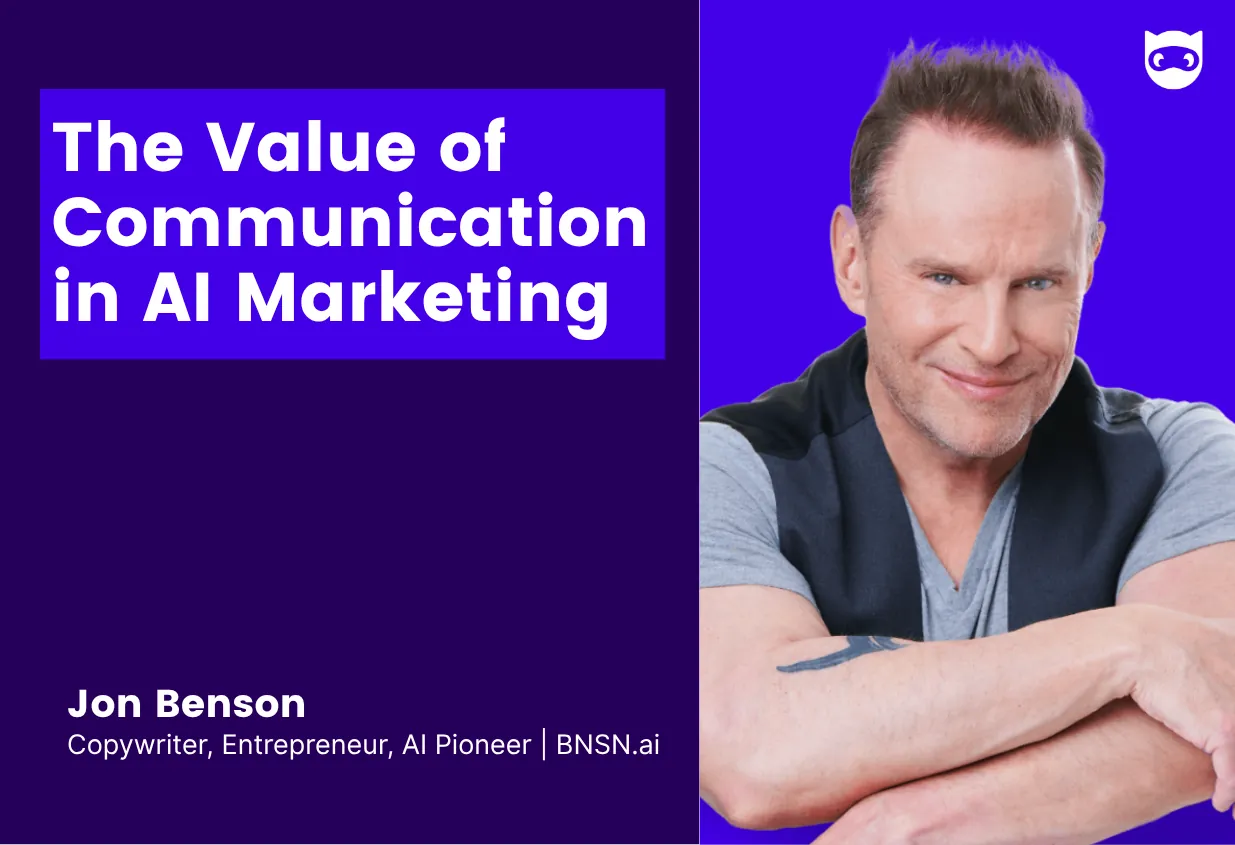
The words a business puts into the world are first a communication problem, before they are a marketing problem. Words either reach the person they are meant for, specifically, at the right moment, in language that feels like it was written for them, or they don't. Most marketing is built as if the gap between those two outcomes is a creative problem. Jon Benson has spent his career arguing it is a human one.
Benson is a copywriter, entrepreneur, and the creator of the Video Sales Letter (VSL) — a format that’s become the engine of modern direct response marketing. He began building AI copywriting tools in 2010, years before the technology had a mainstream name, and his platform BNSN has been trained on the patterns behind high-converting campaigns ever since.
In this podcast interview, Jon walks through the communication principles that most agencies are skipping: where buyer pain actually lives, what AI copy requires before a prompt is written, and why the most durable competitive advantage in a technologically transformative market, has nothing to do with automation.
Most pain-point marketing gets the category right and the moment wrong. Marketing and sales teams identify what the audience probably cares about — save time, cut costs, grow revenue — and build campaigns around those assumptions. Jon's argument is that assumed pain and actual pain are rarely the same thing, and the distance between them is where most campaigns lose their footing.
He uses two specific frames, mirror & 11PM language, to find subatance.
"The mirror language is what you say to yourself when you wake up in the morning and look in the mirror for the first time,” explains Jon. “Whatever you say into that mirror, particularly the stuff you don’t like, those get you closer to actual pain points."
The second frame brackets the other end of the day. "The 11 PM language is what you're thinking as you fret. As you're winding down the night, as you can't sleep — what keeps you up at night?"
These two moments, when you’re staring at either the mirror or the ceiling, are where buyers are unguarded. You won’t find this in surveys or on sales calls. Getting to that language takes more upstream work than most briefs allow for. "To discover that takes a little bit more work," Jon says, "and fortunately, AI really helps with that."
When the research is done and the language is right, something shifts in the marketing copy. "When you are in alignment with your core values and you're writing from that perspective… that seeps into the words. And all of a sudden people start feeling like, what this guy's writing, it feels like he's writing to me."
The brief doesn't necessarily start with the message. It starts with understanding the moment.
Jon has been training language models on marketing and sales copy patterns since 2010 — doing pre-prompting and multi-shot sequencing before those terms existed in common use. That history gives him a specific kind of impatience with how most teams approach AI copy today.
"Most people approach this without nearly enough training in the models. They'll go to ChatGPT and go, 'Hey, I need to write a VSL for my new dog training product. Why don't you go ahead and write that for me?' It's like — good luck with that."
For more insight on this topic from NinjaCat, check out our blog, "Successful AI Agent Builders Start With This Step"
The problem is not the tool. It is what the tool was never given. A model does not know the mirror language of the buyer. It does not know which objection is the real one versus the polite one. It does not know what the brand actually stands for at the level of values, not taglines. All of that has to come in before a prompt is written. Jon's platform, BNSN, was built on this principle.
"You don't see the six or seven rewrites that we do behind the scenes before we show you the final. And you don't know that when you say 'I want a VSL,' that this part went to this LLM, and this other part went to this one, and this other part got edited by this one but was written by this one."
That architecture is not replicable with a single chat window, but the underlying principle is. The quality of the output is a direct function of the specificity of what goes in. "AI sounds like AI until it doesn't," Jon says. The gap between those two states is almost never the tool. It is almost always the preparation.
The standard instinct in marketing is to maximize reach. Jon's argument is that chasing reach before defining fit is where most of the real cost accumulates — not in media spend, but in time, energy, and the downstream friction of working with buyers who were never quite right.
He provides a concrete example: imagine you can bring in 10 clients who are exactly right for what you do, or 20 where the fit varies widely. "So many people, believe it or not, their first reaction is that they're gonna take the 20. They might get a couple more people out of that group."
Jon’s challenge to that instinct isn’t philosophical, but a question of operations and aging.
"To get to those 12 out of the 20 is gonna cost you hair. It's gonna cost you wrinkles. It's gonna cost you energy. It's gonna cost you time."
The solution is targeting so specific that the wrong buyer self-selects out. Jon has opened sales letters with language like: If you own a business and you make more than ten million a year, click off. This is not for you. While most teams read a self-selecting message like that as risk, Jon views it as precision. Telling people who you’re wrong for, is a fast way to tell the right people they are in the right place, and Jon admits, this is the preferred problem.
"I want the customers that are like, 'I love what you're doing. Is there anything I can do to help your business grow?' Give me 10 of those any day over 20 of the other. Any day of the week."
The question worth asking before any brief gets written is not "what should we say?" It is "have we defined our buyer specifically enough that one sentence would make them feel immediately understood?" If the answer is no, even well-crafted messaging is working against a headwind.
Jon runs an AI company. He has spent fifteen years building the kind of infrastructure that makes AI copy actually perform. He believes in the technology. He is also direct about what it cannot do.
"I'm gonna own an AI company and I hate it myself," he says of generic AI output. "You'll never make it."
The more capable and accessible AI tools become, the more everything produced by their defaults sounds the same — polished, competent, and unmistakably manufactured. The audience is noticing. Jon draws a distinction that explains why generic AI output fails even when it's technically correct: the difference between coercion and compulsion.
Coercion is pressure applied to a decision the person doesn't actually want to make. Compulsion is what happens when someone is shown something true about their situation and finds they can no longer look away. "I'm not afraid of the truth, and I don't expect my readers or viewers or buyers to be afraid of the truth either. If they're afraid of the truth, I don't want them."
The businesses that survive the current market, in Jon's view, are the ones willing to be specific, polarizing, and honest in their communication — not as a content strategy, but as a posture. "If you're not willing to be fully, authentically human — turn off people that you're okay to turn off, turn on people that you're okay to turn on — you're dead in the water."
Jon has an epic line he says people quote back to him more than almost anything else he's written. It started as a note in a copywriting course:
"You don't have to lie to write great copy. But you have to be brave enough to tell the truth."
In a market where every AI tool is available to everyone, the ability to tell the truth is the one thing that cannot be automated.
Listen now: Spotify | YouTube | Apple
Connect with Jon: LinkedIn | Website
Subscribe to What Gets Measured for more conversations like this.