Jake Sanders
Content Strategist
As marketing analytics and operations leaders prepare for 2027, the enterprise operating environment has reached a definitive tipping point. The initial wave of artificial intelligence adoption—characterized by fragmented point solutions, hasty generative copy tools, and uncoordinated pilot projects—has given way to a fundamental truth: AI maturity is a direct reflection of organizational maturity.
Organizations that attempt to deploy autonomous AI agents or sophisticated predictive models onto fractured data stacks, ambiguous team hierarchies, or organizational silos merely succeed in automating their pre-existing chaos.
Managing marketing performance across complex portfolios, whether across dozens of client accounts, distinct regional markets, or a multi-brand corporate enterprise, requires a shift from campaign-centric execution to systematic operational design. As production constraints dissolve through automation, context constraints and human judgment emerge as the ultimate competitive bottlenecks.
This playbook provides a comprehensive, evidence-based strategic blueprint for Heads of Marketing Analytics and Marketing Operations leaders preparing their organizations for 2027. Built directly from insights and executive interviews across the What Gets Measured podcast, this guide details the six foundational pillars required to transform AI from speculative hype into a scalable, revenue-generating decision engine.
Enterprise AI readiness begins at the foundational data layer. For operations leaders managing multi-brand or multi-account portfolios, relying on fragmented SaaS silos or 'off-the-shelf' public language models creates unacceptable security risks, data drift, and platform lock-in. The primary directive for 2027 is establishing an owned data layer unified by a standardized semantic model that bridges technical engineering teams and commercial decision-makers.
But data ownership shouldn't be confused with building everything from scratch. For marketing leaders, the hidden costs of building a custom enterprise AI stack can introduce the very complexity, maintenance burdens, and operational risks that a unified architecture is meant to eliminate.
Traditional marketing analytics relied strictly on structured performance metrics—click-through rates, conversion totals, and cost-per-acquisition. Modern AI agents, however, require multi-dimensional context to execute strategic reasoning.
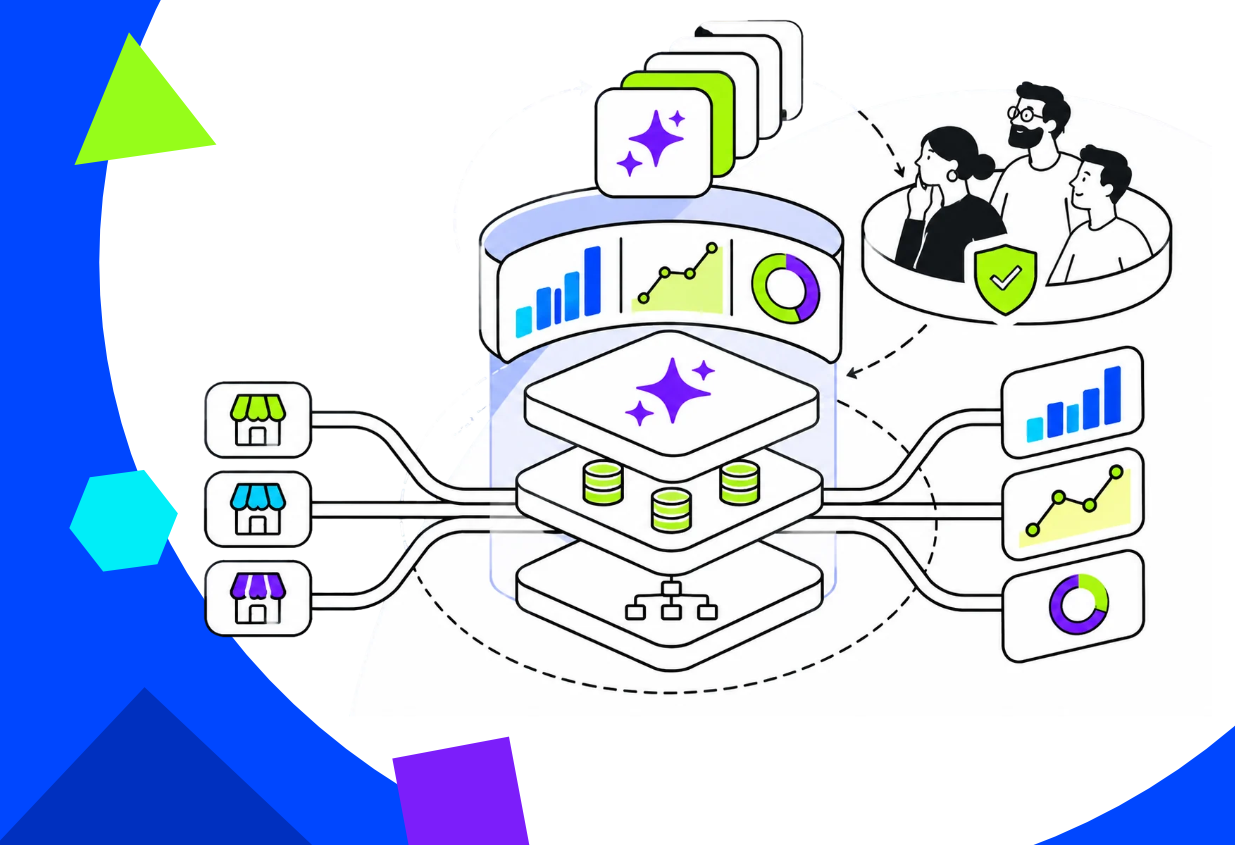
An AI-ready data architecture must integrate structured transactional data with unstructured assets, including creative copy, video transcripts, customer review sentiment, CRM interaction logs, and internal organizational knowledge.
By placing a semantic layer over central data warehouses, analytics leaders enable natural-language querying across technical pipelines, allowing non-technical stakeholders to extract immediate business intelligence without creating engineering tickets.
Featured Expert Insight; Luke Ambrosetti, Principal Industry Architect for Marketing at Snowflake Episode Link: [The AI Ready Marketing Stack]
"The biggest change over the past several years is that brands are starting to really want to take control of their own data and their own data processes. With AI, the bar has been lowered significantly to make this approachable.
A modern AI-ready data architecture starts with customer structured data and performance data, placing a semantic model or layer over it so teams can chat with that data in natural language. The next layer is unstructured data—reasoning between creative assets, actual performance, and individual segment behaviors. The final layer is capturing organizational data: how your team actually makes decisions, how terms are defined, and capturing that strategy context so AI agents can reason across the entire enterprise."
Before deploying generative AI for client-facing content creation, operations teams must direct automation toward the invisible, high-friction backend tasks that consume team bandwidth and introduce human error. Tasks such as taxonomy alignment, tracking tag validation, content audits, SEO/AEO compliance, and budget pacing offer immediate, measurable efficiency gains while establishing baseline operational hygiene.
In addition, leaders must safeguard custom prompts, brand persona definitions, and agent instruction sets by storing them in independent, enterprise-owned repositories rather than building proprietary workflows on vendor platforms.
Featured Expert Insight; Brian Piper, Author, Educator, and International Keynote Speaker Episode Link: [Automate The Work That Hurts]
"Don't start with flash; start with friction. The boring layer in the background that teams ignore—compliance audits, content audits, taxonomy, tagging alignment, AEO, and SEO—that is where these tools excel. On content creation projects, we typically see a 20% to 40% savings in time, but on data analysis and insight projects, we see a 60% to 80% time savings because these tools are so effective at searching large data sets.
However, these commercial models are the ultimate rented land. You can build on them, but every so often you must export what the tool knows about your company, your prompts, and your persona instructions, and store them in your own repositories. That way, if a platform changes, goes away, or you switch providers, you retain full control over your information assets."
To ensure operational stability, analytics leaders should structure their data architecture across four distinct functional layers:
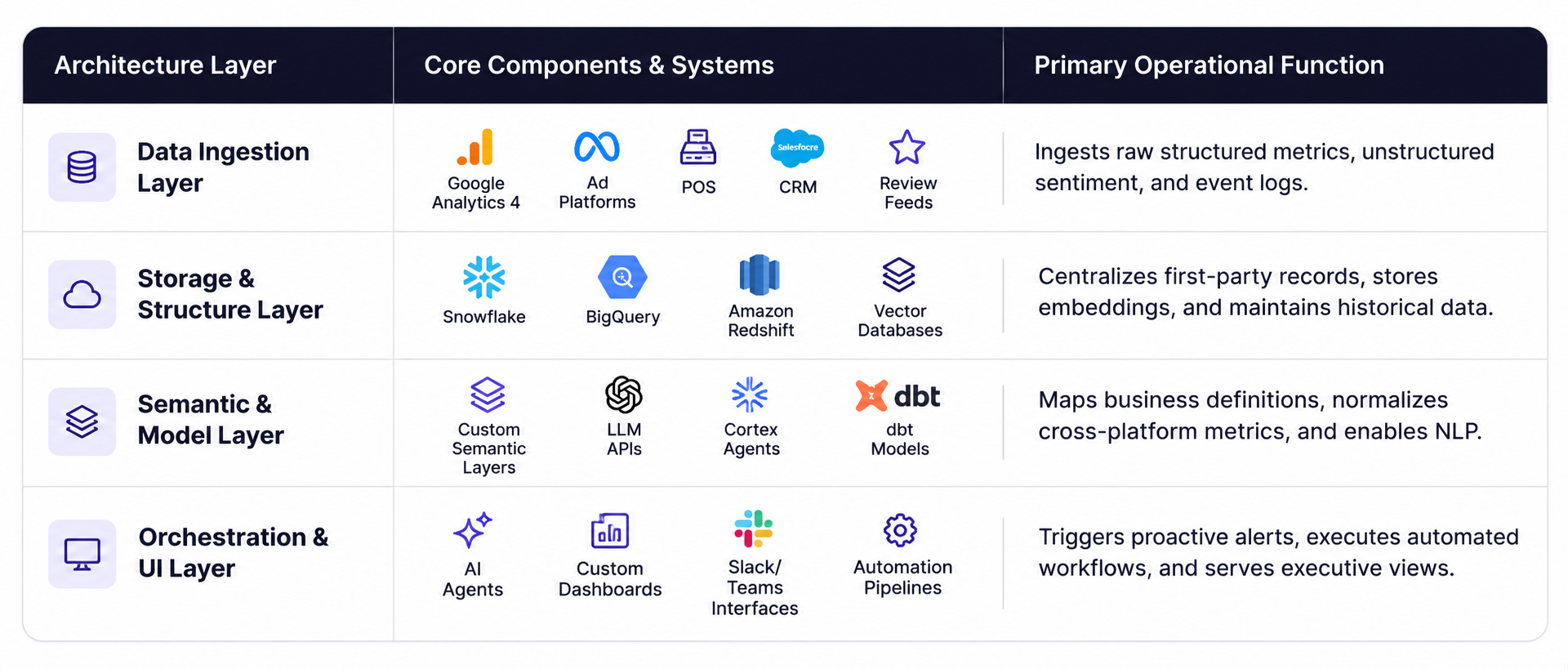
These four layers do not necessarily require four separate technology investments or a custom-built infrastructure. Integrated marketing AI platforms can unify data ingestion, storage, transformation, and agent orchestration within a governed environment, allowing enterprises to retain control of their data while reducing integration complexity and ongoing maintenance.
Scaling marketing operations across dozens of distinct accounts, franchisee locations, or regional markets presents a classic tension between operational efficiency and contextual relevance. Standardizing every workflow results in rigid, tone-deaf marketing; conversely, allowing every account to build custom workflows creates chaotic tech debt and eliminates economies of scale.
To manage multi-account portfolios at scale, leading agencies and enterprise operations teams enforce a strict 70/30 operational split. Under this model, 70% of campaign architecture, data taxonomy, tracking infrastructure, and reporting pipelines are standardized across all accounts. The remaining 30% is explicitly reserved for account-specific customization—tailoring messaging to local buyer personas, vertical nuances, and regional competitive dynamics.
Scaling multi-account operations successfully depends on disciplined communication structures and transparent change management. Trust across client accounts or brand managers is built not through static dashboards, but through consistent execution, verified QA processes, and human accountability.
Featured Expert Insight; Robb Fahrion, Co-Founder & CEO of Flying V Group Episode Link: [Running Multi Account Marketing At Scale]
"Marketing at scale stops being about isolated campaigns and becomes a systematic operational challenge. 60% to 70% of your campaign setup, conversion tracking, and data pipelines are built the exact same way regardless of the client. What changes is that remaining 30%: who is the target customer persona and what unique expertise does the brand bring to the table to cut through the noise?
Scaling multi-account marketing requires two non-negotiable principles: communication and accountability. Trust is built when team members show up consistently with accurate, QA-checked reports and actionable strategic recommendations. Dashboards alone do not build trust; trust is an operational behavior maintained through clear human relationships."
In multi-location retail, franchise, or healthcare operations, high-level summary metrics frequently mask severe operational variances. A 4.7-star average rating across twenty locations provides zero actionable intelligence if ten locations excel at service but fail on product quality, while the other ten experience the inverse.
Operations leaders must utilize natural-language AI to disaggregate customer review data and voice-of-customer sentiment across individual locations, transforming qualitative feedback into precise operational KPIs.
Featured Expert Insight; George Swetlitz, CEO & Co-Founder of Right Response AI Episode Link: [How To Leverage Customer Review Data]
"Most platforms give you a surface view of average ratings—a 4.5 or a 4.7—which is practically unusable for driving operational improvement. You can have two locations averaging 4.7, but one is failing on service while the other is failing on product quality. To fix the issue, you must peel the onion through voice-of-customer sentiment analysis, extracting specific topics, sentiment intensity, and trigger phrases.
Review sections are not administrative tasks to check off; they are high-intent, bottom-of-the-funnel marketing opportunities. Customers reading reviews are actively making a buying decision. Responding with generic, canned AI text is a net negative that hurts brand perception. Organizations must use granular sentiment data to fix operational root causes internally while providing rich, contextual responses publicly."
A primary vulnerability in contemporary marketing analytics is the widespread reliance on platform-reported metrics. Ad platforms operate with inherent conflicts of interest, utilizing aggressive attribution windows (e.g., 7-day click, 1-day view) that claim credit for transactions driven by organic demand, email nurtures, or upper-funnel awareness channels.
For 2027, analytics leaders must dismantle platform Return on Ad Spend (ROAS) as a decision metric and transition to holistic, incrementality-based measurement frameworks.
To obtain an objective view of business health, operations teams must evaluate performance using the Marketing Efficiency Ratio (MER) and Acquisition Marketing Efficiency Ratio (aMER):
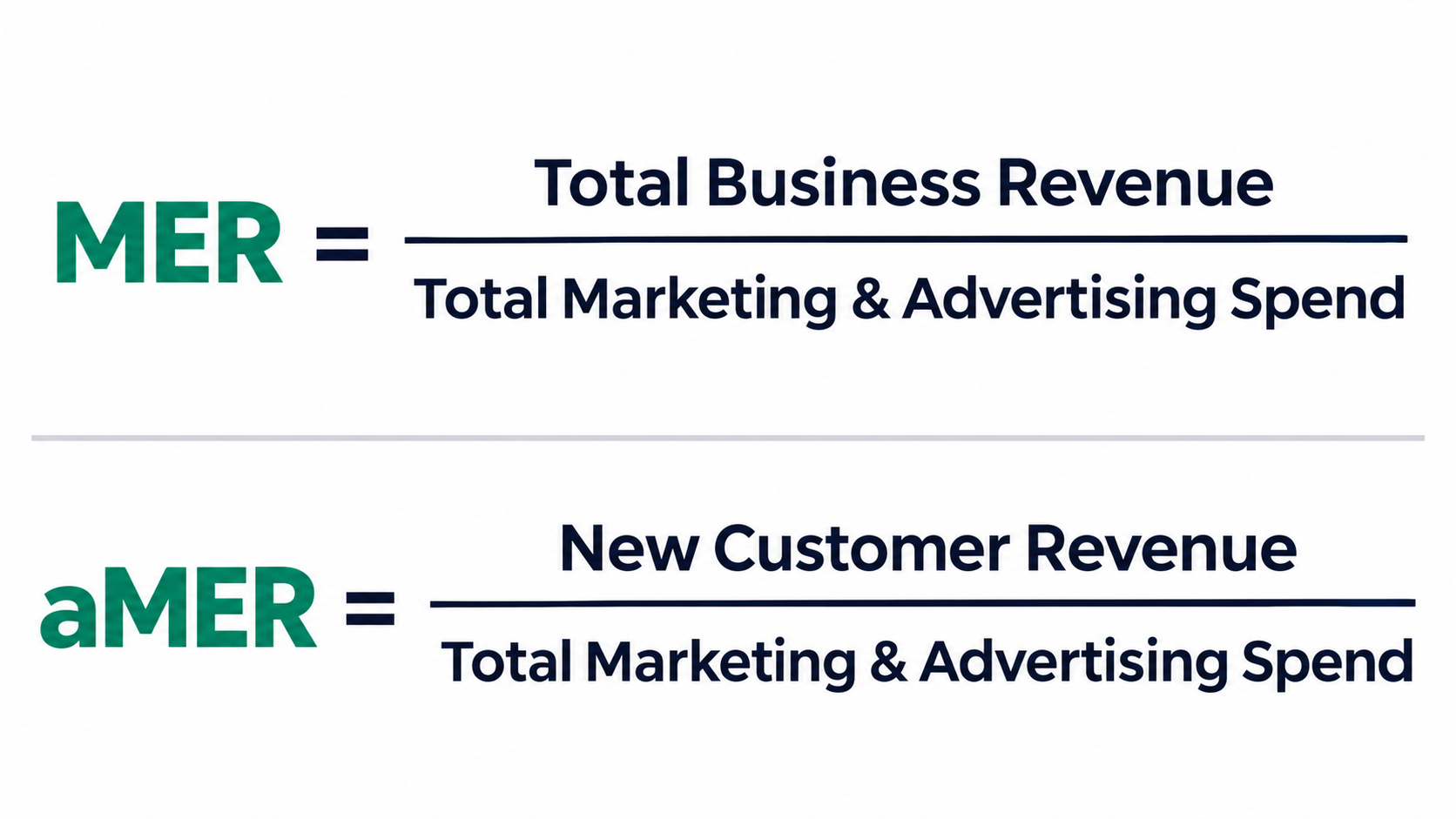
By evaluating overall revenue against total marketing outlay, marketing efficiency ratios eliminate cross-channel attribution duplication. Acquisition MER isolates the efficiency of acquiring brand-new customers, ensuring that paid ad spend is actively expanding the customer base rather than merely retargeting existing brand loyalists.
Featured Expert Insight; Krista Karpan, Co-Founder & CEO of Milk Media Episode Link: [How Data Drives Ecomm Brand Marketing]
"When you advertise across multiple platforms—Meta, Google, TikTok, Pinterest—every platform reports its own revenue and ROAS using overlapping attribution windows. If you add up platform-reported revenue, it is frequently higher than your actual total enterprise bank revenue.
Marketers must stop letting platform ROAS be their North Star metric. We prioritize the Marketing Efficiency Ratio (MER), calculating total revenue divided by total ad spend, and specifically Acquisition MER (aMER), which divides new customer revenue by total ad spend. Paid advertising's primary responsibility is driving new customer acquisition, while email and retention marketing handle repeat purchases. Evaluating aMER gives you an unvarnished, truthful view of spend efficiency."
Dashboards have historically functioned as passive reporting tools—visual grave sites where data is displayed but rarely acted upon. Analytics leaders must redesign dashboard infrastructure to serve as decision engines aligned directly with high-stakes executive questions regarding customer lifetime value (LTV), customer acquisition cost (CAC) paydown debt, and segment-specific churn.
Featured Expert Insight; Tim Shea, Founder & CEO of Lattiswork Insights Episode Link: [Dialing in Marketing Performance Dashboards]
"Most companies have data trapped across 20 to 40 different platforms, creating a reporting nightmare. Furthermore, AI is currently producing bad software and filler reports that lack real insight. Dashboards must be transformed from passive reporting tools into decision engines centered around true North metrics like Lifetime Value (LTV).
LTV is not a static single number on a screen; it is a story that requires segmenting customers and removing Black Friday discount noise. When you present a founder with a dashboard and say, 'If we divide your customers into three buckets and reduce churn for enterprise customers by 1%, that pays for all CAC across medium and small accounts for six months,' everyone says, 'I want to look at that dashboard.' Analytics must demonstrate a clear return on analytic spend."
Beyond descriptive analytics, advanced operations teams are deploying Causal AI—utilizing Directed Acyclic Graphs (DAGs) and counterfactual modeling to understand the structural 'why' behind buyer decisions rather than relying on correlative statistics. Concurrently, programmatic media buyers must enforce strict supply-chain hygiene, auditing and records to eliminate bot fraud and un-viewable inventory.
Featured Expert Insight; Bill Schmarzo, 'Dean of Big Data,' Author of The AI Human Edge, Lecturer at Iowa State Episode Link: [The AI-Human Edge]
"Organizations are infatuated with technology, but value is created strictly at the front lines of customer engagement. You cannot understand value if you don't understand what your customers define as valuable. That requires moving away from summary statistics and averages toward individual propensity models.
True competitive advantage lies in Causal AI—understanding the causal factors, intervention levers, and counterfactuals behind human decisions. Correlation is not causation. Causal models allow you to run simulations, evaluate 'what-if' scenarios, and make precise decisions that optimize long-term outcomes while continuously updating as customer behaviors evolve."
Featured Expert Insight; Eric Tilbury, Head of Programmatic at Inuvo Episode Link: [What Are You Really Buying in Programmatic]
"Over 95% of programmatic ad buyers have no idea what exchange or inventory sources they are actually purchasing in their DSPs. They optimize for superficial metrics like click-through rates or low CPMs without realizing they are buying fraudulent bot traffic, VPN apps, or un-viewable placements.
Most campaigns fail before an impression even runs because buyers don't inspect or records. Programmatic advertising must be treated as a digital billboard designed to influence real human beings. Measurement must be moved completely off-platform using Media Mix Modeling (MMM) to evaluate true incremental impact on the business rather than relying on inflated platform dashboards."
To guide measurement selection, analytics leaders can evaluate the primary methodologies across four key operational criteria:
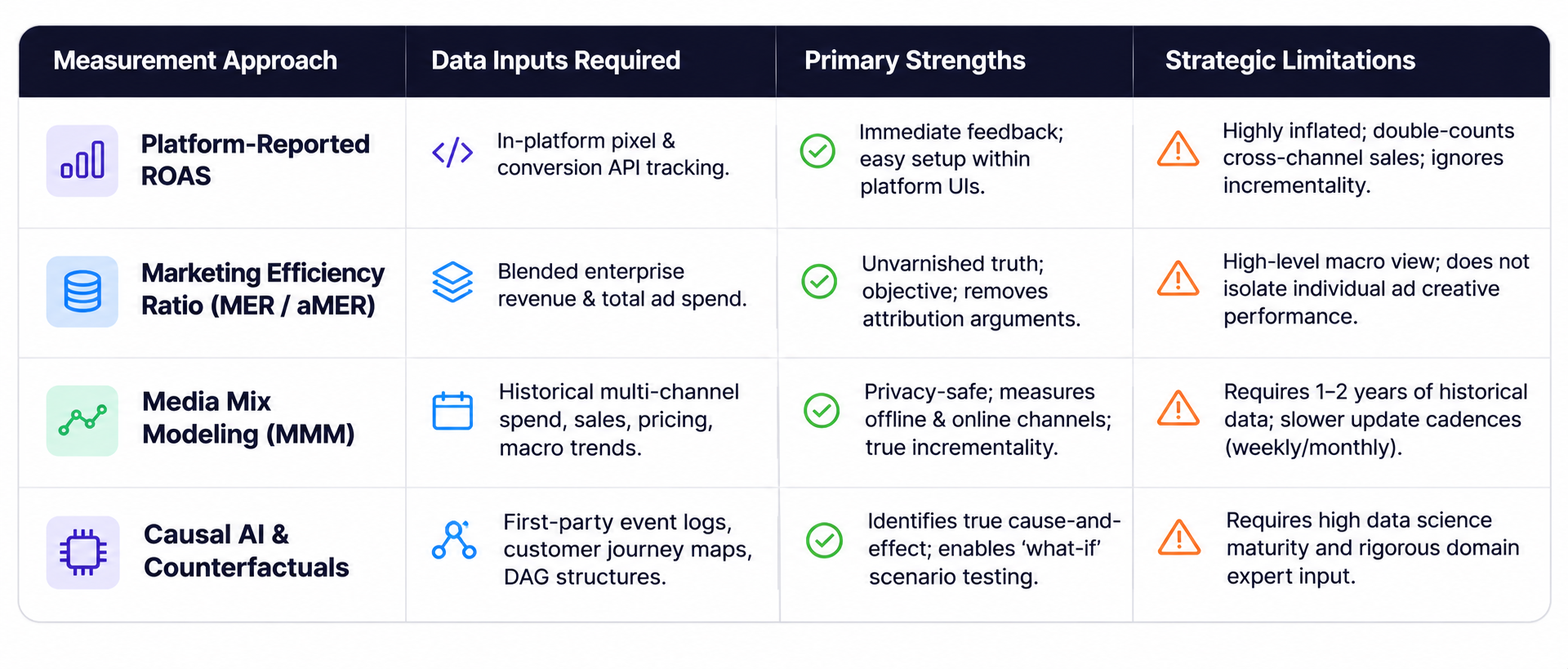
The rapid emergence of specialized AI agents is fundamentally redefining team roles within marketing operations. The traditional operational role—focused on manual data extraction, spreadsheet formatting, and campaign staging—is being superseded by the Marketing Engineer or Agent Conductor. This hybrid role combines strategic domain expertise with technical system design, orchestrating fleets of autonomous agents while establishing rigid deterministic guardrails.
A critical mandate for Marketing Engineers is eliminating 'data obesity'—the practice of generating overwhelming 50-page reports simply because automated tools make text generation effortless. Operations teams must enforce an 'artfully simple' presentation standard, synthesizing complex multi-channel analysis into concise, executive-ready briefings designed for mobile consumption.
Featured Expert Insight; Keith Clay, Senior Vice President of Product & Operations at Overdrive Interactive Episode Link: [The Marketing Engineer Mindset]
"The Marketing Engineer is a hybrid professional who combines marketing strategy with technical building skills to eliminate mundane agency busy work—daily budget pacing, manual reporting, and tracking sheets. However, before automating any system, step zero is verifying data accuracy. If data inputs are incorrect, even the most polished AI output becomes useless or damaging.
Furthermore, teams must avoid generating massive, unread artifacts simply because the technology allows it. Every output must be synthesized down until it appears artfully simple. Assume your executive or client is on their mobile phone running between meetings; they must immediately absorb the 'so-what' and key decision points without wading through dense filler."
Connecting AI agents for marketing directly across disparate enterprise systems—such as ERP inventory, point-of-sale systems, paid ad channels, and predictive weather feeds—enables marketing operations to transition from reactive post-campaign reporting to proactive, real-time forecasting.
Featured Expert Insight; Sandra Oono-Thomas, Vice President of Enterprise Growth & Digital Commerce at Daye North America Episode Link: [The Marketing Leader's Guide to AI Agents]
"In e-commerce, our reporting used to live in manual 20-tab Excel spreadsheets. We were constantly reacting to past performance, and by the time we assembled the data, two weeks had passed and the market had moved.
Connecting AI agents across our sales, inventory, paid media, and predictive weather data fundamentally transformed our operating model. It shifted us from a reactive state to a proactive model where we set strategies based on predictive forecasts and real-time visibility. AI agents do not replace human strategy; they act as co-strategists, drastically compressing the time between data, analysis, and execution."
As automated outreach and agentic communication proliferate, generic AI messaging suffers from severe diminishing returns. Persuasive copy and brand resonance require deep alignment with core organizational values and direct, empathetic understanding of ideal buyer profiles.
Featured Expert Insight; Jon Benson, Creator of the Video Sales Letter (VSL) & Founder of Benson AI Episode Link: [The Value of Communication in AI Marketing]
"Most AI-assisted marketing copy feels polished but performs flat because it lacks true buyer alignment and human resonance. You do not have to lie to write great copy, but you must be brave enough to tell the truth.
As we approach 2027, if you are not willing to be authentically, genuinely human in your messaging, your business is falling behind. Audience connection requires understanding your ideal buyer's visceral pain points while speaking directly from your organization's core values. AI tools must be trained on deep contextual frameworks rather than simple one-line prompts, allowing copy to resonate on an authentic, human level."
The dominant variable holding teams back from achieving enterprise marketing AI maturity is rarely software capability—it is organizational culture, internal alignment, and talent upskilling. As AI tools produce increasingly sophisticated, professional-looking outputs, organizations face a subtle but severe risk: the AI judgment gap.
The judgment gap occurs when junior talent or non-expert reviewers accept AI-generated recommendations at face value because the output appears visually competent. Because generative models operate via statistical pattern recognition rather than genuine reasoning, reviewers must possess deep domain expertise to identify subtle hallucinations, weak evidence, or missing business context.
Featured Expert Insight; Jacey Berg, Senior Vice President of Strategy & Planning at Mediabridge Advertising Episode Link: [The Judgment Gap Between MarTech & Talent]
"Generative AI does not think—it performs pattern recognition across training data. The output can look remarkably competent, but reviewers who lack domain expertise will not understand what 'good' or 'working' actually looks like.
Marketers must value their own human expertise, questioning AI recommendations and pushing back on generated outputs exactly as they would with a junior employee. Furthermore, leaders must preserve talent development by providing safe environments where junior employees can chase theories, make mistakes, and build the critical judgment required to evaluate automated work."
Analytics leaders frequently complain that executive stakeholders ignore their dashboards. This disconnect typically occurs because the analytics team presents technical metrics (e.g., click-through rates, impression volumes, bounce rates) that hold zero relevance for C-suite executives. Data points function as communication vehicles within an enterprise; metrics must be explicitly tailored to align with the personal and professional incentives of the target stakeholder.
Featured Expert Insight; Shiv Gupta, Managing Partner at UT Group & Founder of QuantumSight Episode Link: [Marketing Analytics Has A People Problem]
"After 25 years in analytics, it is clear that most business problems are fundamentally people problems, not data problems. Metrics are vehicles of internal discourse and influence within an organization.
Marketing teams fail when 80% of their dashboard carries no meaning for the CFO. A CFO does not care about click-through rates; they care about incremental lifetime value, margin impact, and CAC paydown. Presenting the exact same data deck to every stakeholder is a mistake. Analytics leaders must customize their communication to speak directly to the explicit and implicit incentives of the person across the table."
Building an AI-ready workforce requires moving past one-off tool software demos and establishing continuous learning frameworks. Upskilling must balance technical/analytical capabilities with uniquely human skills—empathy, communication, strategic leadership, and domain context.
Featured Expert Insight; Ben Tasker, Senior AI Strategist at National Grid & Dean of AI Episode Link: [Why Skills Beat Tools in AI]
"Data is the oil to AI's engine. If your organization's baseline data maturity is low, your AI capabilities will rank even lower. Organizations must stop viewing AI as a point solution and approach upskilling as a systematic, multi-tier program.
Upskilling should address three distinct organizational tiers: Leaders (focused on strategic risk, SWOT, and decision governance), Specialists (focused on technical integration, coding, and ethical guardrails), and Generalists (focused on workflow automation and task efficiency). Crucially, technical upskilling must be paired with uniquely human skills—empathy, communication, and critical thinking—which become more valuable as routine tasks are automated."
A foundational error in executive decision-making is treating data as a neutral, objective truth that automatically dictates action. Numbers are inherently open to human interpretation, and figures are frequently selected to reinforce pre-existing biases.
Featured Expert Insight; Angeline Corvaglia, Former CFO, Founder, and Data Safety Advocate Episode Link: [When Data, AI, and Decisions Meet]
"Data is never neutral, and numbers are always open to interpretation. Early in my CFO career, my personal instinct told me our business trends were fine, but a year and a half of data trends proved my instinct completely wrong. It was a humbling lesson that you cannot always follow instinct; you must sometimes follow the numbers.
However, people incorrectly assume AI is neutral because it runs on data. Data is collected, categorized, and labeled by humans with explicit instructions and biases. Effective leaders must continuously challenge their own egos, look for the data trends everyone else is ignoring, and recognize that data is merely an input to human judgment, not a substitute for it."
As artificial intelligence eliminates production bottlenecks and floods digital channels with automated content, traditional search engine optimization (SEO) and linear conversion funnels are breaking down. In 2027, brand equity, trust, and contextual relevance represent the primary battlegrounds for consumer attention.
The traditional linear marketing funnel—where a consumer moves neatly from awareness to consideration to conversion—no longer reflects buyer behavior. In high-consideration purchases, consumers operate in the 'messy middle'—a prolonged, non-linear browsing environment spanning 30 to 45 days and dozens of quiet touchpoints across connected channels.
In this environment, last-click attribution provides misleading data, taking credit for transactions built on weeks of trust accumulation.
Featured Expert Insight; Carole Lawson, CIO & Founder of MarketStorm, Behavioral Dynamics Researcher Episode Link: [How Trust is Replacing The Marketing Funnel]
"The traditional marketing funnel is broken. In high-ticket or high-consideration decisions, buyers operate in a chaotic 'messy middle,' taking an average of 45 days and 35 touchpoints before converting.
We have moved from a traffic economy to a trust economy. When consumers are exposed to thousands of ad impressions daily, frequency alone does not drive sales—trust does. Trust is built by delivering contextual, relevant messaging across display, audio, and search when the consumer's frame of mind is receptive. Marketers must measure long-term brand influence and directional shifts in lower-funnel channels rather than relying on last-click attribution."
To achieve campaign effectiveness across automated environments, brands must execute five interdependent variables: Right Person, Right Message, Right Time, Right Environment, and Right Outcome. Omitting even one variable—such as allowing clean ad creative to serve on unsafe, unverified websites—invalidates the entire marketing investment.
Furthermore, brands must cultivate aesthetic intelligence—the deliberate curation of sensory, emotional, and brand ethos inputs across every digital and physical touchpoint.
Featured Expert Insight; Greg Licciardi, Vice President of Partner Programs & Sponsorships at the ANA, Author of The Holy Grail of Marketing Episode Link: [The Holy Grail of Marketing]
"Modern campaign success requires executing the Five Rs as an interdependent system: Right Person, Right Message, Right Time, Right Environment, and Right Outcome. Missing even one 'R' unravels your entire investment. For example, if you craft a brilliant message for the right audience but allow programmatic algorithms to spray it across unverified, low-quality websites, you destroy brand equity.
AI easily solves for the 'what, where, and who,' but human marketers must remain 'why curious'—uncovering the underlying consumer need. Brands must cultivate aesthetic intelligence, ensuring that brand ethos, sensory details, and customer experience remain authentic and consistent from ad exposure to final retail delivery."
The current transitional phase in martech resembles a chrysalis—a messy, non-linear state where old deterministic rules are dissolving, but fully autonomous systems are still taking shape. To succeed, operations leaders must combine deterministic scaffolding (clear guardrails and workflow checks) with probabilistic AI reasoning.
Concurrently, as consumers increasingly utilize conversational AI engines instead of traditional search bars, brands must optimize their data footprints for AI Engine Optimization (AEO) and AI Optimization (AIO), ensuring LLMs accurately index and recommend their business entities.
Featured Expert Insight; Scott Brinker, Creator of the Marketing Technology Landscape, VP of Platform Ecosystem at HubSpot Episode Link: [What Comes After Martech?]
"We are currently in a martech chrysalis phase—an intermediary, dissolving stage where old practices are disappearing but the final destination is still forming. AI eliminates production constraints, which immediately exposes an underlying context constraint.
The dominant variable holding organizations back is not software; it is organizational culture, team alignment, and incentive structures. To navigate this phase, operations leaders should combine deterministic scaffolding—rigid guardrails, approvals, and workflow steps—with probabilistic AI reasoning for adaptability. Furthermore, as search transitions toward conversational AI, brands must structure their entity data for AI Engine Optimization (AEO) to remain discoverable."
Ultimately, data-driven dogma must be replaced by decision-driven analytics. Operations teams must resist the urge to jump directly from raw data to executive decisions, reclaiming the human 'understanding layer'—where value is created through domain debate, trade-off analysis, and hypothesis testing.
Featured Expert Insight; Robert Van Ossenbruggen, Marketing Strategist, Analyst, and Partner at The Commercial Works Episode Link: [The Problem With Data Driven Marketing]
"Organizations are drowning in data while suffering from a decision drought. We operate under the naive assumption that more numbers equal better choices. In reality, teams jump from data to decisions while completely skipping the 'understanding layer'—the messy, human work of debating trade-offs, contextualizing findings, and testing hypotheses.
The short-term obsession with accountability drives efficiency over effectiveness. We must shift from data-driven dogma to decision-driven analytics. Discussions should center on business evidence and critical questions rather than filling out repetitive KPI templates. Data does not speak for itself; human domain experts must make the data speak."
For enterprise marketing leaders, the challenge in 2027 isn't adopting more AI, collecting more data, or adding another dashboard. It's getting greater value from the systems, people, and processes already in place.
Most mature marketing organizations have invested heavily in analytics infrastructure, reporting automation, and AI capabilities. Yet many still struggle to turn those investments into consistent, actionable intelligence across brands, regions, and client accounts.
The opportunity now is to close the gaps between data, analysis, decisions, and execution.
1. Eliminate the work between your systems.
Your organization may already have reliable data pipelines, a centralized warehouse, and sophisticated analytics capabilities. But how much manual effort still goes into reconciling metrics, preparing reports, investigating anomalies, and communicating findings across accounts?
Focus on automating the operational work that happens between existing systems. Standardizing data definitions, automating QA, and connecting reporting workflows can unlock capacity without requiring another infrastructure overhaul.
2. Turn portfolio-wide visibility into portfolio-wide intelligence.
A consolidated view of performance is valuable, but it doesn't automatically tell marketing leaders where attention is needed.
Deploy AI agents that continuously monitor performance across accounts, brands, and locations, identify meaningful changes, and surface exceptions that warrant investigation. The goal isn't more dashboards. It's helping teams identify which opportunities and problems deserve attention before they become apparent in the next reporting cycle.
3. Connect measurement to decisions and action.
Better attribution models, MER, and media mix modeling can improve how organizations evaluate marketing effectiveness. But better measurement only creates value when it changes what teams do next.
Connect performance intelligence to the workflows where decisions happen. Give stakeholders the context behind changes in performance, the implications for business outcomes, and clear recommendations they can evaluate and act upon.
4. Scale expertise without multiplying operational complexity.
Enterprise marketing teams need consistency across accounts without sacrificing local context. Building separate reports, workflows, and AI agents for every brand or business unit quickly becomes difficult to govern and maintain.
Standardize the underlying data, agent instructions, and repeatable processes while allowing teams to apply account-specific business knowledge. This makes it possible to scale operational expertise without requiring headcount or technical overhead to grow at the same rate.
5. Measure AI by the work it improves, not the technology it deploys.
The number of AI agents, dashboards, or automated reports in production says little about their business value.
Evaluate AI investments by measurable operational outcomes: time saved, faster identification of performance issues, fewer reporting errors, lower cost per completed task, and better-informed decisions. Maintain human accountability for the decisions that matter while automating the work required to support them.
The organizations that succeed in 2027 won't necessarily be those with the largest AI budgets or the most sophisticated custom-built technology stacks.
They'll be the ones that connect their existing marketing data, institutional knowledge, and operational workflows into a system that continuously turns intelligence into action.
That's the shift from using AI across marketing to operating marketing with AI.
Ready to put your 2027 marketing operations strategy into action? Request a demo to see how NinjaCat connects your marketing data, scales AI agents across brands and accounts, and turns analytics into actionable intelligence.