
Jake Sanders
Content Strategist

Marketing has a new job title, and it didn't originate from a trend report or a LinkedIn influencer. It’s a title that’s evolved from necessity.
Somewhere between the explosion of ad platforms and the rise of AI agents, the work of martech outgrew what any single marketer could handle. Data was fragmented across dozens of sources, pipelines clogged, reports stalled, and the people hired to fix it, the ones building connectors, governing schemas, and keeping the whole stack from falling apart, didn't have a clean name for what they did.
That name is marketing engineer.
It's not simply a token term, but a real and rapidly growing job category, and it describes a role that organizations looking to scale increasingly can't function without. This post is the definitive explanation of what a marketing engineer is, what they actually do, why the role exists now, and how the best ones are already using AI to do more than anyone thought possible just two years ago.
A marketing engineer sits at the intersection of marketing and software or data engineering. Where a traditional marketing analyst asks "what does the data say?", a marketing engineer asks "how do we get the data here — reliably, at scale, in a form that can actually be used?"
They own the infrastructure that makes marketing intelligence possible. That means:
In plain language: the marketing engineer is the person who makes the rest of marketing's work possible.
The marketing engineer didn't emerge from nowhere. The role is a direct response to three converging forces:
The average enterprise marketing team runs data across Google Ads, Meta, programmatic platforms, CRM systems, Google Analytics, retail data feeds, and a dozen more sources depending on the vertical. None of these platforms use the same naming conventions, data structures, or update cadencies. Someone has to reconcile them — not once, but continuously, as platforms change their APIs, add new fields, and deprecate old ones.
That someone is a marketing engineer.
As Mark Darling, Solutions Engineer at NinjaCat, put it: "Most 'automation' inside agencies still means a series of brittle scripts and human babysitting. Every new client adds new data sources, formats, and naming conventions."
The result, without engineering discipline, is predictable: inflated lead counts that break trust with clients, delayed reporting cycles, and analysts who feel more like spreadsheet janitors than strategists.
The actual inflection point that's making this role urgent, is the increasing realization that AI agents, similar to the realizations reached during the automation era preceding them, are only as good as the data they run on.
You can deploy the most sophisticated AI model ever built, but if the underlying data is fragmented, stale, or ungoverned, the agent either produces wrong answers or produces the right analysis on the wrong inputs. Either outcome is worse than not deploying AI at all.
This is why the marketing engineer has moved from "useful" to "essential" almost overnight. Organizations that want to benefit from AI-driven marketing intelligence need someone who can build and maintain the data foundation those agents depend on. That person is the marketing engineer.
Most organizations hired analysts to do both the data engineering and the strategic interpretation work. That worked when data volumes were manageable. It doesn't work anymore. When analysts spend 60–80% of their time preparing data before they ever analyze it, the interpretation never gets the attention it deserves.
The marketing engineer solves this by owning the infrastructure layer, freeing analysts to do what they were actually hired to do.
Marketing engineers wear different hats depending on the organization, but the core responsibilities cluster into five functional areas:
Marketing engineers design and maintain the marketing data pipelines that connect source platforms to downstream reporting and analytics environments. This isn't a one-time build — it's ongoing operational work. Platforms change their APIs. Clients add new channels. Attribution models shift. The pipeline has to keep up.
In practice, this means writing and maintaining connectors, monitoring for failures, handling schema changes when a platform updates its data structure, and building redundancy so that when one source goes down, the broader data environment doesn't collapse.
Raw data from ad platforms, analytics tools, and CRM systems doesn't arrive in a form that's ready for analysis. A marketing engineer runs the marketing ETL process — extracting data from sources, transforming it into consistent formats and naming conventions, and loading it into the environment where it will be used.
This is where deduplication lives. Where currency normalization happens. Where a "campaign" in Google Ads and a "campaign" in Meta get mapped to the same concept so an analyst — or an AI agent — can compare them. The ETL layer is where chaotic raw data becomes trustworthy structured data.
The marketing data warehouse is the central repository where marketing data from all sources lands after ETL. Marketing engineers design the schema, govern the data model, and maintain the warehouse so that it scales as new data sources are added without requiring a full rebuild.
At enterprise scale, this includes managing query performance, access controls, and the documentation that allows other teams — and increasingly, AI agents — to understand what data is available and how to use it.
Marketing engineers don't just build pipelines, they own quality. That means implementing anomaly detection, building alerting logic when data looks wrong, and conducting root-cause analysis when something breaks.
This is one of the most important and least glamorous parts of the role. Catching a tracking discrepancy before it makes it into a client report is invisible work, until it isn't.
This is the newest and fastest-growing dimension of the marketing engineer's job. As AI agents for marketing enter the stack, marketing engineers are increasingly responsible for the infrastructure those agents run on: connecting data sources to agent environments, defining the data models agents query, setting guardrails for what agents can and cannot do, and maintaining the governance layer that keeps automated decisions trustworthy.
This is the point where marketing engineering and AI engineering start to converge. The marketing engineer who understands both sides of this is becoming one of the most valuable people in any marketing organization.
Because the title is still emerging, marketing engineers often operate under adjacent titles. Here's how to tell the difference:
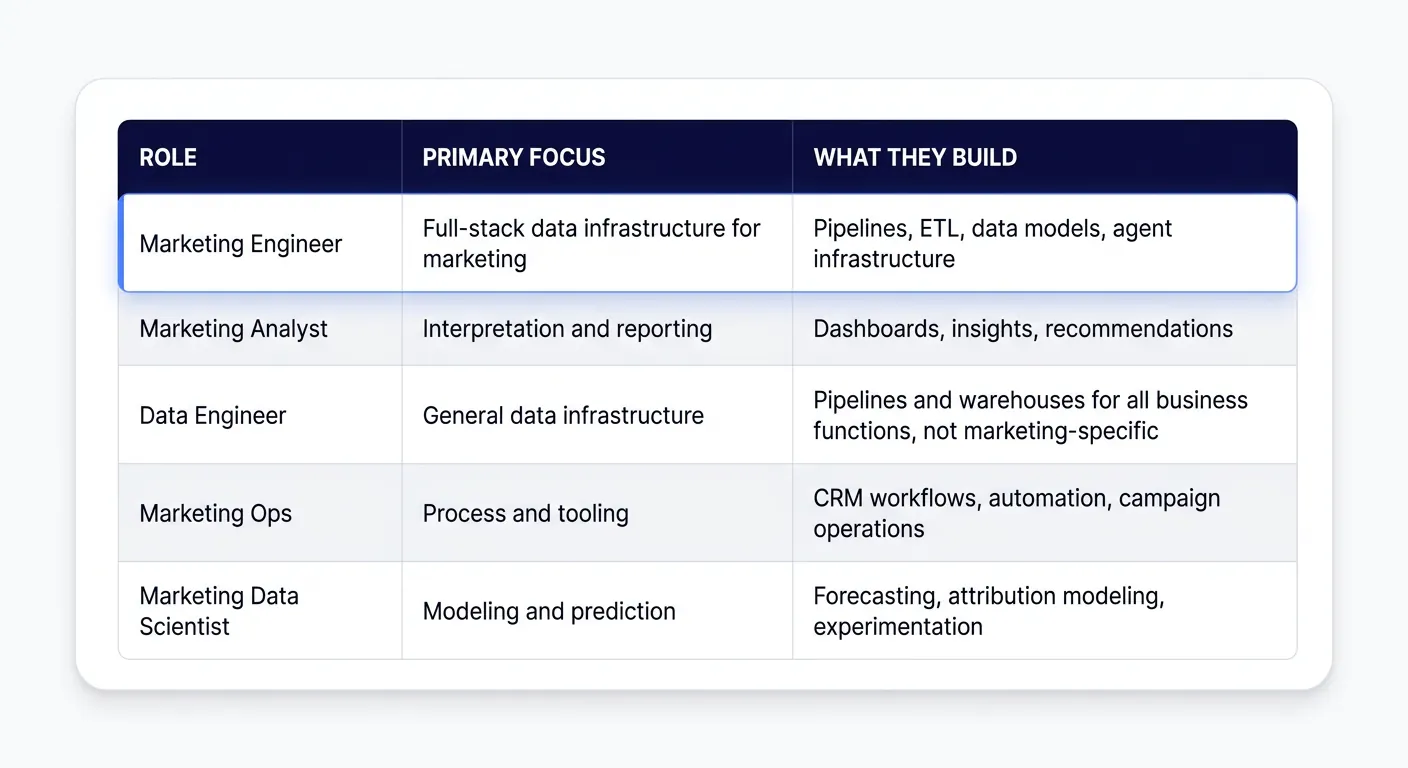
The marketing engineer overlaps with all of these, but sits at a specific intersection: they have the engineering depth to build infrastructure and the marketing domain knowledge to build it right for marketing workflows.
That combination is rare. It's also the combination that makes marketing at scale actually work.
The marketing engineers doing the most interesting work in 2026 aren't just maintaining pipelines. They're building agent infrastructure that changes what's possible for their organizations.
Sandra Oono-Thomas and her team at Daye North America (DNA) are a case study in what happens when a lean team with strong domain expertise gets the right infrastructure underneath them. Before NinjaCat, their data lived in disconnected places. Getting a complete view across brands, channels, and geographies required manual work that was always a week behind.
After implementing NinjaCat and building out their AI agent infrastructure, DNA achieved:
"The agents don't replace your expertise. They multiply it." — Sandra Oono-Thomas, Head of Marketing & Digital Commerce, Daye North America
The key to DNA's success wasn't just the AI — it was the data foundation they built underneath it. Connecting ad platform data, GA4, weather signals, and retail POS data into a unified environment is engineering work. The agents run on top of that foundation.
Global agency VML built two purpose-built AI agents — Meta Creative Carol and Commerce Funnel Felicity — inside NinjaCat to tackle the data challenges their teams face at enterprise scale.
Meta Creative Carol monitors hundreds of Meta campaign placements daily, identifying creative fatigue, surfacing performance patterns tied to creative attributes, and generating optimization recommendations. The result: a 30% increase in consumer engagement.
Commerce Funnel Felicity monitors 20 million e-commerce sessions weekly, connecting behavioral data from Google Analytics with Medallia customer feedback to surface funnel issues and emerging geographic anomalies that wouldn't have been visible otherwise. The result: a 53% increase in site conversion rate.
Neither agent required custom data engineering or outside development. But both required a solid, governed, unified data infrastructure for the agents to query. This case study demonstrates the type of infrastructure a modern marketing engineer has to build.
"What drew us to NinjaCat was the ability to work with large, complex data sets and pair them with AI automation. Instead of spending time pulling reports, our teams can focus on improving performance." — Erick McNett, Managing Director of Marketing Effectiveness & Analytics, VML
Global B2B agency Just Global | Trilliad deployed more than 150 AI agents across 18 departments using NinjaCat, automating workflows including invoice reconciliation, high-volume media trafficking, and password-protected dashboard delivery.
The result was thousands of hours returned to teams who could then focus on the strategic work that moves the needle for clients. The partnership earned NinjaCat the Just Global | Trilliad's internal 2026 One Team Collaboration Award.
"What started as an initial workflow and agentic 'one-stop shop' has quickly grown into a powerful solution that helps us analyze, create, visualize, and act faster than ever before." — Emilie Sanders Lee, EVP of Client Operations, Analytics & AI, Just Global | Trilliad
Understanding what a marketing engineer does also means understanding what makes the job hard.
Every ad platform, analytics tool, and data source has an API. Every API changes. Platform updates break schema structures, deprecate fields, or change rate limits — and when they do, the downstream data environment breaks too. A marketing engineer managing dozens of integrations is effectively running a permanent API maintenance operation in the background.
The manual version of this is unsustainable. The best marketing engineers are increasingly relying on platforms that abstract the API maintenance layer — so a platform change doesn't require re-engineering the pipeline from scratch.
"Campaign" means something different in every ad platform. So does "impression," "click," "conversion," and nearly every other metric that marketers use. A marketing engineer building a unified data model has to make and document normalization decisions for every one of these — and revisit those decisions every time a new data source is added.
At the agency level, where the same work has to happen across dozens of clients, this complexity multiplies. Organizations that solved this problem well report 75% reductions in reporting setup time when the normalization layer is handled systematically rather than manually.
One of the most persistent challenges for marketing engineers at agencies is the build trap: every new client requires a custom pipeline, and every custom pipeline is technical debt. Over time, the engineering team's bandwidth gets consumed by maintenance rather than innovation. New capabilities are perpetually in the backlog because the team is too busy keeping existing pipes running.
This is the challenge that platforms with pre-built connectors and managed integrations are specifically designed to solve. There are hidden risks to building your own AI marketing data stack. The marketing engineer who isn't caught in the build trap is the one who has time to build the things that actually differentiate their organization.
At enterprise scale, data governance isn't just a best practice — it's a requirement. Clients have data privacy requirements. Teams have access restrictions. Reports need to be auditable. And as AI agents enter the workflow, governance extends to decisions about what data agents can access, what actions they can take, and how their outputs are reviewed before reaching stakeholders.
The marketing engineer increasingly owns this governance layer — which means they need both technical and organizational credibility to enforce it.
Marketing engineering draws from a genuinely unusual combination of disciplines. The strongest practitioners tend to have:
Technical fluency:
Marketing domain knowledge:
Systems thinking:
Increasingly: AI literacy
The most significant shift in marketing engineering right now is the relationship between infrastructure and intelligence. For most of the last decade, a well-run marketing data stack was a means to an end: it existed to produce reports, dashboards, and analysis. The stack was infrastructure in service of human decision-making.
That relationship is changing. Now, the infrastructure doesn't just serve human analysts — it also serves AI agents. And the quality of the infrastructure directly determines the quality of what the agents can do.
This creates a new framing for the marketing engineer's work. Building a well-governed, unified, normalized data environment isn't just operational discipline — it's the strategic asset that makes AI-driven marketing possible.
The marketing engineers who understand this are already positioning themselves as the architects of their organizations' AI strategy, not just the plumbers who keep the pipes flowing.
As NinjaCat Solutions Engineer, Curt Cook put it: "Agencies aren't just 'using AI.' They're collaborating with it. The ones leading this shift aren't chasing hype or dashboards. They're engineering autonomy, one data pipeline at a time."
Not all marketing data platforms are built for the complexity that marketing engineers actually manage. When evaluating options, the questions that matter most are:
On integrations:
On data modeling:
On governance:
On AI agents:
On scale:
These are the questions a marketing engineer asks. They're also the questions a platform should be able to answer clearly and specifically.
Here's what makes the marketing engineer role so important right now: the work of building a trustworthy, governed, unified data environment is exactly the same work required to make AI agents effective.
There's no AI strategy that runs without a data strategy. There's no data strategy that executes without engineering discipline. And there's no engineering discipline in marketing without the marketing engineer.
The organizations seeing the most dramatic results from AI — the ones cutting manual work by 80%, driving measurable sales impact from intelligent agents, and deploying 150 autonomous workflows across an enterprise — all have one thing in common: they invested in the infrastructure first.
NinjaCat is how marketing engineers stop building infrastructure from scratch and start deploying intelligence instead. Pre-built connectors that don't break when APIs change. A governed data environment that scales across clients without custom engineering for each one. An agent builder that lets domain experts build and customize workflows without being blocked by developer availability. And the data foundation — unified, normalized, quality-assured — that makes everything else possible.
The marketing engineer's job is too important to spend it maintaining brittle pipelines. The best ones aren't.
What does a marketing engineer do?
A marketing engineer builds and maintains the data infrastructure that marketing teams and AI agents run on. This includes designing marketing data pipelines, running ETL processes to clean and normalize data from multiple platforms, managing a marketing data warehouse, ensuring data quality, and increasingly, building the infrastructure that AI agents query to produce automated insights and recommendations.
Is marketing engineering the same as marketing analytics?
No — though the two roles work closely together. A marketing analyst interprets data and produces insights. A marketing engineer builds the systems that make the data trustworthy and accessible in the first place. The marketing engineer is infrastructure-focused; the analyst is interpretation-focused. Both are necessary.
What skills do you need to be a marketing engineer?
Marketing engineers typically combine SQL, Python, API integration experience, and data warehouse knowledge with marketing domain expertise — understanding ad platforms, attribution models, and marketing measurement concepts. Increasingly, AI literacy is becoming essential: knowing how to design data environments that AI agents can effectively query and act on.
Why is the marketing engineer role growing so fast?
Two reasons. First, the complexity of the modern marketing stack — dozens of platforms, hundreds of data sources, constantly changing APIs — has made data infrastructure a full-time engineering challenge. Second, the rise of AI agents in marketing requires a governed, unified data foundation to run on. Organizations that want to benefit from AI-driven marketing need marketing engineers to build and maintain that foundation.
What's the difference between a marketing engineer and a data engineer?
A data engineer builds pipelines and infrastructure for general business data across many functions. A marketing engineer specializes in the specific data models, platforms, measurement concepts, and governance requirements of the marketing stack. The marketing domain knowledge makes the difference — a marketing engineer can make normalization and architecture decisions that a generalist data engineer would need significant context to get right.
NinjaCat is the enterprise AI agents and reporting platform built for the multi-account marketing teams who need both data infrastructure and intelligent automation — in one governed environment. [ Book a demo to see what NinjaCat's AI agents can do for your team ]