Jake Sanders
Content Strategist
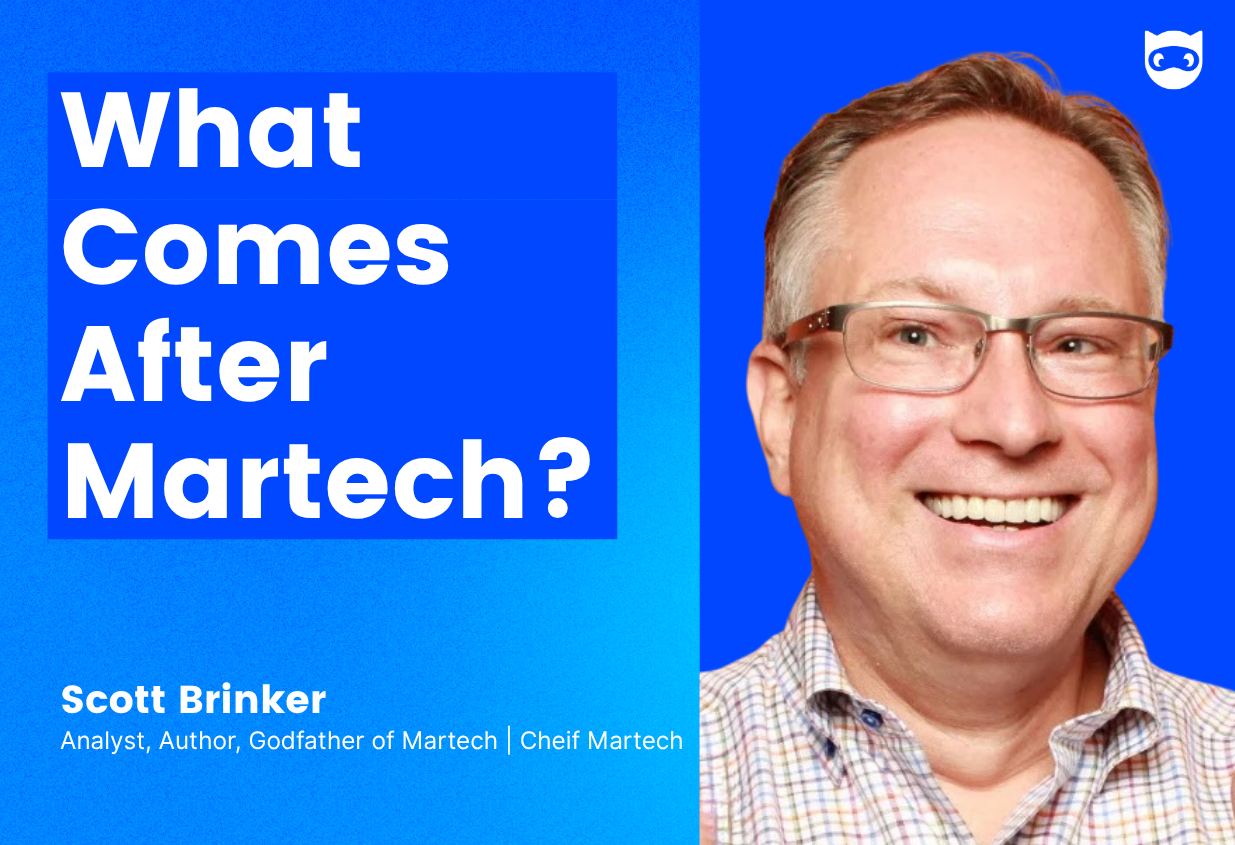
Scott Brinker is a martech analyst, advisor, bestselling author, and the creator of the Marketing Technology Landscape. Known by AdAge as the "Godfather of Martech," Scott previously led HubSpot's platform ecosystem strategy as VP of Platform Ecosystem and has spent more than two decades helping businesses navigate the evolving intersection of marketing, technology, and innovation.
Mr. Brinker joined the NinjaCat podcast for a discussion about the chrysalis question, dominant variables, explanations on how AI creates new bottlenecks and blasts down silo walls, what new roles and responsibilities we might see in the agentic future, and how context has always been the key to the kingdom.
Scott Brinker has spent more than two decades mapping the MarTech landscape — literally. He created the Marketing Technology Landscape, a sprawling visual index of every tool competing for a spot in the modern marketing stack. He's watched the industry inflate, consolidate, pivot, and reinvent itself more times than most practitioners have changed jobs.
So when Scott says the current moment feels categorically different, it's worth understanding exactly what he means. He doesn't reach for a tech analogy, but for the life cycle of a butterfly.
"There's this intermediary stage where things are really kinda messy," Scott says, "and it does not look at all like what that butterfly is gonna be. It doesn't, frankly, look anything like what the caterpillar was."
Scott mentions this intermediate stage explicitly in the report, the chrysalis. Not a caterpillar with better legs. Not a butterfly ahead of schedule. Something in between — structurally dissolved, reforming into a shape that isn't legible yet.
That's where marketing is right now. And transition is one of the main themes that permeates Scott's 2026 State of MarTech report and the entire episode.
When generative AI arrived, the first wave of excitement was about speed. More content, faster. Campaigns that used to take weeks could be assembled in hours. For many teams, that felt like the unlock they'd been waiting for.
Scott saw it differently.
"If we multiply the amount of content in the world by 100," he says, "that does not inherently improve our situation. In fact, if we don't manage it right, it actually might worsen our situation."
The production constraint in marketing was real. AI removed it. But removing a constraint doesn't solve the underlying problem — it reveals the next one. And the next one was always context.
"Because there's so much noise," Scott says, "if we don't have mechanisms to really be able to better match the right content to the right moment for the right person, the content isn't helping. I think it's actually hurting."
More output meeting less precision is not a marketing win. It's ambient noise with a budget behind it.
What makes this particularly sharp for organizations right now is that the context problem turns out to be an organizational problem. The teams Scott watches thriving aren't the ones with the most sophisticated tools. They're the ones that had already done the unglamorous work: data hygiene, governance structures, defined context lanes before AI arrived and demanded them.
"The tech can only go as fast as the organization's ability to actually absorb and leverage what the tech has to offer," he says.
The tools didn't create the bottleneck. The org did. And the teams that understood data governance as infrastructure — not as a compliance exercise — are the ones that have bridged the AI maturity gap in marketing and are now positioned to move. Everyone else is discovering that the production engine runs fine, but there's nowhere useful to send what it makes.
"It's like we've been building the engines but we haven't been building the roads," Scott says.
The implication for both brand teams and agencies is the same: AI returns are gated by context quality, and context quality is gated by organizational discipline that most teams haven't built yet. The work isn't acquiring more tools. The work is creating the conditions under which tools can actually function.
For the first time in the history of Scott’s MarTech Landscape, the total number of logos went down.
"We went from about 14,000 to 11,000 solutions," Scott says. "Not because companies went out of business — a lot of it is mergers and acquisitions, a lot of it is pivots."
That's a 21% contraction, in a space that had grown every single year for over a decade. The reversal is a structural signal worth examining.
And the shrinkage in total logos isn't the most telling part. The reason teams are removing tools is.
"The number one reason (martech tools were removed) was it didn't integrate well," Scott says.
Not cost. Not capability. Integration failure. Tools that couldn't connect to the rest of the stack are getting cut — and the platforms that were once selling point solutions are now embedding those capabilities directly, removing the case for the standalone vendor.
"The platforms are actually just embedding a lot of these capabilities directly," Scott says. "And I think that's making people think, 'Maybe I don't need that third-party solution for X.'"
The tension Scott identifies is real and immediate for anyone managing a stack right now. Composability — the ability to assemble best-of-breed solutions from across the vendor landscape — has always been the promise of modern MarTech. But composability requires integration, and integration requires organizational capacity that most teams are already stretching thin.
The contraction of the landscape is the market resolving that tension. Teams are simplifying. Platforms are consolidating. The era of reflexively adding a tool to solve a problem is giving way to a harder question: can this actually connect to everything else we run?
Scott draws a line from 25 years of search optimization to where marketing strategy is headed next — and the scale of the shift is not small.
"A massive portion of how marketing restructured and strategized itself for 25 years was, all right, how do we make sure we're serving the Google bot well?" he says. "Because the Google bot is our gateway to reaching these consumers."
That logic — optimize for the intermediary that controls access to your audience — is about to apply again. Except instead of one model with a known algorithm, agencies and brands are looking at a proliferating layer of AI agents making decisions on behalf of consumers. Purchasing decisions. Research decisions. Discovery decisions.
"Instead of just one Google bot, we're gonna have this absolute mesh... you know, of all sorts of different kinds of agents," Scott says, "and it's gonna become marketers' responsibilities to make sure we're serving those agents well. Because they are the conduit to reaching the audience that we want."
The consumer doesn't need to understand or manage any of this. Apple, Google, Samsung — these companies will embed agentic behavior into consumer experiences in ways that feel invisible to the end user. The average person won't think about optimizing their AI agent any more than they thought about how Google's algorithm worked. But behind the invisible layer of AI agents for marketing, a new set of rules is being written for how brands get found, evaluated, and chosen.
"There is a behavioral change, there's a channel change, there's a strategy change," Scott says, "and I suspect it's gonna happen faster than any of us would ideally like."
Twenty-five years of SEO strategy was built incrementally, with time to adapt. The agentic shift won't offer the same runway. And unlike SEO, where the rules of the game were at least eventually legible, the rules here are still being written — by multiple platforms, in multiple directions, simultaneously.
Scott's advice for navigating all of this is not strategic. It's physical, and again, based in metaphor.
"The only way you actually develop a true intuition with this stuff is you have to get into the mud," he says.
Reading about AI, attending presentations, following newsletters — Scott is direct that none of these are sufficient. They are useful, but they are not how intuition is built.
"You really do have to get hands-on with this stuff," he says. "The changes are so different. The mental models are so different."
The people Scott sees operating on the frontier of AI-driven go-to-market aren't the ones who read the most. They're the ones who started experimenting a year to a year and a half ago — running tests with marketing data analysis, hitting dead ends, adjusting, trying again as new models arrived. That iteration built something that can't be transferred through a webinar or a report.
"A lot of the people you see who are now on the frontier... they started a year, a year and a half back of playing around with this. And okay, this didn't quite work, but let me try it this way."
The gap between those practitioners and everyone else is already compounding. And demand for people who actually understand how to apply this — not just talk about it — is outrunning supply.
"Those people are in such high demand right now because there are so few people who actually have invested in really getting hands-on and understanding this stuff," Scott says. "And I think the demand is going to exceed supply for a number of years here."
The chrysalis doesn't resolve itself through observation. It resolves through the work happening inside it — the dissolving, the reforming, the emergence of something that didn't exist before. For marketers, that process is hands-on or it isn't happening.
The organizations building that capacity now, at the team level, are the ones who will recognize the butterfly when it arrives. Everyone else will still be looking for the caterpillar.
Listen now: Spotify | YouTube | Apple
Connect with Scott: LinkedIn | Website
Subscribe to What Gets Measured for more conversations like this.
Jake: Scott Brinker, welcome to What Gets Measured. How are you, sir?
Scott Brinker: I am good. Thanks for having me
Jake: Oh, it's one of those things, before we hit record, I was like, "Can we get Scott?" And yes, we got him. Back and forth in the scheduling. Um, the MarTech stack master, uh, you know, the, the guy who's been creating those things that you have to zoom into, he's here.
Jake: You know what I mean?
Scott Brinker: sure if that's considered a feature or a bug, but yeah.
Jake: But, you know, if you've been following, uh, MarTech and all of these things, you, you know about Scott Brinker's work, you know about, um, how he's s- up to date. And today we're gonna focus on the latest State of MarTech report, uh, 2026. But before we get into it, I just wanted to talk about the way you marketed the marketing report.
Jake: It's very meta. Um, but there was no paywall. Uh, there was a companion Spotify playlist with humorous footnotes, um, in the PDF. I was [00:02:00] l- I laughed at the
Scott Brinker: that
Jake: PDF,
Scott Brinker: so happy.
Jake: which I was like, "This shouldn't happen." Um, plenty of cheeky metaphors, like, really great poetic language, just plain good writing. It just felt like a joy to read.
Jake: Um, tons of research, surprising glances at data visualizations. One of them was the, how MarTech is being removed,
Scott Brinker: Mm-hmm.
Jake: d- or what parts of it are being removed. I thought that was really interesting. W- why did you give such a hoot about marketing this marketing report, and what's been the reaction?
Scott Brinker: Um, well first of all, thank you. I'm, I'm so glad, uh, that all those aspects resonated with you. I mean, I love this stuff, you know? And, uh, a big part of this for me is helping to connect this passion of how marketing and martech is evolving,
Jake: Totally
Scott Brinker: others. And so for me, it, um, the writing itself I wouldn't really see as a [00:03:00] marketing thing, at least that isn't how I thought about it so much as like, know, I kind of wanna write something that I would enjoy, that, you know, I would wanna read.
Jake: Yeah
Scott Brinker: there's a lot of, like, incredible writing out there, and there's a lot of great stuff, but I think honestly, 'cause I read a lot of other reports that get produced, is very often there becomes that sort of like corporate style, you know, to these reports. Which again, you know, the, the content can be great, the data can be amazing, you know, uh, and totally respect people's choices for their brands,
Jake: All right
Scott Brinker: I kind of felt like we had the opportunity to be like, "Okay, let's talk to people the way we would actually talk to people about this."
Scott Brinker: And yeah, if it borders on getting a little bit silly here and there, you know, part of that is like, well listen, I mean, this is, these are really serious,
Jake: serious, hard topics that
Scott Brinker: keep, keep the
Jake: we're wrestling with. You're doing so great, Owl. We're able to actually
Scott Brinker: in the, you know, time of AI? So I, it
Jake: Right
Scott Brinker: me very happy when [00:04:00] people say they enjoy that,
Jake: Oh
Scott Brinker: I have to imagine there's people out there who read it and
Jake: Who ate it?
Scott Brinker: "This guy's just nuts."
Jake: Yeah, I don't wanna suffer through another metaphor. Um, no, but, uh, no paywall. What was the thought there? Because you coulda got a bunch of leads and,
Scott Brinker: Mm-mm.
Jake: know, why didn't you, why didn't you snuff, snuff up all our data while you were giving us information about data?
Scott Brinker: Um, well, I, I, I do have to give credit to our sponsors that they went along with
Jake: Hmm.
Scott Brinker: you know, 'cause our perspective was, listen, the most important thing here... 'Cause we, we used to paywall these. I mean, not
Jake: Ye-
Scott Brinker: used to, you know,
Jake: gate. Yeah, yeah, yeah.
Scott Brinker: you
Jake: Right. Yeah
Scott Brinker: uh, and we'd get maybe, like, 5,000, 6,000 people who would, you know, go through that, which again, for, you know, lead
Jake: Not bad
Scott Brinker: good thing. Um, but it always felt like, listen, these are discussions that should be wider discussions.
Jake: Hmm.
Scott Brinker: when we, uh, proposed to our sponsors, can... You know, we'll, we'll, we'll gate the webinar and there'd be some [00:05:00] lead gen that happens there, but let's just get this report out there, and hopefully this will, from a brand and ability to get your messaging out in your interview, uh, hopefully be a really good way to, like, help you succeed. And in doing that, it... I mean, we were hoping, okay, maybe if we're really ambitious, we'll bring this from 5,000 to 50,000. Um, boy, the first time we did that it was over 250,000. Um, and so sort of ever since then we've been like, okay, listen, th- this seems to resonate with people. I think overall as the sponsors have been very happy with, you know, the, the, the representation they get out of it, and so, like, yeah, let's... Why gate it?
Jake: God, I love that. Well, well, but why you won't know until you let it go. And, and I love that your thought was it was a discussion that needed more broad distribution, which ends up being the marketing problem du jour, or no, just de [00:06:00] facto. You know? It's like you got a great thing, but no one saw it. Um, so I, I love reading this, and I love that I saw it.
Jake: And, and speaking of that writing, and again, I, I know, I know how you are. I love metaphors, and I know that businesspeople are like, "Get to the point." Um, one of your metaphors that I loved was chrysalis, and it hit me. It hit me in a way that I felt like this has Velcro on it. There's some traction here. Um, so can you explain why the seismic AI transformation marketing technology we're experiencing right now isn't just to get a caterpillar with better legs?
Scott Brinker: Yeah. Uh, this was one of those moments of serendipity where, uh, you know, um, a lot of writing about transformation is, like, a two-column sort of thing. It's like, "Okay, here's where we were. Here's where we're going," the, the old world and the new world, you know? And that structure's actually, you know... I've always found it very helpful
Scott Brinker: Mm-hmm.
Scott Brinker: like, just, you know, crystallize on a number of different [00:07:00] dimensions.
Scott Brinker: Like, okay, well, how does this change? What looks different, you know? And so when we knew we had to write that, you know, for this, uh, report, we're like, "Yeah, it's an evolution. It's a metamorphosis. It's a transformation," you know? And of course, like, the cliche, uh, you know, I mean, it's absolutely a cliche of, like,
Jake: It totally is.
Scott Brinker: butterfly.
Jake: It is
Scott Brinker: think about it like that, well, wait a second, there's this intermediary stage where things are really kinda messy, and it does not look at all like what that butterfly is gonna be. It doesn't, frankly, look anything like what the caterpillar was. Um, and it, it, it just really clicked of, like, oh my God, that is exactly what this moment in time feels like because it is this dissolving of what marketing has been, certainly what martech
Jake: Mm-hmm.
Scott Brinker: has been.
Scott Brinker: But what this is becoming, it's not entirely clear yet, and
Jake: For sure.
Jake: Hmm.
Jake: Mm-hmm.
Scott Brinker: for a lot of companies, they're really in this messy middle. I mean, you and I were talking earlier. While it's a very [00:08:00] exciting time to be in this position of having
Jake: Yeah.
Scott Brinker: to help reinvent marketing,
Jake: it, yeah
Scott Brinker: also an incredibly stressful and just challenging and hard time, you know, because, like, literally every week I mean, I do this full time. This is all I do, and every
Jake: I can't imagine
Scott Brinker: something gets announced or comes out somewhere where I'm like, "Okay, wow, that's gonna require me to, like, sort of rethink wh- what, what's possible, what's the state of this." Um, so anyway, yeah, the chrysalis is we're in kind of this messy middle stage.
Jake: And I, I love what you're saying 'cause it got me thinking of, well, we're all talking about butterflies,
Scott Brinker: Hmm.
Jake: and y'all wanna be... Where are the butterflies? You know, where are those fully transformed entities? They're not here, question mark. You know? Not here yet, but or are they in places where you just can't quite see 'em because you're thinking caterpillar, uh, you know, butterfly.
Jake: But the chrysalis is sort [00:09:00] of this lens that gets you to see the butterfly stage clearly, but maybe only through experience. See, and this is why before we were recording, we're like, it's philosophy. All of these softer conversations are now hard coming to the front of the stage, and we have to answer them.
Jake: But I love that chrysalis gets us thinking that there is a non-determinant stage that we have to kinda get through that doesn't look like the past or the future. So I appreciated that because it f- it felt like it didn't add more stress, it added a little bit more clarity. Um, an- another sentence that you had in your, uh, piece that says, "AI dissolves a production constraint and reveals a context constraint hiding behind it."
Jake: And that is sort of that breakdown of the soft/hard skills that, uh, everything's coming together. I really enjoyed that sentence, but I wanted... I, I felt that like it was like a touchstone of the piece, but I want you to unpack it. [00:10:00] So AI dissolving production constraints and revealing context. What... Talk to me
Scott Brinker: Yeah. I mean, one of the early ways I was thinking about this when, uh, the first explosion of generative AI was coming, um, is there were so many people talking about like, "Oh my goodness, like here I can accelerate all this content production. Now I can, you know, uh, I can create content that was never able for me to even personally make before.
Scott Brinker: Right
Scott Brinker: do it. I've got these superpowers." I remember at the time thinking like, "Okay, well that's, that's good," you know? But that's like a first order effect, uh, you know, of this. What are the second order effects? You know, like if we multiply the amount of content in the world by 100, um, you know, okay, well what, what happens next?
Scott Brinker: Um, you know, and I think, uh, this is, you know, we very come- quickly come to realize like, oh, okay, well it turns out [00:11:00] actually that does not inherently improve our situation. In fact, actually, if we don't manage it right, it actually might worsen our situation. Like, like just the, the ambient noise
Jake: Mm-hmm. Mm-hmm.
Scott Brinker: I mean, what was it, uh, was it Mark Schaefer and the whole context, uh, shock thing like, you
Jake: Yes, remember that
Scott Brinker: You know, like this is I- if that was content shock, I mean, I don't know what this is, content cataclysm or something. I mean, it's, you know, absolutely crazy. And it's not that there isn't good content, but it's now like, because there's so much noise, if we don't have mechanisms to really be able to better match, you know, the right content to the right moment for the right person, the, the content isn't helping.
Scott Brinker: I think it's actually hurting. Um, and so great, I've got this whole production engine that makes all this new stuff possible. Now the question becomes like, okay, how do I actually deploy that and apply that in a way that's helpful? And I think that's what gets us into this conversation [00:12:00] of context, um
Jake: And then context coming from other places, from the market, from inside, from, from the metrics, from... A- and so, uh, that context is this big thing. Uh, you've been saying it's the... I forget what it was, the age of context or the context golden circle. I have no idea. The, the composable canvases are blending together.
Scott Brinker: way too many like,
Jake: Ah.
Scott Brinker: thrown all at you. You've been doing marvelously, so, uh,
Jake: Well, thanks, you know. But context is funny because I, I, I, I agree, uh, sim- uh, uh, uh, related to what we were talking about earlier, is this organizational maturity. NinjaCat just did a, a, a research report. We asked a whole bunch of marketing leaders how they were working with AI, w- adoption rates, and all this stuff.
Jake: And it turns out the orgs that have high maturity have high AI maturity because they already have context lanes de- [00:13:00] defined, and tech isn't s- isn't this new thing that has to change all the context. Do, do you think there is something about context? 'Cause you're saying it's really important. Do you think AI is causing us to miss context more now because of that shock angle?
Jake: You, you brought up, uh, Schaefer, and then I was thinking Alvin Toffler, you know, The Future Shock, and then you're thinking, what is shock? Shock is your ear response, 'cause when you're in shock after a traumatic event, you're just like, "Who?" And I think we're sort of thinking like shock, that's shocking. Oh, there's so much content.
Jake: No, no, no. Your brain don't work no more. Do you know what I mean? And so c- I think AI is sort of, it helps us find the context, but it, just its presence makes context seem i- inescapably hard to define. So I, I, I would say context is here. It's really important. Uh, but AI's making it hard to get to it, or am I wrong?[00:14:00]
Scott Brinker: I mean, this is why these things are complicated because there are... I think there are some ways in which AI is absolutely, uh, helping,
Jake: Oh, 100%.
Scott Brinker: um, you know, in particular, like, this ability to... Uh, if you have the right data, if it's accessible, we should come back to that caveat. But, you know, if you do, this ability for AI, uh, you know, particularly from an inference perspective,
Jake: ん。
Scott Brinker: to be able to synthesize across relatively large data sets and not just, like, the structured data that we've been used to reporting for, you know, decades at MarTech, but, um, you know, unstructured data and conversations and emails and all that, and be able to draw from that relatively quickly, relatively efficiently, you know, uh, either s- conclusions or insights or ch- decision choices that we can then action on, that's amazing.
Scott Brinker: And so if we have the right data and we have the right mechanisms for doing that, I actually think AI is, uh, can be a huge lever in, like, both discovering context and applying it. [00:15:00] But those they're not small. This is not a tiny little asterisk. Oh, yeah, when you've got all your data set and it's flowing in the right way, and you're like, "Yeah, yeah, yeah."
Scott Brinker: Um, few companies are in a really strong position with that at this point, and I think we continue to underestimate amount of actual work that needs to be done there to unlock those potential
Jake: And, and, and it was work that we could have, should have, and most m- most real data teams have been doing that stuff, but they've been in silos. And I agree, um, I, I... When you have your data queryable, all of it's in there, unstructured, structured, the context is just flowing. But you have to ax- ask contextually relevant questions.
Jake: And now that's more, that's a skill that I think people haven't necessarily had because they had to deal with the silos. They had to deal with Greg, and Greg never gives it to you [00:16:00] straight, does he? You know? And some people are like, ah, hoarding their data. We've been decades into behaving like caterpillars and butterflies and chrysalises in this manner, but now we have this maybe an instantaneous chrysalis that can get you from catapilar- caterpillar to butterfly, but you have to have the contextual wherewithal to know how to ask a better dumb question.
Jake: I, I, I was speaking about this the other day to who? I don't know. Probably my fish as I was feeding them. But I was thinking of it isn't about acquiring knowledge, and this is kind of where I was getting at. All of the con- all of the info is here. All of the contextual, if you want it, is here. But what you have to do is raise your dumb up.
Jake: You have to bring your ignorance to sophisticated levels. What don't I know here? And then if you are asking really smart what-don't-I-know questions, it's gonna be amazing [00:17:00] for you. So I, I, I, I guess I'm, I'm kind of wondering what you think. How do people get to what they don't know?
Scott Brinker: Yeah. I mean, my, my take on the situation is, I know this is, uh, probably ironic coming from the, you know, the MarTech landscape guy. Um, but boy, if there's one regret I have over that landscape, um, it's that I think, for better or worse, it, it got people a little too focused on the, the tech and the tools side of it.
Scott Brinker: And it's not to say that the tech and the tools don't have
Jake: They matter. Yeah, they're...
Scott Brinker: can bring to the world,
Jake: Yeah, yeah, yeah
Scott Brinker: you know, they are not the dominant factor in the success here. Um, uh, I'm a recovering, you know, engineer, computer science nerd, you know, so there's this thing in computer science of like the big O, like what's the dominant variable, you know, that's sort of shaping these outcomes? And the dominant variable is not tech. The dominant variable is org. Uh, and in particular, [00:18:00] would say as a key part of that is even like the culture, uh, for it. I mean, this thing about like... I, I fully grant you, people need to learn a whole bunch of new skills about how to leverage this stuff and how to think with it and, you know, the...
Scott Brinker: It, it is an evolving set of strategies and tactics,
Jake: Totally.
Scott Brinker: it's going to take time to
Jake: Yeah
Scott Brinker: you know, learn these and master them.
Jake: Right.
Scott Brinker: I don't actually think it's the skill gap that is the biggest barrier there. I think it's that the culture of marketing in the, particularly where we took it in the past 20 years of the digital world is it got focused on a set of, "Oh, we- here's this journey and we control this, and this is this pipeline, and this is the metric, and if we do this metric here,
Jake: Right here
Scott Brinker: metric will be there," you know?
Scott Brinker: And again, I don't wanna, you know, not disparaging folks, you know? There's a playbook that got developed, and it worked and, you know, a lot of people did very well with that.
Scott Brinker: Right
Scott Brinker: But I think that was a [00:19:00] moment in time, and I think in some ways in that pendulum we lost, we lost something, uh, about the larger mission, you know, of marketing. Um, and that, yeah, the, this is sort of very siloed, highly instrumented, you know, arguably over-optimized, you know, approach to marketing versus this ability to like step back and say like, "Well, wait a second. we synthesize, you know, across this a very different way to approach our customers, our market, like how our teams are running?" And I think AI, you know, the the technology is actually making it possible for to do this in ways
Scott Brinker: Yep.
Scott Brinker: possible before.
Scott Brinker: Yep
Scott Brinker: I see holding it back is in these orgs and the culture, the politics and the incentive structures and the things like this, they are not yet ready to let people actually operate that way.
Scott Brinker: And [00:20:00] until that starts to get solved- I mean, you can have all the tech and tech skills and all this and the... It, it's not actually gonna get applied successfully
Jake: I, well, and I love that, um, there's a, Mark Stoos is somebody I follow, former guest of the pod-
Scott Brinker: him. Yeah.
Jake: You, you like Mark? You like Mark?
Scott Brinker: thing I keep hearing from Mark is, you know, "Reality matters." I'm
Jake: You know,
Scott Brinker: "Okay, I'm, I'm here for that."
Jake: I love that. But, uh, when he was on, he, he told me about the triangle, which was people, processes, and tech. And the shortest end of this triangle is always tech. People and processes, and I was like, oh, that just makes sense.
Jake: But we want to have a sort of technical thinking. I think a productized version of a brain has taken place in marketers' heads, and we have a lot of if, if this, then that. We have a lot of binaries. We have a lot of, uh, uh, context as a service, service as a software, blank as a [00:21:00] blank. Um, is there dis- some disruption that needs to happen with the binaries and substitution thinking?
Jake: Like, isn't the butterfly idea in your report, the context as a service and value engineering you were talking about, it feels like that's more of a ride-along function with AI. It's a service with the software. It's not one and one. It's as a thing, it's with a thing. And do you think there's something here?
Jake: Do you, do, like, in- instead of that blank, blank, blank, what about with? What about in conjunction? I mean
Scott Brinker: I mean, so the first part about what you were saying there resonates very deeply with me. Um, you know, the sort of, uh, very deterministic if this, then that structure. You
Jake: Right
Scott Brinker: just what we were talking about too of like, you know, we had kind of really optimized a certain, uh, flow, you know?
Scott Brinker: W- what, what marketers would call a journey. Um, you know, whether the
Jake: But
Scott Brinker: actually
Jake: on that [00:22:00] journey
Scott Brinker: journey, mm, know, that depends. But as far as we were concerned, this was the journey,
Jake: Sure do
Scott Brinker: very well instrumented, and we had all this
Jake: Right
Scott Brinker: very deterministic if this, then that
Jake: Yeah. Right, right, right, right,
Scott Brinker: And
Jake: right. Right
Scott Brinker: for that moment in time, what that unlocked, I think it was great. But there were all these challenges with that. First of all is, boy, you start doing that at scale, it becomes ... I mean, talk about spaghetti code. Uh, you know, like, uh, it, it was ... It's not uncommon, I know you've seen this, where like people would come in and they're like, "You know, rather than try and fix your existing Marketo, HubSpot, Salesforce, we're just gonna throw it out and start from scratch because that's gonna be a lot easier and a lot cleaner than this."
Scott Brinker: And
Jake: I've been through that. I've been through that. I've been... Somebody just pulled their car over and started to cry because they were just seen so hard.
Scott Brinker: Exactly. So anyways, so that's where we're coming from. What's fascinating is, you know, these, uh, AI [00:23:00] engines,
Jake: Mm-hmm.
Scott Brinker: they're not deterministic. They,
Jake: Hmm.
Scott Brinker: probabilistic nature to them. And initially, I think people are very scared about that. They're treating that as a bug, like, "Oh, well, you mean I can't be guaranteed when I put in X, I'm always gonna get
Jake: It just goes everywhere. Right
Scott Brinker: know? I mean, you might get something Y, Y prime, Y double prime, but yeah, there's gonna be some variance.
Jake: Right
Scott Brinker: the thing. While that, that variance is... I, I mean, it's a trade-off. While, you
Jake: Mm-hmm.
Scott Brinker: you have to be comfortable with living with some sort of variance,
Jake: ambiguity
Scott Brinker: Exactly, that actually is a huge feature in the other direction of being like, okay, these things aren't, they aren't, they aren't as fragile as the, you know, structured if this, then else, that if something changes in the
Jake: Hmm.
Scott Brinker: changes in the environment, you know, the AI actually more often than not can adapt to that.
Scott Brinker: Like,
Jake: Right
Scott Brinker: a flexibility there that those deterministic rules never gave us, you know? And the only thing I'd add on [00:24:00] top of that is this isn't an either/or proposition. I mean, what's so cool about this is, like, we can kind of blend these two models, you know? And the very common, you know, structure you see now is people using a sort of like a scaffolding, you know, that provides a certain set of very clear stages
Jake: Rigger
Scott Brinker: and guardrails and checks we can have at them.
Jake: Right
Scott Brinker: then within those steps, actually turning to, you know, AI to be able to have that more probabilistic way, you know, of doing that inference, doing that, you know, reasoning, and being able to take an action or draw a conclusion on top of that. And it, it's, it's a continuum, and you can kind of blend, you know, across that continuum for any given use case.
Scott Brinker: You know, do we need this to be more deterministic? Do we need this to be more adaptable, more experimental? Um, I think that's one of the most awesome things, you know, about... Like, it's given us a whole new dimension in which we can, you know, think about, like, how do we actually want our [00:25:00] marketing operating system to run?
Jake: I know. And, but, but I'm wondering, we still have if this then that decision tree brain, and it's being shoved into our face, and we're missing the forest. Like, it- it's killing me. We're like, human brains make decisions by looking at things and d- "No, they don't." Look at the way you make a decision. Like, a lot of assumptions happening in marketing, like if you saw the message, you saw the webinar, you saw the thing, well, you're ready.
Jake: You're an MQL, my friend, you know? And y- so, but I, I... This gets at the, the next question about mar- marketing and sales, because I think there's another traditional silo that is still psychologically strong. Um, the moats are filled with alligators, 'cause marketers will tell you that they are not in sales. Y- you know, I'm just generalizing here.
Jake: And salespeople for sure will tell you that they're not marketers, and they'll also say that marketers are not in sales. But there seems to be, [00:26:00] there seems to be... Anyway. And I know, I know who's gonna be, I know who gets cut first. I know who your first-string choice is. You want more salespeople, it's fine.
Jake: But there seems to be an inevitable shakeup that has already happened in smarter orgs that have embraced this go-to-market function. Like, it isn't sales, it isn't marketing, it's all of us. It isn't customer, it isn't support, it's everybody. So, but let's be real. I still think those defensive walls are up. I think there's, uh, human behavior and territorial thinking.
Jake: Um, and I, uh, there's an assumption about, hey, uh, AI- how AI is gonna melt those walls, and if marketers have the keys or sales or vice versa. Is there a chance that silos could be hard-coded with AI? Like, is there a way for... Like, I love that it's a go-to-market function and everything, but what's to stop f- somebody from going in and changing the attribution or the pipeline?
Jake: Like, uh, like I, I just kind of see, like, marketing and sales, [00:27:00] they could come to this beautiful land before time where the v- the leaves are and all the dinosaurs are living together. Or we could keep fucking fighting and use this technology to say like, "Man, I, I, I get sales. I get paid to book things and slap MQL stickers on things."
Jake: But marketers are like, "I don't get commission for anything." So is AI gonna break this up? Or, uh, like I just see the territorial angle between marketing and sales. I want it to be we're all friends, we're on the same side of the coin. But people don't feel like that even today right now. So AI's here. Is it helping?
Scott Brinker: Well, I mean, what we were talking about earlier, like, you know, what's the dominant factor? Not the technology. It's the org, it's the culture, you know? And if you have an incentive structure, you know, that salespeople are gonna optimize for different incentives, you know, uh, than marketers, yeah, uh, you can have all the AI technology in the world, uh, and, and [00:28:00] unless if, I don't know, maybe it's like Arnold Schwarzenegger, The Terminator or something, like nothing's actually gonna like, you know, change how that organization behaves. That being said, one thing that makes me hopeful
Jake: Hmm.
Scott Brinker: the technology to date has probably done more to harden those departmental boundaries and silos than ever before because, right, I mean, sales had, you know, their sales engagement platforms. This is what
Jake: Salesforce. Salesforce. Everybody has Salesforce. It, it's like the new HubSpot. Like, some people, marketers have HubSpot. Do you know what it does? No. Salespeople have Salesforce. Do you know what it does? Mm.
Scott Brinker: Yeah, no, I
Jake: Well, we have it
Scott Brinker: uh, different, different tools, and they were generally very siloed, and, like, sales could run things in their environment, marketing could run thing in theirs. And it was actually, I mean, I, I feel a little bit bad about this because the work I did at HubSpot. For eight years I was trying to, like, help bridge the integration universe
Jake: HubSpot. I'm on HubSpot. I'm on HubSpot. I love that shit. Anyway
Scott Brinker: yeah, I mean, again, like, I [00:29:00] think we made progress as an industry, but still perfect. It, it was actually very hard to get data, you know, from, you know, marketing systems to
Jake: It's at the org. Scott, like that wasn't your fricking problem, man, to solve? Like you just said, it's the org.
Scott Brinker: my friend. I
Jake: Well, I mean, I wish Scott would help us. I wish Scott would help us being territorial, you know, little piecemeals, like, "This is mine. Mew, mew, mew." Of course, but do we want the whole business to win?
Jake: That's where I think leadership, leadership needs to kind of
Scott Brinker: But here's the thing, this
Jake: Oh.
Scott Brinker: so cool. AI, I really do feel has solved that problem because
Jake: It can
Scott Brinker: you know, you have like when people have Claude or ChatGPT or Gemini or whatever, you know, almost all of these vendors have finally s- you know, agreed, like, "Okay, we're gonna have to expose our stuff here through MCP or whatnot."
Scott Brinker: And so now you can have a marketer, you can have a salesperson, you can have anyone come in, [00:30:00] they come into Claude, they connect to these systems. They can ask the sort of human questions that actually were the things we all really wanted to understand, like, "Okay, what's actually working here?" And like, you know, "Where are we at with these customers, and what's
Jake: Yeah, right
Scott Brinker: because the AI sort of hides the systems below its interface, I think we're finally in a position where like, okay, we can no longer have the excuse that like, "Oh, we're siloed organizationally because, ah, the technology just never integrates, and we
Jake: Hey, oh
Scott Brinker: You know? The AI has now sort of solved that, you know, integration...
Scott Brinker: I mean, not perfect, but pretty well. Um, and so now the honest star comes back to us and say like, "Okay, well, you know, you don't have that as an excuse. You know, what decisions are you gonna make about how to create an actual go-to-market alignment here?" Because at the end of the day, that's how we either win together or we lose together, and those companies that are getting really smart, uh, at aligning the entire go-to-market function, [00:31:00] they're, they're kicking ass
Jake: They are kicking ass. And what they're doing is they're coming from a centralized data access point. I mean, you said something that I might, I might come back and say. If a marketer and a sales are on their own instances of these LLMs, what are you-- What? Nah. It has to be connected to some organizational layer, because a lot of people are like, "I'm using AI."
Jake: No you're not. You're raw dogging something in Gemini on your s- spare time. It's not quite the same. Um, what, what's your thought on how do people get onto a centralized layer of data? Like, 'cause that was the original problem anyway before AI showed up, kids
Scott Brinker: Yeah. Okay, well again, this is where I feel like the MarTech vendors, and not just MarTech, I mean more and more tech vendors in general, they're exposing their systems through MCP. So
Jake: Right, right
Scott Brinker: let's say I'm a company that has Salesforce and HubSpot, you know, and like one of my problems has been these two [00:32:00] systems, and didn't really talk to each other exactly the way I would want.
Scott Brinker: I kind of lived in one, you kind of lived in the other. Um, well now, you know, with, uh, you know, I get Claude. Claude connects, you know, an MCP to Salesforce and HubSpot, and now I'm able to start asking questions that I'm not even thinking about like, "Oh, is this in Salesforce or is this in HubSpot or is it in something else?" I'm thinking about like, "What is it I actually wanna know?" Like, you know, and can we have a discussion around this? Um, and I think that's the breakthrough of being like y- you can no longer have the excuse of the siloed systems
Jake: Huge
Scott Brinker: why the organization is behaving in like a siloed manner
Jake: And, but it, it, it's, it's an epistemological question that you have to ask. Is this KPI the KPI? Is this OKR the OKR? How are we m-
Scott Brinker: but think about this. Think about this. Like, the work that used to be involved in coming up with a KPI and implementing it and instrumenting [00:33:00] it, mean, my God.
Jake: My God
Scott Brinker: of any scale, right? I mean, like getting people to agree on this, then getting people to implement it, and then it would
Jake: Right
Scott Brinker: for this, and then we'd debug it.
Scott Brinker: And by the time you get it, somebody would look at it and be like, "Well, here's
Jake: Nah.
Scott Brinker: that."
Jake: Yeah, you're right
Scott Brinker: You know. But it... With AI, I mean, for a lot of these things you're like, okay, hypothetically, what if we looked at it through the lens of this KPI and it was able to, like, pretty instantaneously for a lot of this come back and, like, show you?
Scott Brinker: And we can debate about it. We can say like, "No, I'm not sure that's the right one. Let's do it this other way." But, like, right away we can be in a room together and we can actually productively, like, work through it, see it with real data, and come to an alignment of like, okay, what actually is giving us, you know, the greater insight, you know, into the customer?
Jake: Lining up with that.
Scott Brinker: possible
Jake: It was just, and, and you couldn't, you couldn't go through that data. You had 15 tabs. There was no human eyeball that would, could be stay moist long enough to get through it. So you're so right. I mean, [00:34:00] it really is an amazing time. But I think there's also some presumptions, and I wanted to talk to you about two-tiered internets.
Jake: Because, um, AI inside an organization crushing that data with intent, hyper-focused subject matter expertise, bringing up counterfactuals, raising their dumb floor to sophisticated levels of ignorance to unpack secrets of intelligence never bef- Yeah, that's fine. But what I also wanna think of is The Economist just released an article saying that they're preparing for a two-track tiered internet.
Jake: There's one for humans and there's one for machines. I just saw Cloudflare says the internet is like 53% bots now and 47% humans. Who knows? Whatever. But that's there. Does the future vision... Uh, and this, now I'm going off. This is not AI in the org. This is not AI doing dope data stuff. This is agentic [00:35:00] AI, the Joe and Jane out there.
Jake: That person that was taking time to count all their pennies at 7-Eleven while they were getting the Slurpees, this person has an AI agent now. Uh, this is just what I'm saying. I don't know if it's true, but the future vision of agentic commerce assumes that all c- consumers will increasingly delegate purchasing decisions to AI agents.
Jake: I just wonder if this presupposes a level of technological proficiency, trust, and desire for optimization that may only exist in a relatively small segment of highly sophisticated buyers. Are we overestimating how machine-readable mainstream B2C marketing really needs to become compared to B2B or high-intent procurement context where agentic behavior is much more natural?
Jake: I, I, I wrote that with my ... That's how I actually speak. So I, I just wanna know, the- there's a fleet of idiots who have no need to optimize any agentic anything in their lives. If we all go on an agentic AI [00:36:00] future where everybody's using these things but only a handful of them all are with their vests and their Allbirds and shit, what, like, this two-tiered internet, like, what, what, what are, where are we headed with this?
Jake: Like, just, just wrap as Scott Brinker would
Scott Brinker: Well, I mean, again, uh, what's the, uh, saying, you know, uh, uh, Yogi Berra, you know, like, predictions are hard, especially about the future. Um, you know it's like, yeah, I'm, I'm happy to give you my guess on it, but I, I, I just... I gotta tell you, I have more humility than ever for the fact that, like, this world is changing in so many ways so quickly,
Jake: That's true
Scott Brinker: that just for me personally, I just... I can have hypotheses, but, know, I'm, I'm actually very open, like, uh, what is it, like, uh, um, uh, Bayesian, uh, you know, logic. Like, my priors keep getting updated,
Jake: Yo, they, they better. They better
Scott Brinker: Exactly. Um, anyway, [00:37:00] so with that caveat, though, um, I mean, I think this is the thing about, like, consumer technology is,
Jake: Mm-hmm.
Scott Brinker: I mean, companies like Apple, you know, um, you know, the way in which, like, Google, you know, embedded shopping into it, the way in, like, Amaz- I mean, it's like consumers are not going to play the game. Like, most consumers are not going to play the game that you see the... it? The Vest, uh, SF- I don't wanna insult folks, but there's a set of people who are very clearly, like, two standard deviations away from the mean and like, "Hey, I've got
Jake: Exactly.
Scott Brinker: you know, and I'm going, "You know,
Jake: I'm totally optimized, yeah
Scott Brinker: it's, it's fascinating, but you are not representative of, you know, the population.
Jake: Right
Scott Brinker: that being said, I think you're just going to see so much of this agentic technology embedded into consumer experiences that the, I mean, the consumer isn't gonna be thinking of like, "Oh, here's how I'm optimizing my agent, and these are the sk- " I, I don't know.
Scott Brinker: Maybe they will, but I, I doubt it. But I think, like, what you're gonna see is companies like Apple and Google and Samsung [00:38:00] and, you know, all these folks, like, embedded in a way that makes it very accessible to, you know, the average consumer. But behind the scenes, it's still actually... It's gonna be pretty sophisticated, uh,
Jake: Great
Scott Brinker: buyer-agentic interactions with sellers
Jake: But just what you said, it, just like what you said with m- marketing and sales and Salesforce and all of those MCPs and stuff, all of those integrations, the benefit, maybe not benefit, but there is a psychological benefit of having the stack hidden. Like having the agentic layers hidden. They are just embedded in the thing.
Jake: Of course, it's doing its, uh, amazing thing behind, so it isn't really anything new here. I, uh, yeah, I mean, you, you hit on this 'cause I was like, I'm, I, I just can't imagine these people that I see driving their, you know, whatever, it's just questionable [00:39:00] cars with accident damage on them. These people are gonna optimize AI agents to get better?
Jake: No, they aren't. They can't even fix their car. They're duct taping their windows. Come on. But
Scott Brinker: see. Yeah, I mean, they will d- they will use
Jake: And they will give
Scott Brinker: in a way that, you know, makes it easy for them, and it does change for the marketers. It does
Jake: Mm-hmm.
Scott Brinker: you know, frankly, I mean, like the Google SEO thing that we spent like 25, 30 years on, well, 25 years on, I
Jake: Remember that
Scott Brinker: Right? It, um... You know, again, most consumers didn't care about that or think about that or whatnot, but oh my God, like a massive portion of how marketing restructured and strategized itself for 25 years was, all right, how do we make sure we're serving the Google bot well? Because the Google bot is our gateway to, you know, reaching these consumers. Well, now instead of just one Google bot, we're gonna have this like absolute you know, of all sorts of different kinds of agents, and it's gonna become marketers responsibilities to like, how do we make sure [00:40:00] we're serving those agents well? Because they are the conduit to reaching the audience that we want.
Scott Brinker: And the fact that the audience that we reach doesn't give a shit
Jake: Mm.
Scott Brinker: the, you know, the plumbing and, you know, the conduits to
Jake: Right. Right
Scott Brinker: the fact that like, no, that actually is... There is a behavioral change, there's a channel change, there's a strategy change, I suspect it's gonna happen faster than any of us would ideally like if, you know, we could take a vacation.
Jake: Yeah, no, no, there are no vacations. There's no breaks here. Um, no, but what you said, um, throughout this whole thing is landing on a picture of the chrysalis moment, um, the switches that are happening, the gifts that are being given to us, and sort of the organizational, um, awareness. I think it just has to be more relationships.
Jake: And then if you're really hip on those things, well, you can use a calculator or AI or [00:41:00] whatever, but you're going to have some strength because you're coming from a place. And I... Your, your state of MarTech, I mean, I... The, the, the, the takeaway for me was that the organizational, the bottlenecks that were holding us back, um, are kind of gone because the tech just shot it out of the sky.
Jake: So now we have different bottlenecks, and they're organizational, they're much more metaphysical, they're softer, but we have hard ways to fix it. So if, you know, please get, download this report, but if you had to give one piece of advice for someone who's newly walking into the caves of MarTech for the first time, what, what would you tell this person?
Scott Brinker: Go back.
Jake: Dude, we'd be doing Plato's cave shadow puppets and be like, "Nah, man. We're three,
Scott Brinker: Um,
Jake: layers deep into the shadows."[00:42:00]
Scott Brinker: I don't know. I think, uh, my number one advice to almost everyone, new or old in this space, um, you just gotta... You really do have to get hands-on with this stuff. Um, the, the changes are so different. The mental
Scott Brinker: Hmm.
Scott Brinker: are so different. And
Scott Brinker: Hmm.
Scott Brinker: you can listen to you can read articles, newsletters, you can go hear people present on stage, and, and you should.
Scott Brinker: You should be listening to this. But that is not ultimately how you're gonna master this. The only way you, like, actually develop a true intuition with this stuff is you have to get into the mud, and you have to get hands-on with that. And a lot of the people you see who are now on the frontier of this ev- evolution of, like, go-to-market, you know, with AI, they started a year, a year and a half back of, like, playing around with this.
Scott Brinker: And okay, this didn't, uh, quite work, but let me try it this way. And oh, now there's this new model. Let me retry it. Like, what can I do here with cloud code? Maybe that's too scary. [00:43:00] Let's try cloud code or... know, but they develop this intuition, and it is one of those things. It's like, um, a little bit like the, the Gartner Hype Curve.
Scott Brinker: Uh, actually, um, um, it matches a bit of like, you know, the, the learning curve of
Scott Brinker: Mm-hmm. I know.
Scott Brinker: it's like, oh, my God, this is so hard. I suck at this. I don't understand it. And then eventually, if you, like, just keep pushing through, you get to the other side where you're like, "Okay, I, I actually truly get how to use this and what it can be useful for." And so I think that's the only way anyone stands a prayer of really being able, uh, to do this. But the good news is, you know, you go through that, man, those people are in such high demand right now because there are so few people who actually have invested in really getting hands-on and understanding this stuff.
Scott Brinker: And I think the demand is going to exceed supply for a number of years here. Um, so it's kind of like a phenomenal career opportunity if you're willing to put in that work.
Jake: Yeah. And value [00:44:00] engineering is one of those kind of new, um, thoughts or modalities of, you know, um, sort of strategic thinking. Like, it's just such a gift. Scott, you are, uh, you're a mensch. You're a writer. You, you give out metaphors like you're handing out candy. Um, and you are such an inspiration, and I love that you just stay on it.
Jake: And I, and I agree, get in there, experience, learn through failure, and come back with some learnings. Always learning, always burning, not tokens, uh, but glucose in your brain. Um, man, people wanna connect. The- download this State of MarTech Report 2026. Um, but if people wanna connect with you online, how can they do that, Scott?
Scott Brinker: Yeah, p- uh, I mean, you can come to my site, chiefmartec.com. That's Chief MarTech without the H at the end. Brilliant branding, uh, decision, terrible branding decision. You be the judge. I think you already have made your call on that. Um, but yeah, I think you can sign up for my newsletter or reach out [00:45:00] to me on LinkedIn.
Scott Brinker: But, um, yeah
Jake: Excellent. Boom. Okay, we're not gonna let you go until we play a game called Cheese or Chocolate, where I ask you two questions, two... I give you two options, and you have to choose one. Are you ready?
Scott Brinker: Okay, let's do it.
Jake: Cheese or chocolate?
Scott Brinker: Oh, cheese.
Jake: Eh, cheese. Wait, which-
Scott Brinker: I'm a cheesy guy, what can I
Jake: No, my God, he is. Read this. Read this report. You'll find out.
Scott Brinker: A lot of cheese in there, yeah.
Jake: no, it's a sweet treat.
Jake: I think it was a chocolatey treat. Anyway, he's the Willy Wonka of MarTech. Okay, get out of here. Um, but he only eats cheese. Get out of here. Okay. Alien or aliens?
Scott Brinker: Oh, Aliens.
Jake: Really?
Scott Brinker: Yeah, that
Jake: that
Scott Brinker: I mean, they were both great movies, but the, the scale of what, uh, he envisioned with that. But yeah
Jake: Yeah, James Cameron bringing it hard. Okay, in the sequel. Very good. Um, IKEA or antiques?
Scott Brinker: I've, [00:46:00] I have actually built IKEA in my life. I've never purchased an antique, so
Jake: So there you go. They're out there. I know, but y- the whole problem is lifting them up.
Scott Brinker: And,
Jake: You're like, "I'd love to have
Scott Brinker: and this is one of these things where just like in marketing where taste and judgment matter, I'm gonna be very honest, and my wife would certainly agree with me, I don't really have taste or judgment when it comes to furniture. So we'll, we'll keep it on the cheap IKEA anyway.
Jake: I've asked, I've asked throw pillows to a lot of people and they're like, "No." And I was like, "See? We're not into it, okay? Get rid of your throw pillows. Go away." Anyway
Scott Brinker: seen that crazy MarTech landscape knows I have no design sense whatsoever, so like you know. Like, know
Jake: That's the f- the first time I saw that, I was like, "Tasteless." Uh,
Scott Brinker: much.
Jake: no, I zoomed in to see if I was in there, 'cause I'm just... It's all about us, isn't it?
Scott Brinker: you know, interesting, yeah.
Jake: I know. Um, okay, no. I'm with you. I have some IKEA right over there. Oh, right here. Okay. [00:47:00] All right. Parking spots. Are you backing in, or are you fronting in?
Scott Brinker: Yeah, Boston. Oh, see, I'm thinking parallel parking, uh, which, yeah, if you don't pack in, you're gonna have some pain.
Jake: Who is that?
Scott Brinker: if it's just a, if it's a
Jake: Yeah, straight
Scott Brinker: thing, I'm just going front in, like, yeah.
Jake: That's fine. That's fine. No, some people have real opinions about this. Okay,
Scott Brinker: I, I can imagine.
Jake: uh, you know, you know
Scott Brinker: I'm usually sitting behind them while they're trying to make those decisions in the parking
Jake: And just staring at him
Scott Brinker: Can't we just, like, optimize for efficiency here?"
Jake: 'Cause yeah, you're going over the billiard table. Like if I go here, if I go here. Just park the car. Okay, um, blank canvas or silent space?
Scott Brinker: Silent space
Jake: Yeah. We had some
Scott Brinker: one though. I, I [00:48:00] appreciate both of those
Jake: I know. It, well, that's why I was like, there isn't really a choice, but this is a good one. Okay, here we go. Last, this is probably pretty contentious. Eat a Fig Newton with Isaac Newton or eat an apple with Steve Jobs
Scott Brinker: Where do you come up with these things?
Jake: I just came up with it the other day, Scott. This is from here
Scott Brinker: All right. Uh, I'm gonna take the, uh, yeah, as, as much as I love, uh, Steve, uh, I'm gonna take the Fig Newton with Newton
Jake: Not that there was a right answer, but come on. You don't wanna eat an apple? It's just like you can't hang out and eat an apple. Can you? I don't know. Anyway, here I go. Let me hit stop. Um, well, Scott