Team NinjaCat

There's a version of the AI agents for marketing conversation that's mostly about efficiency. Save time. Cut costs. Automate the boring stuff. That version is fine, but it undersells what's actually happening.
The more interesting shift isn't that work is getting faster. It's that some marketing work is becoming possible for the first time. It wasn’t a question of speed or finances, this work was impossible.
Which is a distinction that matters because it changes how you think about where agents belong in your martech stack. You're not just looking for tasks to accelerate. You're looking for the places where human bandwidth was the ceiling — where your team wanted to do the work, knew it would matter, and simply couldn't cover it at the required volume, frequency, or depth.
Those are the gaps AI agents for marketing were built for. Here are five examples.
For most of the last decade, creative analysis in paid social happened at the campaign level. You'd review performance weekly, flag what wasn't working, and adjust. Which was fine, until you realized how much signal was being lost in the aggregation.
The actual story of why a campaign underperforms is almost always at the placement level. Which specific creative is fatiguing. Which format stopped resonating in week three. Which combination of visual and copy is outperforming everything else but getting buried by budget allocation rules.
Human teams couldn't live at that level of granularity across more than a handful of campaigns. The data was there, but the time required to deal with it properly wasn't.
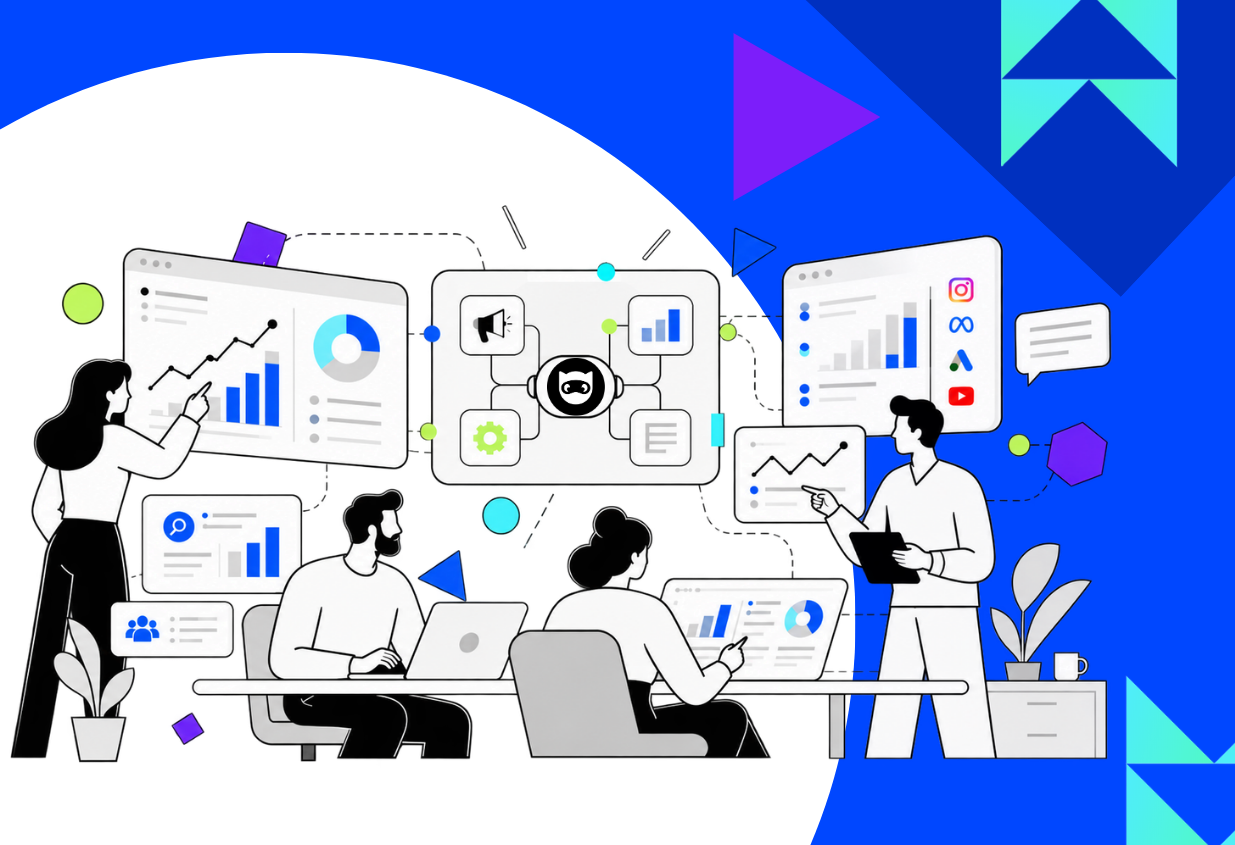
AI agents changed that math. Teams can now monitor performance across hundreds of placements, every day, and surface not just what is happening but why — detecting fatigue curves, spotting creative attribute patterns, and flagging reallocations before the budget burns.

The shift isn't just operational but analytical. Teams that used to review weekly are now catching things on day three that would have cost them two more weeks of underperformance. This step-change function in AI maturity across the analyze, optimize, act cycle is categorically putting these marketing teams in another league.
Here's a workflow most marketing teams know intimately: you want a complete picture before making a significant media decision. You need ad platform data, analytics, first-party sales data, possibly weather or seasonal signals, competitive context, geo-level performance.
Assembling that used to take the better part of a week. Which meant it usually didn't happen — or it happened in a compressed, incomplete version that left everyone a little uneasy about the call they were making.
The hidden cost of this compression was the decisions that got made without the full picture because the full picture cost too much to build.
Agents solve this by collapsing the assembly step almost entirely. When all your marketing data management sources are connected and an agent can pull, normalize, and synthesize across them on demand, "complete picture" stops being a luxury and starts being the baseline.

The teams benefiting most from this aren't necessarily doing fancier analysis. They're performing the same analysis they always wanted to do — just actually doing it, instead of approximating it.
There's an uncomfortable truth about quality assurance at growing agencies: the manual QA process that worked at 20 clients breaks at 50, and is largely theatrical at 100.
You still run through the checklist. You still spot-check. But you know, and your team knows, that the margin for error is widening with every account you add. The volume isn't humanly coverable. So you hope the errors are small when they happen.
Agents don't hope.
Anomaly detection agents can monitor incoming data continuously — not on a weekly review schedule, but in real time — and flag issues before a report ever gets generated. A missing ad group. A pixel that stopped firing. A spend anomaly that looks like a tracking break. These aren't edge cases; they're the exact errors that erode client trust when they make it into deliverables.

The deeper unlock here is what it does to team culture. When analysts aren't spending their cycles checking for errors, they're spending them on the work that actually requires their judgment. The QA agent doesn't replace the analyst, but removes the part of the analyst's job that was exhausting them.
If you want a simple proxy for how agentic a workflow actually is, count the number of browser tabs it requires. And the number of times you copy-paste data from one tool into another.
The multi-tool SEO or campaign workflow is a perfect example. Pull data from one platform. Open a competitor analysis tool. Cross-reference a keyword tracking sheet. Draft recommendations in a doc. Pass to someone else for implementation. Each handoff is friction. Each friction is delay. Each delay is a window where the insight gets stale or loses momentum.

An agent collapses this into a single environment. Not because it's smarter than the person doing the work — but because it removes the translation layer between tools that humans were filling manually.
The result isn't just efficiency. It's better thinking. When an analyst isn't spending cognitive energy on data movement, they have more of it for interpretation. The work that used to take most of a day — and required context-switching across a dozen surfaces — becomes a focused, sub-hour task.
This is what "amplifying human expertise" actually means in practice. Not replacing the strategist. Removing everything that was slowing the strategist down.
Until very recently, "deploying AI across your marketing operation" was a sentence that came with an implicit asterisk: if you have the engineering resources to build and maintain it.
Custom AI workflows meant custom integrations. Custom integrations meant engineers. Engineers meant budget, lead time, and a dependency that most marketing teams couldn't absorb. Even when the business case was obvious, the build cost made it prohibitive.
On the heels of new job titles like “marketing engineer,” and more conversations about the importance of context and orchestration, the old constraints are dissolving. The emergence of no-code agent builders — tools that let non-technical marketers build, test, and own their own agents — means the question has shifted from "can we afford to build this?" to "what should we build first?"
This is the part of the AI agents story that gets underreported. It's not just that the technology got better. It's that access to the technology stopped requiring a specialized team. A content strategist can now build an agent that automates their own most tedious workflow. A media planner can build one that monitors their own clients. They don't need to submit a ticket. They don't need to wait.
When you multiply that across an organization — across departments, disciplines, and functions — you stop talking about AI as a tool and start talking about it as infrastructure.
If you want to ground this in what's happening today rather than what's theoretically possible, here’s a few NinjaCat AI agent case studies worth knowing:
• VML built two purpose-built agents — one that monitors Meta creative performance across hundreds of placements daily, another that watches e-commerce funnel health across 20 million sessions weekly. The creative agent produced a 30% increase in engagement. The commerce agent contributed to a 53% lift in conversion rate.
• Seer Interactive built an SEO AI agent that runs their full optimization workflow — Search Console data to competitive analysis to recommendations — without switching tools. A target page went from position 11 to position 6 in seven days, with a 28% increase in clicks.
• Daye North America connected POS trends, weather signals, and inventory data to build a NinjaCat AI agent that flags stockout risk weeks before it becomes a revenue problem. Measured impact this selling season: $1.5M+.
• Just Global | Trilliad deployed more than 150 agents across 18 departments — invoice reconciliation, media trafficking, dashboard delivery — built and owned by their own team using a no-code builder.
These aren't pilot programs. They're in production, running live, and measurable.
Learning about these awesome teams and edge cases with AI agents for marketing, doesn’t really matter if you don't know where to apply it to your instance.
The most useful exercise isn't browsing a list of AI agent use cases and picking one, although that might help. It's looking at your own operation and asking: where does human bandwidth become the ceiling? Where is there work your team wants to do — knows would improve outcomes — but can't cover at the required scale or frequency?
That's where agents earn their place. Not by automating what's easy, but by making possible what wasn't.
The ceiling moved. The question is whether you're building toward it.